
GLP-1 Weight Loss Injections in Shreveport: What You Need to Know Before Starting
If you live in Shreveport or anywhere in Northwest Louisiana, you've probably heard the buzz about GLP-1 weight loss injections. Maybe a friend lost 30 pounds on Ozempic. Maybe you saw an ad for semaglutide and wondered if it was right for you. Maybe you've already tried every diet out there and you're ready for something that actually works.
You're not alone — and you're not failing.
Louisiana has one of the highest obesity rates in the entire country. According to the Trust for America's Health, 39.2% of Louisiana adults have obesity — the third-highest rate in the United States. That's nearly 2 out of every 5 people. And researchers at Pennington Biomedical Center in Baton Rouge have said our state's environment is "obesogenic" — meaning the combination of our food culture, our infrastructure, and our healthcare access all push toward weight gain.
This isn't a willpower problem. It's a biology problem. And for many people, GLP-1 medications are the most significant medical breakthrough for treating that biology in decades.
But before you start, there's a lot you need to understand. This guide will walk you through everything — what these medications are, how they work, what to realistically expect, who they're right for, and why it matters to have a doctor guiding you every step of the way.
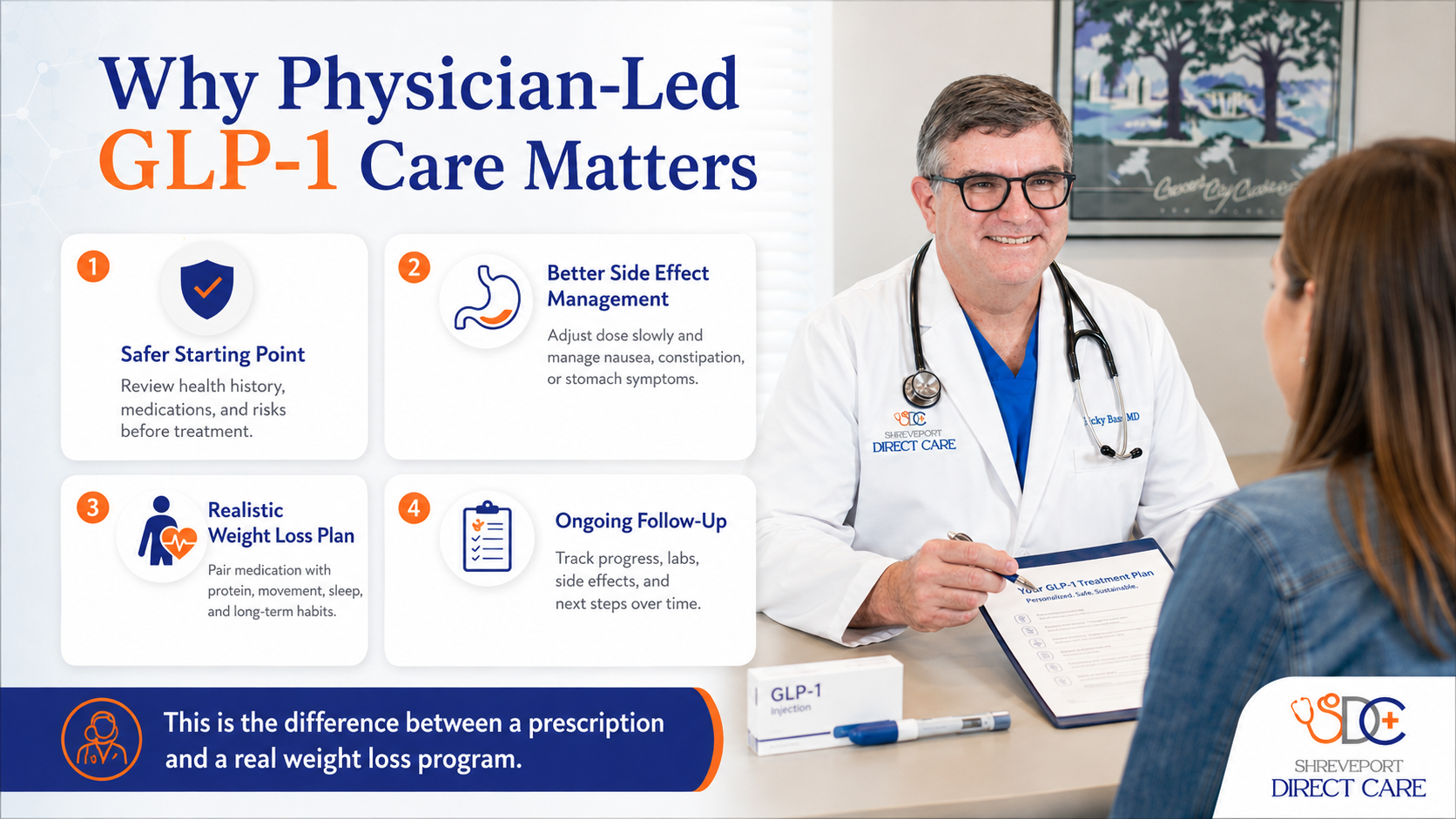
Why physician care matters for GLP-1 weight loss .
What Are GLP-1 Medications?
GLP-1 stands for glucagon-like peptide-1. That's a mouthful, so let's simplify it.
GLP-1 is a natural hormone your body already produces — mainly in your gut — after you eat. Its job is to signal your brain that you're full, slow down how fast food moves through your stomach, and tell your pancreas to release insulin. In people with obesity or type 2 diabetes, this system often doesn't work as well as it should.
GLP-1 receptor agonists (GLP-1 RAs) are medications that mimic this hormone, but in a much more powerful and longer-lasting way. They help you feel fuller faster, stay full longer, and reduce food cravings at the level of your brain. When combined with healthy habits and medical guidance, the results can be dramatic.
These are not stimulants. They are not diet pills. They work with your body's own hormonal system.
The Big Names: Ozempic, Wegovy, Mounjaro, and Zepbound
You've probably heard several brand names thrown around. Here's how they relate to each other:
Semaglutide is the active ingredient in two brand-name drugs: Ozempic and Wegovy. Ozempic was originally approved for type 2 diabetes. Wegovy is the same medication at a higher dose, approved specifically for chronic weight management. Both are once-weekly injections.
Tirzepatide is newer, and it does two things at once — it activates both GLP-1 receptors and a second receptor called GIP. This dual action is why tirzepatide tends to produce even stronger results. Mounjaro is tirzepatide for diabetes, and Zepbound is the same medication approved specifically for weight loss.
When people say "I'm on Ozempic for weight loss," they often mean they're taking semaglutide in some form. When your doctor prescribes one of these, they'll match the right medication and dose to your specific health history and goals.
How Much Weight Can You Actually Lose?
Here's the honest answer: it depends — on the medication, the dose, how long you stay on it, and the lifestyle habits you build alongside it.
In clinical trials, the numbers are impressive. A 2025 analysis published in a peer-reviewed journal found that injectable semaglutide produced an average weight loss of about 13% of body weight compared to placebo, while tirzepatide produced roughly 18% weight loss. For someone weighing 250 pounds, that's 32 to 45 pounds.
In the real world, the numbers are a bit lower — but still meaningful. A 2025 study found that after one year, patients on semaglutide lost an average of 7.7% of their body weight, while those on tirzepatide lost about 12.4%. Early research also shows that real-world outcomes are improving as doctors get better at managing side effects and keeping patients on their medications longer.
One important truth: the medication works best when you stay on it consistently. Studies show that patients who stop early — in the first three months — lose only about 3.6% of their weight. Those who continue past the one-year mark see results much closer to the clinical trial data.
This is why having a doctor who actively manages your care isn't optional — it's what separates people who see real, lasting results from those who stop after two months because of side effects they didn't know how to handle.
Who Is a Good Candidate for GLP-1 Medications?
GLP-1 medications are not for everyone. They are FDA-approved for specific groups:
- Adults with a body mass index (BMI) of 30 or higher, or
- Adults with a BMI of 27 or higher who also have a weight-related health condition such as type 2 diabetes, high blood pressure, or high cholesterol
Your doctor will also look at your full medical history before prescribing. These medications are generally not appropriate for people who have a personal or family history of a specific type of thyroid cancer called medullary thyroid carcinoma, or a condition called Multiple Endocrine Neoplasia syndrome type 2. They are also not recommended during pregnancy.
A good candidate is also someone who is ready to make some lifestyle changes alongside the medication. GLP-1s work best when paired with improved eating habits, regular movement, and consistent medical follow-up. They are powerful tools — but tools still work best in skilled hands.
If you're not sure whether you qualify, the first step is a conversation with a physician who knows your full health picture.
What Are the Side Effects?
The most common side effects of GLP-1 medications are digestive — and for many people, they're the main reason people stop taking the medication before it has a chance to work.
The most common ones include:
- Nausea — the most frequently reported, especially in the first few weeks
- Diarrhea or constipation
- Vomiting
- Stomach discomfort or bloating
These side effects happen because the medication slows down how fast food moves through your stomach. They tend to be worst when you first start or when the dose increases. For most people, they improve significantly after the first four to eight weeks.
The key to managing them is a slow, carefully paced dose escalation — starting at a low dose and moving up gradually over several months. This is something your doctor controls. When patients experience severe nausea or quit the medication early, it's often because the dose was increased too quickly or they didn't have guidance on what to eat and how to manage the adjustment period.
Less common but more serious potential side effects include pancreatitis (inflammation of the pancreas) and gallbladder problems. These are rare but worth discussing with your doctor — especially if you have a history of gallstones.
Beyond Weight Loss: The Cardiovascular Benefits
Here's something many people don't realize: GLP-1 medications do more than help you lose weight. For people with existing heart disease, the evidence is striking.
The SELECT trial — a landmark study involving more than 17,600 adults — found that people with obesity who took semaglutide for about three years had a 20% lower risk of heart attack, stroke, or death from cardiovascular disease, even without having diabetes. This was published in the New England Journal of Medicine.
This matters enormously for people in Shreveport and across Louisiana, where heart disease rates are already 26% higher than the national average. If you're carrying extra weight and have any history of heart disease, high blood pressure, or diabetes, these medications may be doing more for your long-term health than just changing the number on the scale.
Other research has also shown that semaglutide reduces inflammation markers in the blood — including C-reactive protein — and can improve outcomes for people with heart failure. These are not small findings. They represent a fundamental shift in how we think about obesity as a disease and how we treat it.
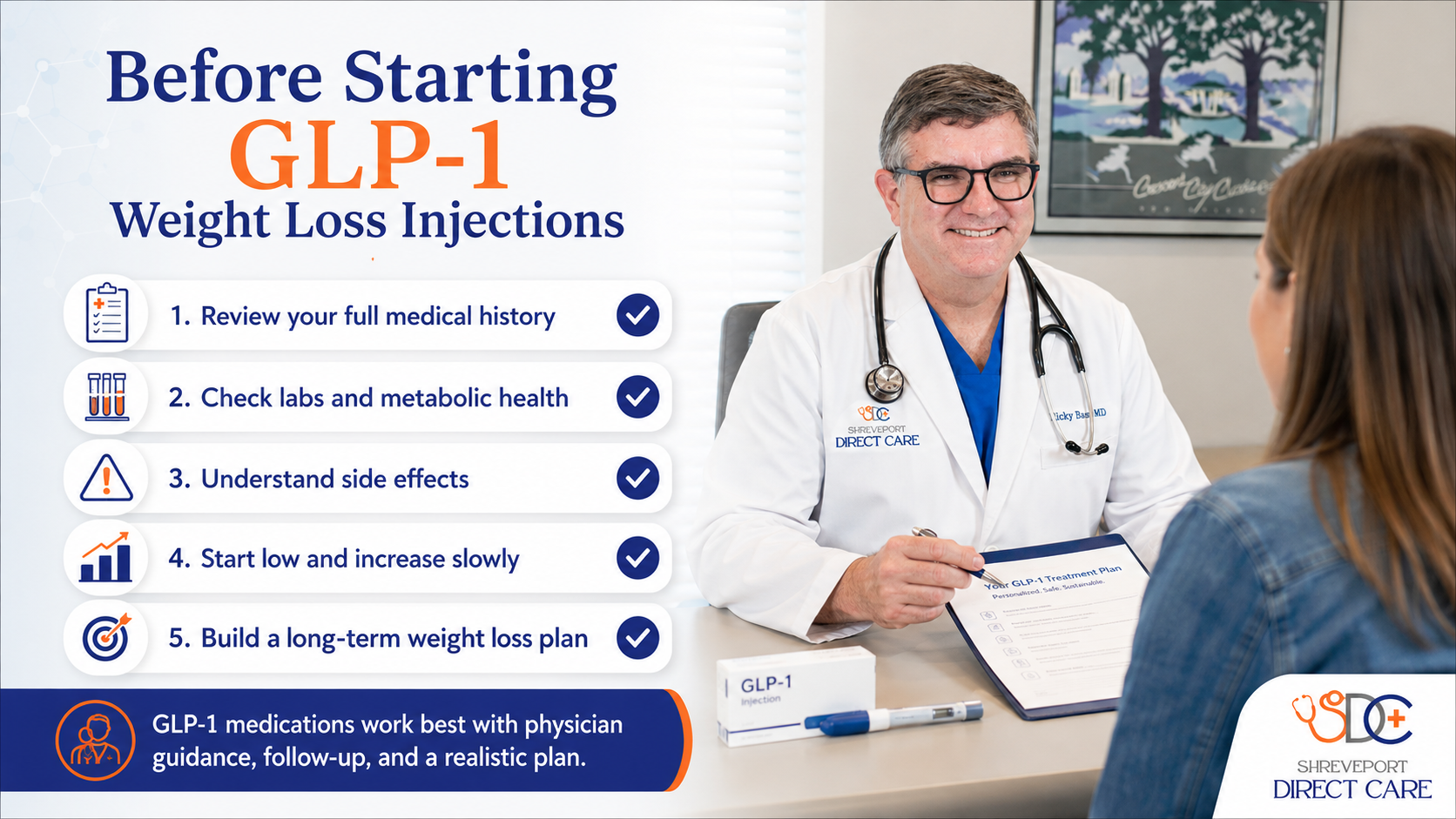
A plan for GLP-1 weight loss.
Why Medical Supervision Matters More Than You Think
There's a tempting shortcut circulating in Shreveport and across the country: online subscription services, med spas, and weight loss clinics where you fill out a quick form online and a prescription arrives in the mail. No doctor who knows you. No follow-up. No one monitoring your labs or adjusting your dose.
For some people, this works fine. For others, it's how they end up with uncontrolled side effects, missed contraindications, and no real plan for the long term.
Real-world research tells us that persistence — staying on the medication long enough for it to work — is the biggest predictor of success. A 2024 study found that as of early 2024, 63% of patients who started Wegovy or Zepbound were still taking it one year later, up from 40% in the 2023 group. That improvement is directly tied to better medical management and access to physicians who help patients through the difficult early weeks.
Here's what physician-led care actually looks like:
- A full health history review before any prescription is written
- Lab work to check your baseline metabolic numbers, kidney function, and thyroid
- A slow, individualized dose schedule tailored to how your body responds
- Ongoing check-ins to monitor weight loss, side effects, and medication adjustments
- Guidance on nutrition and activity that's realistic for your life — not a one-size-fits-all handout
- A long-term plan for what happens after the initial weight loss phase
This is what separates a weight loss prescription from a weight loss program.
The Shreveport Reality: Why This Especially Matters Here
Louisiana's food culture is one of the richest in the world. The combination of good food, warm weather, and a driving-dependent environment creates real challenges for maintaining a healthy weight — and our health statistics reflect that.
Nearly 40% of Louisiana adults have obesity. Heart disease rates are among the worst in the South. Type 2 diabetes affects nearly 1 in 7 Louisiana adults. These aren't moral failures — they're the outcome of environment, access, genetics, and a healthcare system that, for too long, has left people without real tools.
GLP-1 medications are a real tool. But so is having a doctor in your corner who understands the full picture — not just what your weight is today, but where it came from, what's driving it, and what a sustainable path forward looks like for you specifically.
How Shreveport Direct Care Approaches GLP-1 Treatment
At Shreveport Direct Care, GLP-1 weight loss care is built into your membership — not billed as a separate procedure, not rushed in a 7-minute visit.
Dr. Bass is a board-certified Internal Medicine and Pediatrics physician who takes a whole-person approach to weight management. He's not going to hand you a prescription and send you home. He's going to sit with you — in an hour-long visit — and understand your health history, your goals, your barriers, and build a plan that's actually designed for your life.
Here's what that looks like in practice:
Starting at $109 per month, your SDC membership includes unlimited visits, over 1,000 generic medications at no extra cost, and direct access to Dr. Bass by text or email. If you're on a GLP-1 and you're having nausea at week three, you don't wait three weeks for an appointment. You text him. That kind of access is what makes the difference between pushing through the adjustment period and quitting before the medication has a chance to work.
If you've been thinking about starting a GLP-1 medication but haven't known where to begin — or if you've tried one before and stopped because you didn't have proper support — this is the place to start. No insurance required. No complicated billing. Just a physician who has the time to help you get this right.
Ready to find out if a GLP-1 medication is right for you? Schedule a free meet-and-greet with Dr. Bass — no commitment, no pressure. Just an honest conversation about your health and what's possible. Book your free consultation at Shreveport Direct Care →
Shreveport Direct Care is a direct primary care practice serving adults and children in Shreveport, Bossier City, and surrounding communities in Northwest Louisiana. Dr. Pat "Ricky" Bass III is board-certified in Internal Medicine and Pediatrics.
References
Trust for America's Health. State of Obesity 2025: Better Policies for a Healthier America. TFAH. October 2025. (Louisiana obesity rate of 39.2%, third-highest in the U.S.)
Louisiana Department of Health. Obesity in Louisiana. LDH. 2024. (Louisiana obesity rates and contributing environmental and socioeconomic factors.)
Müller T.D. et al. Glucagon-Like Receptor-1 Agonists for Obesity: Weight Loss Outcomes, Tolerability, Side Effects, and Risks. Obesity Medicine. PMC. 2024. (Clinical trial weight loss data: semaglutide ~12%, tirzepatide ~18%.)
HealthVerity. GLP-1 Trends 2025: Real-World Data, Patient Outcomes & Future Therapies. HealthVerity Blog. 2025. (Real-world weight loss: semaglutide 7.7%, tirzepatide 12.4% at one year; 63% persistence at one year for 2024 cohort.)
ICER. Semaglutide and Tirzepatide for Obesity: Effectiveness and Value. Institute for Clinical and Economic Review. September 2025. (Head-to-head trial data: tirzepatide -20.2% vs. semaglutide -13.7% body weight.)
Lincoff A.M. et al. Semaglutide and Cardiovascular Outcomes in Obesity Without Diabetes. New England Journal of Medicine. February 2024. (SELECT trial: 20% reduction in cardiovascular events in people with obesity and no diabetes.)
Arty F. et al. Semaglutide in Heart Failure With Preserved Ejection Fraction: Emerging Evidence and Clinical Implications. Cureus. July 2025. (STEP-HFpEF trial results; anti-inflammatory effects including CRP reduction.)
Centers for Disease Control and Prevention. Adult Obesity Prevalence Maps, 2024. CDC. December 2025. (National and state-level obesity prevalence; Southern states context.)