
Caffeine and High Blood Pressure: Is Coffee OK for High Blood Pressure?
If you have high blood pressure and you love your morning coffee, you have probably wondered: Is this cup hurting me?
You are not alone. Nearly half of all U.S. adults — about 47.7% — have high blood pressure. Here in Louisiana, the numbers are even higher. Recent state data put hypertension prevalence around 43%, which is well above the national average. That means a lot of people in Shreveport, Bossier City, and the surrounding parishes are asking the same question every time they pick up a mug.
The short answer is reassuring for most people. Moderate coffee — about one to two cups a day — appears safe for most adults with well-controlled high blood pressure. But "moderate" matters. So does your current blood pressure, what else you put in the cup, and whether your numbers are well-controlled to begin with.
Let's walk through what the research actually says about caffeine and high blood pressure, when coffee is fine, and when it might be time to cut back.
How Caffeine Affects Blood Pressure in the Short Term
Caffeine is a stimulant. When you drink a cup of coffee, caffeine gets into your bloodstream within minutes. It blocks a chemical in your body that normally helps blood vessels relax. The result: your blood vessels narrow a little, your heart works a bit harder, and your blood pressure goes up — at least for a while.
How big is the bump? Studies show that 200 to 300 mg of caffeine — roughly two to three 8-ounce cups of regular brewed coffee — can raise systolic blood pressure (the top number) by about 8 mm Hg and diastolic (the bottom number) by about 6 mm Hg.
The spike usually shows up within 30 minutes. It tends to peak around an hour after your drink. Then it comes back down on its own.
For someone with normal blood pressure, that short-term jump is no big deal. For someone whose blood pressure is already running high, that same bump can push the numbers into a riskier zone — even if only briefly.
A few things to know:
- Your body adapts. Regular coffee drinkers often feel less of a blood pressure bump over time. People who only drink coffee occasionally tend to feel it more.
- Not everyone reacts the same way. Some people are caffeine-sensitive. Their hearts race, their hands shake, and their blood pressure climbs more than average.
- Older adults react more strongly. The blood pressure response to caffeine tends to be stronger in people over 60.
If you ever feel jittery, anxious, or notice your heart pounding after coffee, your body is telling you something. That is worth paying attention to — and worth talking about at your next visit.
Long-Term Coffee Use and Hypertension: What Studies Show
This is where the story gets interesting. You might assume that if caffeine raises blood pressure short-term, then daily coffee must lead to long-term high blood pressure. The research does not back that up.
A 2018 dose-response meta-analysis — a study that combined results from many other studies — found that hypertension risk actually went down by about 2% for each extra cup of coffee per day. A larger 2023 review of 25 studies found that higher coffee intake was linked to a 7% lower risk of developing high blood pressure compared to people who didn't drink coffee at all.
In plain English: people who drink coffee regularly are not, as a group, more likely to develop high blood pressure. Some studies even hint at a small protective effect.
Why? A few possible reasons:
- Coffee contains antioxidants and plant compounds that may support blood vessel health.
- The body adapts to regular caffeine intake over time.
- Coffee drinkers may share other lifestyle traits that lower cardiovascular risk.
That doesn't mean coffee is medicine. It means moderate, daily coffee is probably not the villain it has been made out to be — for most people.
Here is the catch. These population studies look at averages across thousands of people. They cannot tell you how your body, with your blood pressure, responds to your coffee habit. That is why context matters so much.
Is Coffee OK for High Blood Pressure? It Depends on Your Numbers
This is the heart of the question — and the answer changes depending on where your blood pressure sits today.
If your blood pressure is well-controlled (under 130/80 with or without medication), moderate coffee is generally fine. One to two cups a day, sipped with breakfast, is unlikely to cause harm.
If your blood pressure is mildly elevated or stage 1 hypertension (130–139 over 80–89), coffee is still probably okay in moderation. But this is a great time to track how your body responds. Check your blood pressure a few times — once before coffee, once an hour after — and see what happens. The numbers will tell you.
If your blood pressure is severely high (160/100 or higher), this is where caffeine gets riskier. A 2022 study published by the American Heart Association followed people for nearly 19 years. It found that drinking two or more cups of coffee per day was linked to roughly double the risk of dying from cardiovascular disease in people with severe hypertension. Drinking just one cup, or drinking green tea, did not show the same risk.
That is a striking finding. It does not mean coffee causes cardiovascular death. It means that when blood pressure is already very high, adding daily caffeine on top may push the system harder than it can safely handle.
The bottom line: if your blood pressure is severely elevated, this is not the time to keep brewing a strong pot every morning. It is the time to get your numbers under control first.
How Much Caffeine Is Safe with High Blood Pressure
The U.S. Food and Drug Administration considers up to 400 mg of caffeine a day generally safe for healthy adults. That is roughly four 8-ounce cups of regular brewed coffee.
For people with high blood pressure, heart disease, or caffeine sensitivity, most experts recommend a lower ceiling — closer to 200 mg a day, or about two cups.
Here is a rough guide to caffeine content in common drinks:
- 8-ounce brewed coffee: about 95 mg
- 8-ounce decaf coffee: about 2 mg
- 1 espresso shot (1 ounce): about 65 mg
- 8-ounce black tea: about 47 mg
- 8-ounce green tea: about 28 mg
- 12-ounce cola: about 35 mg
- 8-ounce energy drink: 70–200+ mg
A few things to keep in mind:
- Coffee shop drinks are bigger than 8 ounces. A "tall" at most chain shops is 12 ounces. A "grande" is 16. A "venti" is 20. The caffeine adds up fast.
- Energy drinks are unpredictable. Some contain double the caffeine of a strong cup of coffee — plus added sugar and other stimulants. They are a common cause of blood pressure spikes, especially in younger adults.
- Pre-workout supplements often pack 200–400 mg of caffeine in a single scoop. If you take one before exercise, that alone is your daily limit.
If you have high blood pressure, the safest approach is to know your daily total — coffee, tea, soda, energy drinks, supplements, and even some pain relievers like Excedrin all add to the caffeine count.
Beyond the Caffeine: Sugar, Cream, and Hidden Risks
When we talk about coffee and high blood pressure, the conversation usually focuses on caffeine. But what you put in your coffee may matter just as much.
Many popular coffee drinks today are not really coffee. They are dessert in a cup. A large flavored latte from a chain shop can carry 50 grams or more of added sugar — about the same as a can of soda. Whipped cream, syrups, and sweetened creamers add saturated fat and even more sugar.
Why does this matter for blood pressure?
- Sugar drives weight gain and insulin resistance, both major risk factors for high blood pressure.
- Saturated fats and processed creamers can worsen cholesterol and arterial stiffness.
- High-sodium "salted caramel" or seasonal drinks sneak extra sodium into your day, which directly raises blood pressure in many people.
Black coffee is one of the lowest-impact drinks you can choose. If that is too bitter, try a splash of milk, a small amount of half-and-half, or a sugar-free option. Save the dessert drinks for an occasional treat — not a daily habit.
And one more thing: alcohol-laced coffee drinks (Irish coffee, espresso martinis) combine caffeine and alcohol. Alcohol raises blood pressure on its own. Mixed with caffeine, the effect on the heart can be unpredictable, especially in people who already have hypertension.
How to Drink Coffee Without Spiking Your Blood Pressure
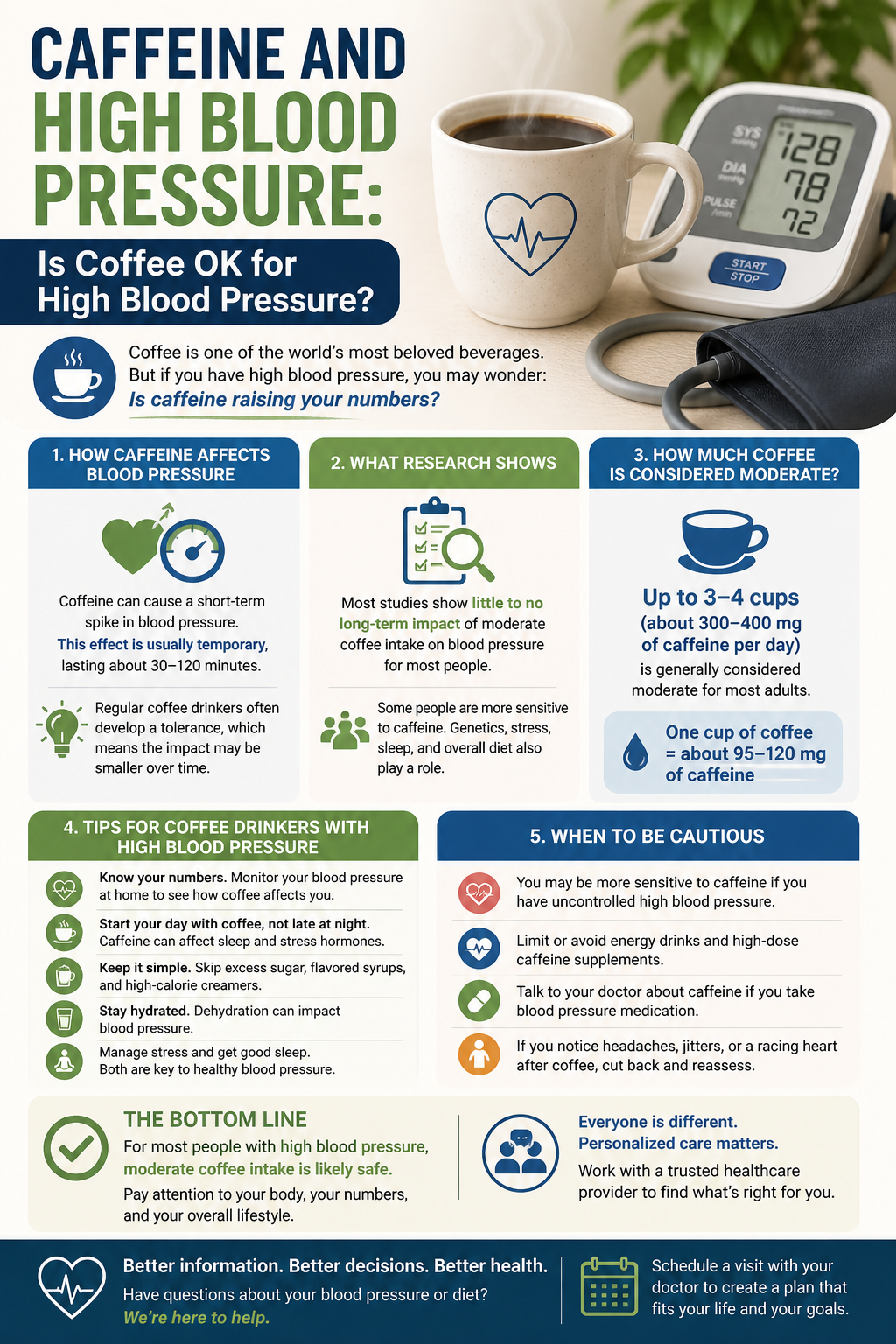
If you have high blood pressure and you want to keep enjoying coffee, here are practical steps that actually work.
Stick to one or two cups a day. This is the sweet spot for most people with well-controlled hypertension. More than that and you are working against your own treatment.
Watch the timing. Drink coffee with food, not on an empty stomach. Food slows the absorption of caffeine and softens the blood pressure bump. Avoid coffee within six hours of bedtime — poor sleep is itself a major driver of high blood pressure.
Test your response. Use a home blood pressure monitor. Take your reading before coffee, then again 30 to 60 minutes after. If your numbers jump 10 points or more and stay up, your body may be telling you to cut back.
Switch to half-caff or decaf. Most decaf coffee still has the antioxidants and flavor. It just skips the stimulant. This is one of the easiest changes for people who love the ritual of coffee but want to lower their caffeine load.
Stay hydrated. Caffeine is a mild diuretic. Pair every cup of coffee with a glass of water. Dehydration on its own can raise blood pressure.
Skip energy drinks. If you have hypertension, energy drinks are not worth the risk. The combination of high-dose caffeine with other stimulants can cause sharp, sustained blood pressure spikes.
Don't smoke with your coffee. Smoking and caffeine together cause a much bigger blood pressure jump than either one alone. If you smoke, quitting will do more for your blood pressure than any other single change.
When Coffee Isn't Really the Problem
Here is something we see often in our practice. A patient comes in worried that coffee is wrecking their blood pressure. We dig in, and it turns out coffee is the smallest piece of the puzzle.
High blood pressure is rarely caused by one thing. It usually comes from a stack of factors: extra weight, poor sleep, chronic stress, too much sodium, not enough movement, untreated sleep apnea, certain medications, or genetics. Coffee may add a small short-term bump, but it is rarely the root cause.
The danger of focusing only on coffee is that you can spend months cutting back, only to find your blood pressure is still too high — because the real drivers were never addressed.
That is why managing high blood pressure works best with a doctor who has time to actually look at the whole picture. Not a 12-minute visit. Not a quick prescription refill. A real conversation about your numbers, your habits, your medications, your sleep, and your goals.
Don't Manage High Blood Pressure Alone
At Shreveport Direct Care, we take care of high blood pressure differently. As a Direct Primary Care (DPC) practice — a membership-based model where you pay a flat monthly fee instead of billing insurance — we have time to do this right.
That means:
- Hour-long visits to actually understand what is driving your blood pressure
- Same-day or next-day access when you have a question or your numbers don't look right
- Direct text and email access to Dr. Bass — not a phone tree, not a portal that takes days
- Affordable medications included — we offer over 1,000 generic medications at no extra cost, including most common blood pressure drugs
- Home blood pressure monitoring support — we'll help you track, interpret, and act on your numbers between visits
For patients in Shreveport, Bossier City, and across Northwest Louisiana, this model removes the rush, the surprise bills, and the gatekeeping. It puts your health back in your hands — with a doctor who has time to help.
If you have been wondering whether your coffee habit is safe, that question deserves more than a Google search. It deserves a real conversation with a doctor who knows your history.
The Bottom Line
So — is coffee OK for high blood pressure? For most adults with well-controlled hypertension, one to two cups of plain coffee a day is fine. The link between long-term coffee drinking and chronic high blood pressure is weak at best. Some studies even hint at a small protective effect.
But context matters. If your blood pressure is severely elevated, two or more cups a day may carry real risk. If your "coffee" is really a sugar-loaded dessert drink, that is a problem regardless of caffeine. And if you are using energy drinks or high-dose pre-workouts, the risk goes up sharply.
The smartest move is to know your numbers, know your daily caffeine total, and check in with a doctor who can help you make sense of both.
Schedule a free meet-and-greet with Dr. Bass — no commitment, no pressure. Just a conversation about your health and how we can help.
Schedule your free visit at Shreveport Direct Care.
Shreveport Direct Care is a direct primary care practice serving adults and children in Shreveport, Bossier City, and surrounding communities in Northwest Louisiana. Dr. Pat "Ricky" Bass III is board-certified in Internal Medicine and Pediatrics.
References
1. Centers for Disease Control and Prevention. High Blood Pressure Facts. CDC. 2024. https://www.cdc.gov/high-blood-pressure/data-research/facts-stats/index.html
2. Centers for Disease Control and Prevention. Hypertension Prevalence and Control Among U.S. Adults, NCHS Data Brief No. 511. National Center for Health Statistics. October 2024. https://www.cdc.gov/nchs/products/databriefs/db511.htm
3. Estave PM, et al. Weighted EHR-based prevalence estimates for hypertension at the state and local levels in Louisiana. PubMed. 2025. https://pubmed.ncbi.nlm.nih.gov/39901106/(S
4. Teramoto M, et al. Coffee and Green Tea Consumption and Cardiovascular Disease Mortality Among People With and Without Hypertension. Journal of the American Heart Association. December 2022. https://www.ahajournals.org/doi/10.1161/JAHA.122.026477
5. American Heart Association News. Drinking 2 or more cups of coffee daily may double risk of heart death in people with severe hypertension. AHA Newsroom. December 2022. https://newsroom.heart.org/news/drinking-2-or-more-cups-of-coffee-daily-may-double-risk-of-heart-death-in-people-with-severe-hypertension
6. D'Elia L, et al. Coffee consumption and risk of hypertension: a dose-response meta-analysis of prospective studies. European Journal of Nutrition. 2019 (PubMed 2017). https://pubmed.ncbi.nlm.nih.gov/29222637/
7. Haghighatdoost F, et al. Coffee Consumption and Risk of Hypertension in Adults: Systematic Review and Meta-Analysis. Nutrients. 2023. https://pmc.ncbi.nlm.nih.gov/articles/PMC10347253/
8. Mayo Clinic Staff. Caffeine: How does it affect blood pressure? Mayo Clinic. https://www.mayoclinic.org/diseases-conditions/high-blood-pressure/expert-answers/blood-pressure/faq-20058543
9. U.S. Food and Drug Administration. Spilling the Beans: How Much Caffeine is Too Much? FDA. https://www.fda.gov/consumers/consumer-updates/spilling-beans-how-much-caffeine-too-much(
10. Cleveland Clinic. How Caffeine Raises Blood Pressure. Cleveland Clinic Health Essentials. https://health.clevelandclinic.org/caffeine-and-blood-pressure
11. American Heart Association. Is caffeine a friend or foe? AHA News. August 2022. https://www.heart.org/en/news/2022/08/08/is-caffeine-a-friend-or-foe
12. Mesas AE, et al. The effect of coffee on blood pressure and cardiovascular disease in hypertensive individuals: a systematic review and meta-analysis. American Journal of Clinical Nutrition. 2011. https://pubmed.ncbi.nlm.nih.gov/21880846/