
Does GLP 1 Cause Muscle Loss?
Is your GLP1 costing you muscle?
Yes, for many patients it is, unless the plan is built to prevent it. GLP-1 medications like Ozempic, Wegovy, Mounjaro, and Zepbound have delivered weight loss results that would have sounded implausible a decade ago. But a growing body of research is pointing to a real, and largely under-discussed, side effect: these drugs can take a meaningful bite out of muscle, not just fat, and new data suggests patients may actually be moving less as the weight comes off, which makes the problem worse.
Here's what the evidence actually shows, and what a real muscle-protection plan looks like for patients in Shreveport and Bossier City using GLP-1 therapy.
The New Finding: Patients Are Moving Less, Not More
It seems logical that losing significant weight would make it easier to move, exercise, and stay active. New research presented at ENDO 2026, the Endocrine Society's annual meeting, found the opposite. Using wearable fitness tracker data, the first large study to do so in this population, researchers found that people with obesity who lost weight on GLP-1 medications became significantly less physically active, not more.[1] That's a counterintuitive and clinically important finding, because these same drugs are known to reduce lean muscle mass alongside fat, and reduced activity only accelerates that muscle loss.[1]
How Much Muscle Are We Actually Talking About?
This isn't a minor asterisk. Across published trials, lean body mass typically accounts for roughly 25% to 39% of total weight lost on semaglutide and tirzepatide.[2] Because total weight loss on these drugs is so much larger than what most patients achieved with diet alone, the absolute amount of muscle lost is also larger. A patient losing 22% of a 100 kg starting weight without an active prevention plan might lose 6 to 8 kg of fat-free mass in the process.[2] Some clinical reports place lean mass decline as high as 10% to 15% in patients losing more than 15% of body weight on higher GLP-1 doses, with older adults and those with pre-existing sarcopenia at the highest risk.[3]
There does appear to be some difference between medications. In the SURMOUNT-1 body-composition substudy of tirzepatide, roughly 75% of the weight lost came from fat and about 25% from lean mass, with fat mass falling about 34% and lean mass falling about 11% from baseline by week 72.[4] That's a somewhat more favorable ratio than has been reported in some semaglutide substudies, though these were separate trials in different populations, not a true head-to-head comparison, so it's worth being cautious about declaring one drug definitively more muscle-friendly than the other. Our comparison of tirzepatide and semaglutide covers how the two medications stack up beyond just body composition.
Why Muscle Loss Matters Beyond the Mirror
This isn't just a cosmetic concern. Muscle is metabolically active tissue. It's where a large share of your resting metabolic rate comes from, it's central to blood sugar regulation, and it's directly tied to functional independence as you age. Losing muscle alongside fat can blunt some of the metabolic benefits patients are chasing in the first place, and in older adults, it raises the risk of a phenomenon called sarcopenic obesity, carrying less muscle and more relative fat than before, even at a lower total body weight. Functional measures like grip strength and the ability to rise from a chair unassisted can decline by 5% to 10% in patients who lose significant lean mass without a counter-strategy in place.[3]
What the Research Says Actually Works
The encouraging news is that muscle loss on GLP-1 therapy is not inevitable. It's modifiable, and the evidence on what works is fairly consistent across multiple recent studies.
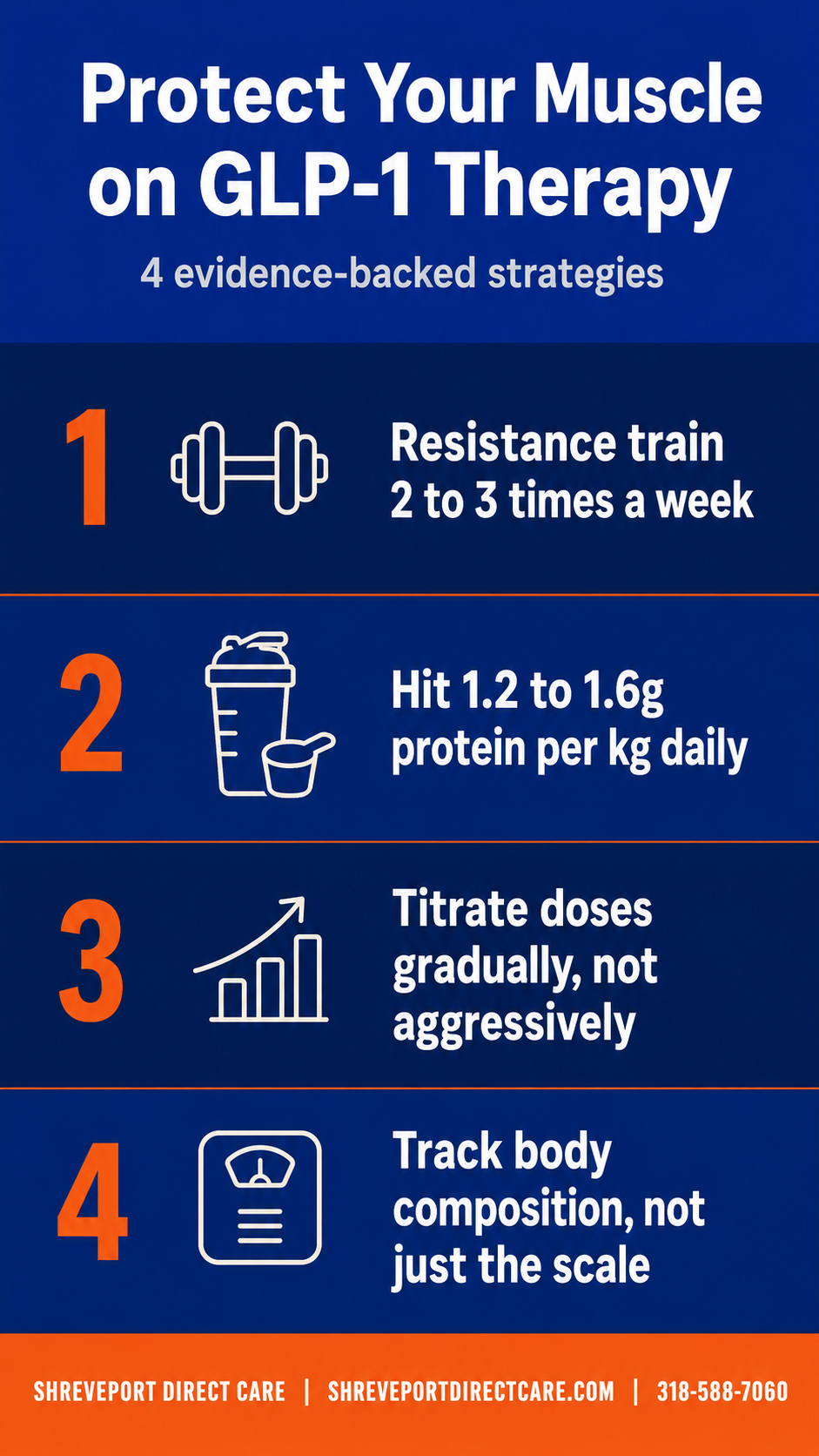
Resistance training is the single most effective countermeasure. A systematic review found that resistance training two to three times weekly during GLP-1 therapy reduced fat-free mass loss by 30% to 50% relative to non-exercising controls, without compromising fat loss.[2] In the S-LITE trial, combining GLP-1 therapy (liraglutide) with supervised resistance and aerobic training didn't just preserve lean mass. Participants actually gained lean mass, an outcome not seen with medication alone.[6]
Protein intake needs to be deliberate, not incidental. Clinical guidance generally converges on a target of roughly 1.2 to 1.6 grams of protein per kilogram of body weight per day, spread evenly across meals rather than loaded at dinner.[7] Because GLP-1 medications suppress appetite so effectively, many patients unintentionally under-eat protein at breakfast and lunch. Restructuring toward a more even distribution, for example roughly 30 grams of protein at each of three meals, tends to improve outcomes even when total calorie intake is lower.[2] A small case series found that patients combining GLP-1 therapy with resistance training and higher relative protein intake saw lean tissue changes ranging from a slight loss to an actual gain, despite total weight loss of 13% to 33%.[8]
Dose titration is a muscle-preservation lever, not just a tolerability one. Aggressive dose escalation produces a steeper energy deficit and faster weight loss, which tends to pull more lean mass along with it. A more measured, patient-tolerated titration schedule gives muscle-preservation strategies time to actually work before the next dose increase.[9] Emerging pharmacology may help too. In an early-phase trial, combining semaglutide with a myostatin inhibitor called bimagrumab lowered the lean-mass fraction of total weight loss to roughly 7%, compared with the 25% to 39% typically seen with GLP-1 monotherapy, though functional outcome data on this combination remain limited, and it isn't yet a standard clinical option.[10]

GLP1 and muscle loss
Building This Into a Real Treatment Plan
The pattern across this research points to a clear conclusion: GLP-1 therapy without a body-composition strategy is an incomplete prescription. A well-designed plan pairs the medication with a structured resistance-training routine, ideally supervised, two to three times weekly, a concrete daily protein target distributed across meals rather than concentrated at one, a measured dose-titration schedule rather than pushing to the highest tolerated dose by default, and periodic body-composition monitoring, not just a number on the scale, so that if lean mass is falling faster than expected, the plan can be adjusted before it becomes a functional problem. If you're weighing which GLP-1 medication fits your goals, our overview of tirzepatide for weight loss covers the benefits and risks in more depth.
Why This Belongs in a Physician-Led Program
At Shreveport Direct Care, GLP-1 therapy is never handed over as a standalone prescription. Our weight loss program is built around the same philosophy behind physician-led weight management more broadly: real lab and body-composition monitoring over time, a resistance-training and protein plan built for your starting point, and a physician who adjusts the plan as your labs and function change, not a quarterly check-in. Patients across Shreveport, Bossier City, and the Ark-La-Tex region choose a flat monthly membership specifically because it gives us the time to build this kind of plan properly.
GLP1 and resistance training
The Bottom Line
GLP-1 medications remain genuinely transformative tools for obesity and metabolic disease. That hasn't changed. But the newest research is a clear signal that success shouldn't be measured by the scale alone. The goal isn't just weight loss. It's fat loss with muscle preserved, function protected, and metabolic health improved in a way that holds up over the long run.
If you're on a GLP-1 medication or considering one, ask whether your current plan includes a resistance-training and protein strategy, not just a prescription and a follow-up weigh-in. Learn more about Dr. Bass's background and training and schedule a visit with Shreveport Direct Care to build a GLP-1 plan that protects your muscle along with your metabolic health.
Ready to get started with a physician-led weight loss plan? Schedule a free meet-and-greet with Dr. Bass and find out if our program is right for you. Book your free consultation →
Phone/Text: 318-588-7060 Email:info@shreveportdirectcare.com
FAQs:
1. Do GLP-1 medications really cause muscle loss? Yes. Studies show that roughly 25% to 39% of total weight lost on semaglutide or tirzepatide can come from lean muscle mass, particularly when the medication is used without a resistance-training plan.
2. Which GLP-1 medication causes less muscle loss, semaglutide or tirzepatide? Some trial data suggest tirzepatide's SURMOUNT-1 substudy had a somewhat more favorable fat-to-muscle loss ratio than reported in some semaglutide substudies, but these come from separate trials, not a true head-to-head comparison.
3. How much protein should I eat while on a GLP-1 medication? Most clinical guidance targets roughly 1.2 to 1.6 grams of protein per kilogram of body weight per day, spread evenly across meals rather than concentrated at one meal.
4. Can resistance training really prevent muscle loss on GLP-1 therapy? Yes. A systematic review found resistance training two to three times weekly reduced fat-free mass loss by 30% to 50% compared to non-exercising patients, without reducing fat loss.
5. Why are patients moving less while losing weight on GLP-1 drugs? New wearable-tracker data presented at ENDO 2026 found that patients became significantly less physically active as they lost weight on GLP-1 medications, a surprising and clinically important finding that appears to compound muscle loss.
6. Does Shreveport Direct Care monitor muscle loss during GLP-1 treatment? Yes. Our weight loss program includes body-composition monitoring alongside lab work, plus a resistance-training and protein plan built around your starting point, adjusted as your results come in.
References
People taking GLP-1 weight loss drugs like Ozempic started moving less. ScienceDaily. Data presented at ENDO 2026. (Source for the reduced-activity wearable-tracker finding.)
Preventing Lean Mass Loss on GLP-1 Therapy: 2026 Evidence Update. Clinical Nutrition Report. Updated April 10, 2026. (Supports lean mass percentage and protein distribution guidance.)
Critical 2026 Update: New GLP-1 Rules to Stop Muscle Loss Now. Ubie Doctor's Note. (Supports functional decline and high-risk patient data.)
Neeland I. S-LITE trial data (NCT04122716), discussed in GLP-1 Therapies in 2026: Beyond Blood Sugar and the Scale. AJMC. (Source for SURMOUNT-1 body-composition substudy figures.)
Locatelli et al. Systematic review on resistance training and fat-free mass preservation during GLP-1 therapy. 2024. (As referenced in Clinical Nutrition Report, 2026.) (Supports resistance-training effectiveness data.)
Neeland I. S-LITE trial data (NCT04122716), discussed in GLP-1 Therapies in 2026: Beyond Blood Sugar and the Scale. AJMC. (Supports lean mass gain with combined therapy and training.)
GLP-1 Therapies in 2026: Beyond Blood Sugar and the Scale. AJMC. (Supports protein intake targets.)
Preservation of lean soft tissue during weight loss induced by GLP-1 and GLP-1/GIP receptor agonists: A case series. PMC. (Supports case series findings on combined strategy outcomes.)
GLP-1 and Muscle Loss 2026: Body Composition Protocols for Med Spas. Published June 10, 2026. (Supports dose titration guidance.)
GLP-1 Therapies in 2026: Beyond Blood Sugar and the Scale. AJMC. (Supports bimagrumab/semaglutide combination trial data, NCT05616013.)
Shreveport Direct Care is a direct primary care practice serving adults and children in Shreveport, Bossier City, and surrounding communities in Northwest Louisiana. Dr. Pat "Ricky" Bass III is board-certified in Internal Medicine and Pediatrics.