
Why am i losing balance?
You feel a little off when you walk. You reach for the wall more than you used to. Maybe you’ve had a close call on the stairs. Losing balance in the elderly is common, but it is not something you just have to accept. In most cases, unsteadiness has a cause, and many of those causes can be found and treated. The most common ones are weak muscles and a balance system that hasn’t been challenged, medicines that cause dizziness or drowsiness, blood pressure that drops when you stand, vision or hearing changes, numb feet, too little water, and alcohol. Often it’s two or three of these working together. This article walks through each one, how a doctor checks for it, and when to get help right away. We see these questions every week in our practice in Shreveport and Bossier City.
Why Balance Gets Harder With Age
Balance is a team effort. Your eyes tell your brain where you are. Your inner ear senses motion and tilt. Nerves in your feet and joints report where the ground is. Your leg and hip muscles make tiny corrections all day long. Your brain pulls all of that together in a split second.
As we age, every member of that team can slow down a little. Muscle mass drops by about 3% to 5% per decade after age 30 if we don’t work to keep it.[1] Vision and hearing change. Nerves in the feet can lose some feeling. None of that has to cause a fall. But when two or three small changes add up, balance starts to slip.
The numbers show why this matters. About 1 in 4 adults age 65 and older falls each year.[2] Falling once doubles your chance of falling again, yet fewer than half of people who fall tell their doctor.[3] If you’ve noticed you’re less steady, that is worth bringing up, even if you haven’t fallen.
The Most Common Causes of Losing Balance
1. Weak Legs and an Untrained Balance System
This is the most common cause, and the most fixable. When we stop challenging our balance, our body stops investing in it. Many people walk every day but never stand on one foot, step sideways, or turn quickly. Over time, the balance system gets rusty.
Here is what most people don’t realize. Exercise that challenges balance lowers the rate of falls by about a quarter, and programs that combine balance and strength training lower it by about a third.[4] That is a big effect for something you can do at home. Our guide to fall prevention for older adults covers the exercises we teach.
2. Medicines That Cause Dizziness or Drowsiness
Many common medicines can affect balance. The CDC lists sleeping pills, anxiety medicines called benzodiazepines, opioid pain medicines, some antidepressants, seizure medicines, and some blood pressure medicines as drugs linked to falls.[5] Over-the-counter products count too. Nighttime pain relievers and allergy pills that contain diphenhydramine are frequent culprits.
The risk often grows when medicines are added over the years by different doctors. That is why a full review of every pill matters. The goal is not to stop medicines just to stop them. The goal is the right medicine at the right dose. Please don’t stop a prescription on your own. Bring the full list, including supplements, to your doctor.
3. Blood Pressure That Drops When You Stand
Some people feel light-headed for a few seconds after standing up. This can be a sign of orthostatic hypotension, which means blood pressure drops when you change position. It is linked to a higher risk of falls.[6] Dehydration, some blood pressure medicines, and certain health conditions can all play a role. We cover this in more detail in our post on feeling dizzy when you stand up.
4. Vision and Hearing Changes
Your eyes do a lot of the balancing work, especially in dim light. Cataracts, old glasses, and bifocals or progressive lenses can all make the ground harder to judge. Hearing matters too. In one study of adults ages 40 to 69, even mild hearing loss was linked to nearly three times the odds of having fallen.[7] Hearing, balance, and thinking are closely connected, which is one reason we pay attention to all three when we talk about protecting your memory.
5. Numb Feet
When the nerves in your feet don’t send clear signals, your brain has a harder time knowing where the ground is. Diabetes is the most common cause, but vitamin B12 deficiency, alcohol, and other conditions can do it too. People often describe it as walking on cotton. Numb feet are on the CDC’s list of fall risk factors.[8]
6. Too Little Water, Too Much Alcohol
Many older adults drink less water on purpose to avoid trips to the bathroom. That can leave you dehydrated and dizzy, especially during a hot Louisiana summer. Alcohol is the other piece. Older adults are more sensitive to alcohol’s effects on balance and coordination, and mixing alcohol with sleep aids or other sedating medicines raises the risk even more.[9]
7. Inner Ear Problems and Other Conditions
The inner ear can cause a spinning feeling called vertigo. Conditions like Parkinson’s disease, a past stroke, arthritis in the knees or hips, low vitamin D, and memory changes can also affect balance. Rushing to the bathroom at night and feeling down or depressed are both on the CDC’s risk checklist as well.[8]
When Losing Your Balance Is an Emergency
Most balance problems build slowly. But some need care right away. Call 911 or go to the emergency room if loss of balance comes on suddenly along with any of these:
Weakness or numbness on one side of the body. Trouble speaking or a drooping face. A sudden, severe headache. Sudden loss of vision. A fall where you hit your head, especially if you take a blood thinner. Chest pain, a racing heartbeat, or fainting.
These can be signs of a stroke, bleeding, or a heart rhythm problem. Don’t wait to see if they pass.
How a Doctor Figures Out the Cause
Finding the cause of unsteadiness takes time. You can’t do it well in a short visit, which is a big part of why the 15-minute office visit fails patients.
International guidelines recommend a full fall-risk assessment for anyone who has fallen, nearly fallen, or feels unsteady.[10] Here is what that looks like in our clinic.
I watch you walk. I watch you get up from a chair, walk down the hall, and turn around. I show you a few balance exercises and watch you try them. That tells me more than any form.
We test your balance and strength. Common tests include the Timed Up-and-Go, where taking 12 seconds or longer suggests a higher risk, the 30-Second Chair Stand, and a 4-stage balance test.[11]
We review every medicine. That includes prescriptions, over-the-counter products, and supplements.[5]
We check your blood pressure lying and standing. This simple check catches drops that a sitting blood pressure misses.[6]
We look at the rest of the picture. That includes your vision, hearing, feet, mood, sleep, and bathroom habits, plus labs like vitamin D or B12 when they make sense.
Losing Balance in Elderly
A Story From Our Practice
Mr. Harold was 71 when he came in. He hadn’t fallen, but he told me he’d started “walking like an old man.” He held onto the shopping cart at the grocery store for support, and he’d stopped walking his dog.
When I watched him walk, he looked down at his feet the whole time. When I tested the feeling in his feet, it was dull, a sign of nerve damage from years of high blood sugar. He was taking a muscle relaxant for an old back injury, often with a beer in the evening. He also admitted he’d been turning the TV up louder for a couple of years.
None of these alone explained his unsteadiness. Together, they did. We worked on his blood sugar, tapered off the muscle relaxant with a different plan for his back, and talked about the evening beer. He got his hearing checked. Most important, he started daily balance exercises and twice-weekly strength work.
A few months later, he was back on the trail with his dog. Not every patient improves this much, and results are different for everyone. But his story shows why losing balance usually has more than one cause, and why it’s worth looking for all of them.
Common Myths About Losing Your Balance
“If I haven’t fallen, I’m fine.” Near-falls and holding onto furniture are early warning signs. They’re the best time to act.
“A cane will fix it.” A cane or walker can be a helpful tool, but it doesn’t fix the cause. Used without proper fitting and training, it can even become a tripping hazard.
“Resting is safer than moving.” It’s the opposite. Moving less leads to weaker muscles and worse balance. The answer is safe, regular practice, not avoiding activity.
“It’s just my age.” Age plays a role, but most of the causes in this article are things we can test for and improve.
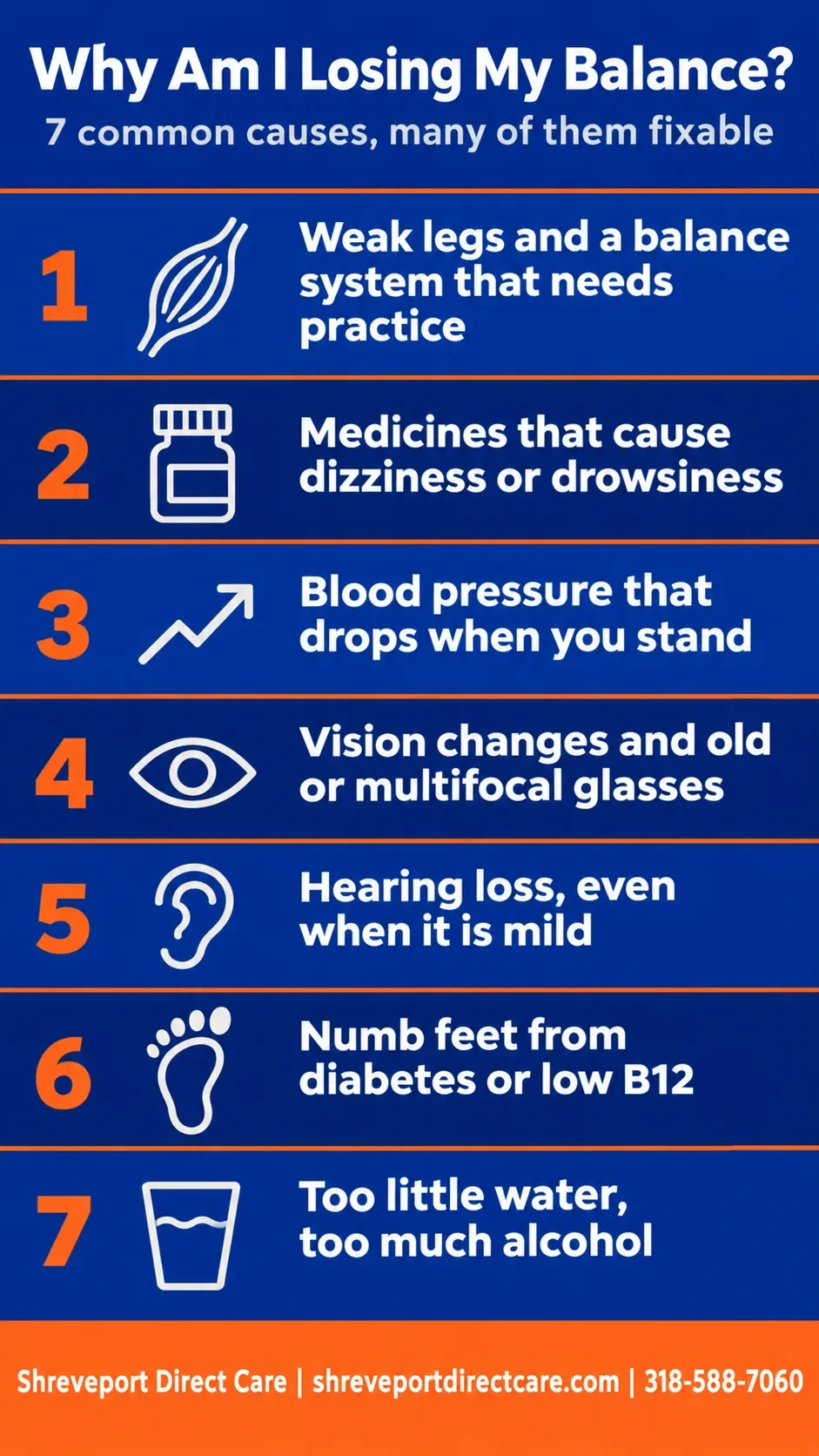
Why am I Losing My Balance?
Getting Help for Balance Problems in Shreveport and Bossier City
At Shreveport Direct Care, a balance concern gets the time it deserves. Visits aren’t rushed, so we can watch you move, review every medicine, and build a plan with you. That plan might include daily balance exercises, a strength routine, changes to your medicines, more water, less alcohol in the evening, vitamin D if your level is low, or a referral to physical therapy.
We also make house calls. With our DPC + Home Visits membership, I can see how you move around your own home and spot hazards you might miss. You can see our services, including home visits.
Between visits, you can call or text me directly. If you have a near-fall on Tuesday, we can talk about it on Tuesday. That is what our membership model is built for. It works alongside Medicare, and it serves patients across Shreveport, Bossier City, and Northwest Louisiana. You can read more about Dr. Bass’s background in Internal Medicine and Pediatrics.
Losing your balance is a signal, not a sentence. The sooner we find out why, the more we can usually do about it.
Schedule a free meet-and-greet with Dr. Bass. No commitment, no pressure. Just a conversation about your health and how we can help.
Schedule your free visit at Shreveport Direct Care →
Phone/Text: 318-588-7060
Email: info@shreveportdirectcare.com
Modern Medicine. Old-School Experience.

FAQs:
1. Is losing balance a normal part of aging?
Some change is common, but losing balance is not something you just have to accept. Most unsteadiness has causes that can be found and treated, like weak muscles, medicines, blood pressure drops, or vision changes. Exercise that challenges balance lowers the rate of falls by about a quarter.[4]
2. What medicines can cause loss of balance?
Sleeping pills, anxiety medicines called benzodiazepines, opioid pain medicines, some antidepressants, seizure medicines, and some blood pressure medicines are linked to falls.[5] Over-the-counter sleep aids and allergy pills with diphenhydramine count too. Don’t stop a medicine on your own. Ask your doctor to review your full list.
3. When is losing balance an emergency?
Get emergency care if loss of balance comes on suddenly with weakness or numbness on one side, trouble speaking, a severe headache, vision loss, chest pain, fainting, or a fall with a head injury. These can be signs of a stroke or other serious problem.
4. What kind of doctor should I see for balance problems?
Start with your primary care doctor. A primary care doctor can watch you walk, test your balance, review your medicines, and check your blood pressure lying and standing. If needed, they can refer you to physical therapy, an eye doctor, a hearing specialist, or a neurologist.
5. Can dehydration make you lose your balance?
Yes. Not drinking enough water can lower your blood pressure, especially when you stand up, and make you dizzy. Many older adults drink less on purpose to avoid bathroom trips. Drinking water steadily through the day, especially in hot weather, can help.
6. Where can I get a balance evaluation in Shreveport?
Shreveport Direct Care offers unhurried fall-risk and balance evaluations for adults in Shreveport, Bossier City, and Northwest Louisiana. Visits include watching you walk, balance testing, a full medication review, and a personalized plan. Home visits are available with the DPC + Home Visits membership.

References
Harvard Health Publishing. Declining muscle mass is part of aging, but not inevitable. Harvard Men’s Health Watch. March 2016. (Adults can lose about 3% to 5% of muscle mass per decade after 30; strength training helps. 2016 source; more recent data may exist.)
Centers for Disease Control and Prevention. Older Adult Falls Data. CDC. Accessed November 2026. (About 1 in 4 adults 65+ fall each year; 14 million+ report falls; fall death rate rose from 64.7 to 78.4 per 100,000 between 2018 and 2024.)
Centers for Disease Control and Prevention. Older Adult Fall Facts. CDC. Updated September 2026. (Falling once doubles the chance of falling again; fewer than half tell their doctor; about 4.5 million ER visits a year; falls are the most common cause of brain injury in older adults; falls cause 88% of hip fracture ER visits and hospital stays.)
Sherrington C, Fairhall N, Wallbank G, et al. Exercise for preventing falls in older people living in the community: an abridged Cochrane systematic review.British Journal of Sports Medicine. 2020. (Exercise lowers fall rate 23%; balance/functional 24%; multiple types 34%; tai chi 19%. Based on the 2019 Cochrane review; still the reference standard.)
Centers for Disease Control and Prevention, STEADI. Medications Linked to Falls. CDC. 2017. (Medication classes linked to falls; stop, switch, or reduce. 2017 source, still a current CDC tool.)
Mol A, Bui Hoang PTS, Sharmin S, et al. Orthostatic hypotension and falls in older adults: a systematic review and meta-analysis. Journal of the American Medical Directors Association. 2019. (Blood pressure drop on standing linked to about 73% higher odds of falls across 50 studies. 2019 source; more recent data may exist.)
Lin FR, Ferrucci L. Hearing loss and falls among older adults in the United States. Archives of Internal Medicine. 2012. (Mild hearing loss linked to nearly 3 times the odds of a fall in adults 40 to 69; each 10 dB of loss raised odds 1.4 times. 2012 source; more recent data may exist.)
Centers for Disease Control and Prevention, STEADI. Stay Independent: Check Your Risk for Falling. CDC. (12-question self-check; a score of 4 or more suggests fall risk; lists unsteadiness, rushing to the toilet, numb feet, and sad mood as risk factors.)
National Institute on Alcohol Abuse and Alcoholism. Older Adults. NIH. Updated December 2025. (Older adults are more sensitive to alcohol’s effects on balance; alcohol with sedating medicines raises fall risk.)
Montero-Odasso M, van der Velde N, Martin FC, et al. World guidelines for falls prevention and management for older adults: a global initiative. Age and Ageing. 2022. (Balance and functional exercise at least 3 times a week; yearly fall-risk screening; full assessment for high-risk adults; medication review.)
MedlinePlus. Fall Risk Assessment. National Library of Medicine. Updated March 2024. (Timed Up-and-Go, 30-Second Chair Stand, 4-Stage Balance Test; 12 seconds or longer on Timed Up-and-Go suggests higher risk.)

*Shreveport Direct Care is a direct primary care practice serving adults and children
in Shreveport, Bossier City, and surrounding communities in Northwest Louisiana.
Dr. Pat “Ricky” Bass III is board-certified in Internal Medicine and Pediatrics.*