
Why You Shouldn’t Use Your Phone in Bed
Using your phone in bed ma have a bigger impact than you think!
We all do it: scroll through social media, check emails, watch one more video before falling asleep. But using your smartphone in bed may do more than just delay sleep — it can subtly disrupt your sleep quality, metabolic health, and even long-term wellbeing.
At Shreveport Direct Care, we care about whole-person health — not just quick fixes. In this article, we explore how phone use before sleep affects physiology, sleep patterns, weight, mood, and overall health, and how small changes can make a major difference in your daily life.
How Bedtime Phone Use Disrupts Sleep and Circadian Rhythms
Your body runs on a biological clock called the circadian rhythm, which helps regulate sleep and hormones. Exposure to screen light, especially blue light from a phone, can interfere with the hormone melatonin that signals your brain it’s time to sleep.¹² When this signal is disrupted:
You take longer to fall asleep
You get less restorative sleep
Your sleep cycles change
A systematic look at smartphone use and sleep found that greater screen time, particularly before bedtime, was associated with shorter and poorer quality sleep among adults over several weeks.³
Similarly, smartphone overuse has been linked to poor sleep quality and delayed sleep onset, especially when used within the hour before bed.⁴
Even short periods of phone use before sleep can suppress melatonin production and delay the natural wind-down process that allows restful sleep.⁵
Phone Use in Bed and Metabolic & Weight Effects
Loss of sleep isn’t just about tiredness — it’s tied to worse metabolic health and weight regulation.
Nighttime smartphone use was associated with a greater chance of being overweight compared to those with little or no nighttime phone use.⁶
Researchers suggest that poor sleep quality — often caused by bedtime screen use — may contribute to:
Increased appetite and cravings
Imbalanced hormones like leptin and ghrelin
Higher body mass index (BMI) in adults and adolescents
Inadequate sleep is a known risk factor for metabolic dysregulation and weight gain.⁷
Mental & Cognitive Impacts of Checking Phones at Night
The habit of frequent smartphone checking doesn’t just affect sleep — it may affect focus and cognitive performance during the day. Even non-sleep disturbances, such as compulsive checking, are associated with:
Reduced attention
Increased mental fatigue
Lower memory performance
Researchers report that regular interruptions, even from phone notifications, can hurt task focus and may have broader implications for daytime cognitive function.⁸
In addition, being psychologically tethered to your device — such as fearing missing messages or notifications — can trigger stress and anxiety.⁹
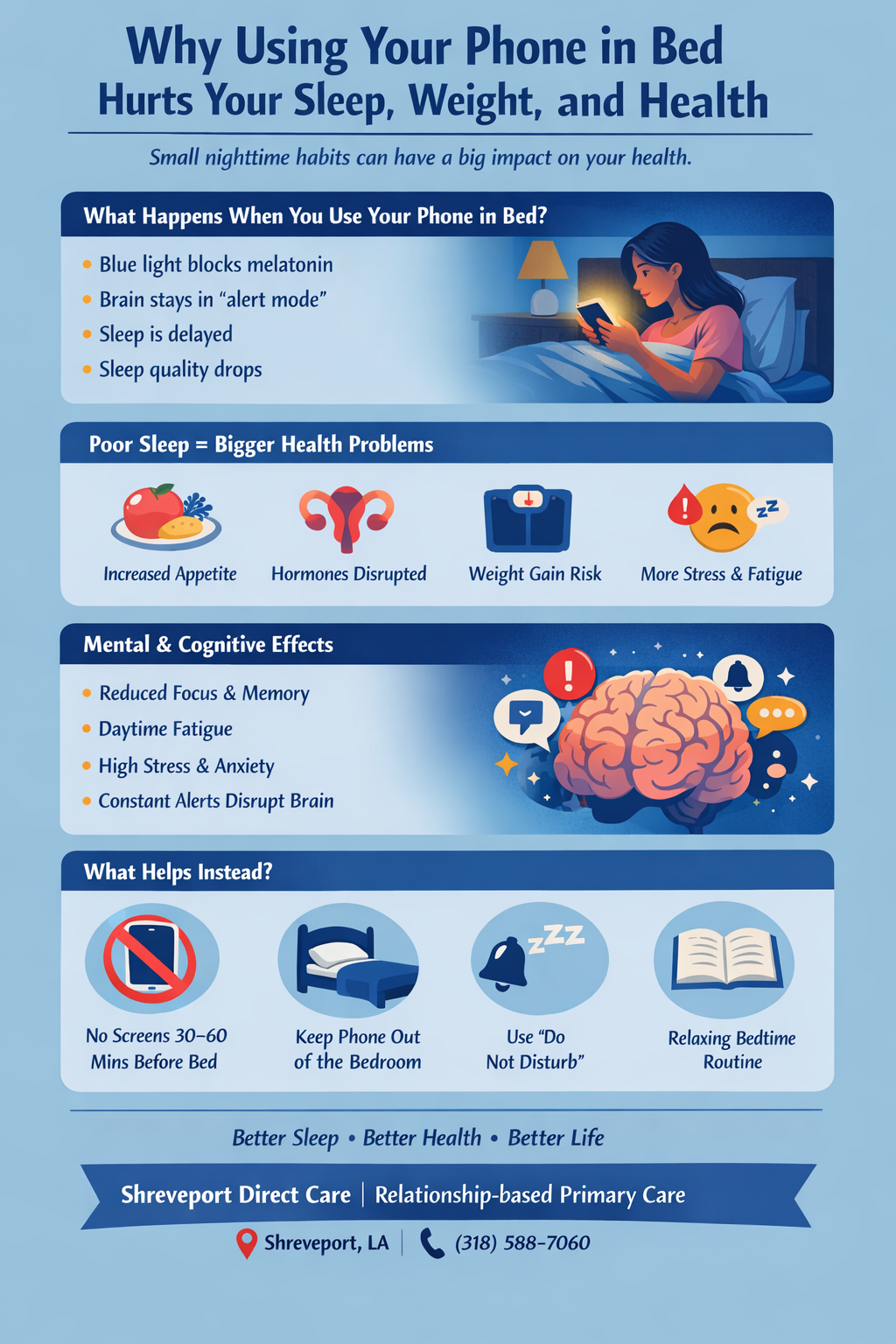
Why using your phone in bed hurts your sleep weight and health
Practical Steps for Better Sleep & Health: Break the Bedtime Phone Habit
Here are actionable steps you can take tonight:
Remove your phone from the bedroom: Screens and notifications stimulate the brain and delay melatonin release.
Turn off screens at least 30–60 minutes before bed: This gives your body time to wind down naturally.⁴
Use “Do Not Disturb” or night modes: If you must keep your phone nearby for emergencies, silence notifications.
Create a bedtime routine without screens: Reading a book, light stretching, or meditation can support sleep quality.
Even short reductions in phone use before sleep have been linked with measurable improvements in sleep quality and duration.¹⁰
Conclusion: Your Sleep and Health Deserve Disconnection
Your phone isn’t inherently harmful — but using it in bed, especially at night, sets up a chain reaction that affects sleep, metabolism, weight, and cognitive function. Better sleep isn’t a luxury — it’s foundational to physical and mental health.
If sleep problems or screen habits are interfering with your goals — whether weight control, mood stability, or energy — small changes at night can create big benefits over time. And if you want personalized guidance on sleep habits, metabolism, or lifestyle change, Shreveport Direct Care is here to help.
FAQs: Phones, Sleep, and Your Health
1. Why should I avoid using my phone before bed?
Using your phone before bed exposes you to blue light that suppresses melatonin and delays sleep onset, making sleep less restorative.³⁴
2. How does poor sleep affect weight?
Poor sleep from screen use is associated with increased BMI and overweight risk, potentially through hormonal imbalance and appetite regulation changes.⁶⁷
3. Does screen time affect stress and mood?
Yes — frequent checking and screen use can trigger stress, anxiety, and disrupt focus and cognitive performance.⁸⁹
4. How long before bed should I stop using my phone?
Experts recommend stopping screen use at least 30–60 minutes before bed to improve sleep quality.⁴
5. Can better sleep improve physical health?
Improved sleep enhances metabolism, insulin regulation, cardiovascular function, and body weight control.⁷
6. What if I need my phone for emergencies?
Use silent or do-not-disturb modes and place the phone away from your bed to minimize stimulation while still maintaining access for emergencies.
References
Goel A, et al. Effect of Smartphone Use on Sleep in Undergraduate Medical Students. Health (Basel). 2023;11(21):2891. https://www.mdpi.com/2227-9032/11/21/2891
Hartstein LE, et al. The impact of screen use on sleep health across the lifespan. Sleep Health. 2024;10.1016/j.sleh.2024.01.001. https://www.sleephealthjournal.org/article/S2352-7218%2824%2900090-1/fulltext
Marcus GM, et al. Smartphone screen time and sleep quality in adults. TIME. 2018. https://time.com/4565122/smartphone-screen-time-sleep/
Qanash S, et al. Effect of Electronic Device Addiction on Sleep Quality and Working Memory. PMC. 2021. https://www.ncbi.nlm.nih.gov/pmc/articles/PMC8529471/
Andersen TO, et al. Self-reported and tracked nighttime smartphone use and overweight. Sci Rep. 2024;14:xyz. https://www.nature.com/articles/s41598-024-55349-2
Wikipedia contributors. Screen time. Wikipedia. https://en.wikipedia.org/wiki/Screen_time
Wikipedia contributors. Sleep deprivation. Wikipedia. https://en.wikipedia.org/wiki/Sleep_deprivation
Washington Post. Why constantly checking your phone can drain your focus. 2025. https://www.washingtonpost.com/wellness/interactive/2025/phone-brain-health/
Wikipedia contributors. Nomophobia. Wikipedia. https://en.wikipedia.org/wiki/Nomophobia
Qanash S, et al. Device restriction and improved sleep outcomes. PMC. 2021. https://www.ncbi.nlm.nih.gov/pmc/articles/PMC8529471/