
Can a Primary Care Doctor Prescribe Adderall?
Can a primary care doctor prescribe Adderall?
Yes. A primary care doctor can prescribe Adderall in many cases. That includes some family medicine doctors, internists, and pediatricians. But the better question is not just whether a doctor can prescribe it. The better question is whether Adderall is the right treatment for you or your child.
In my practice, I evaluate both adults and children for ADHD. Sometimes Adderall or another stimulant is a good fit. Sometimes it is not. Trouble focusing does not always mean ADHD. I often see patients who come in worried they need Adderall, but after a careful review, the real issue turns out to be poor sleep, anxiety, depression, stress, or another medical problem. That is why I believe in careful diagnosis and thoughtful prescribing. The goal is not to rush to a medication. The goal is to understand what is really going on and build the right treatment plan.
Can a Primary Care Doctor Prescribe Adderall?
Yes, many primary care doctors can prescribe Adderall. Adderall is a prescription stimulant used to treat ADHD. It can be very helpful for the right patient. It may improve focus, attention, task completion, and day-to-day function at school, work, or home.
Still, this is not a medicine that should be prescribed casually. A good primary care doctor should first make sure ADHD is truly the right diagnosis. That matters because many symptoms that sound like ADHD can come from other causes. Someone may feel distracted, forgetful, mentally foggy, or unmotivated, but the root problem may not be ADHD at all.
This is one reason primary care can be such a good place to start. In a good primary care setting, your doctor can look at the whole picture. That includes your symptoms, your history, your daily life, your stress level, your sleep, and your overall health. In children, it may also include school performance, behavior concerns, and whether there may be another issue affecting learning.
In other words, yes, a primary care doctor can prescribe Adderall. But good care means taking time to decide whether that is the right next step.
How ADHD Is Evaluated Before Adderall Is Prescribed
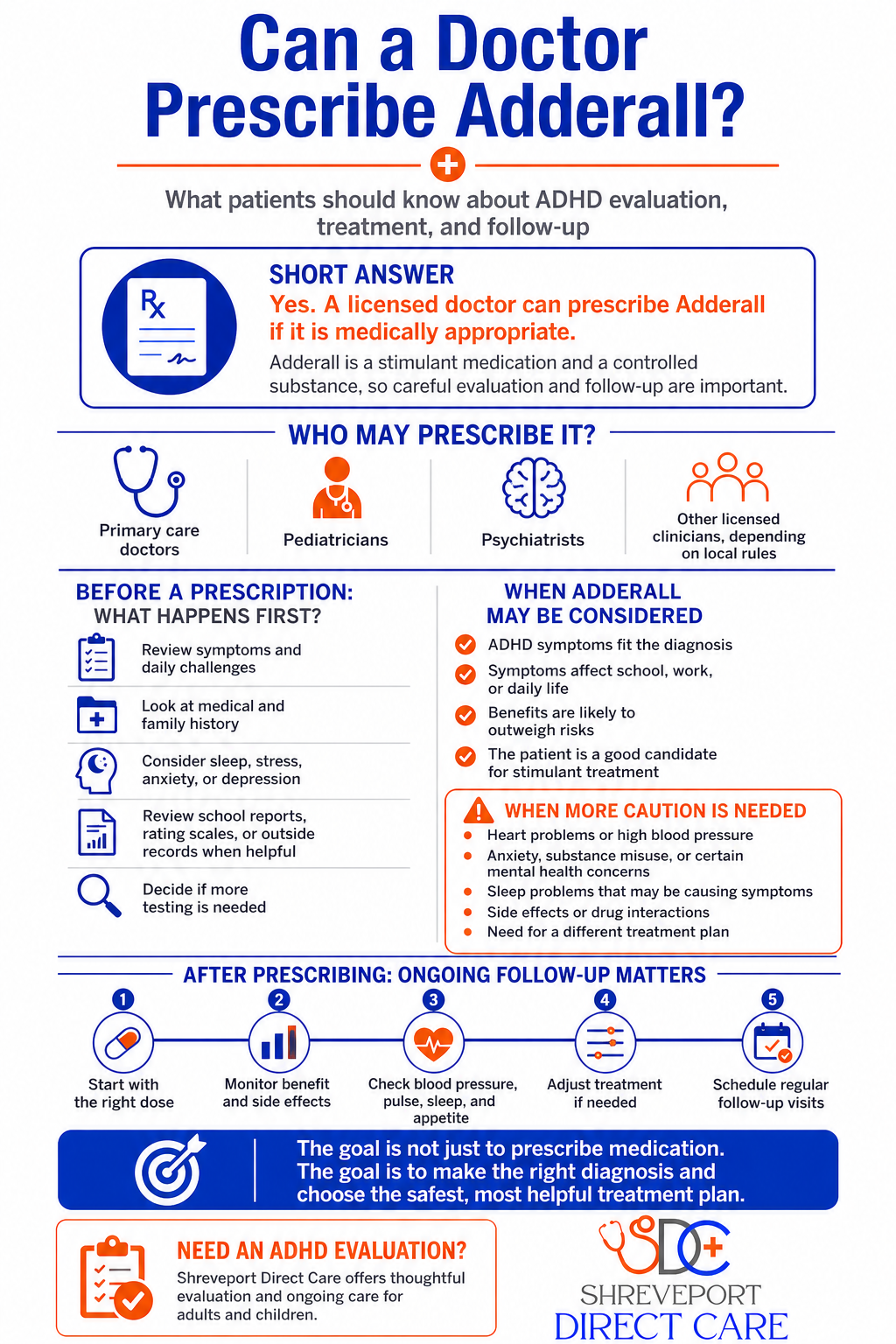
When patients come to my clinic for an ADHD evaluation, we start with a real conversation. We talk about symptoms, medical history, and family history. We look at what problems are happening now and how long they have been going on. We talk about school, work, and daily life. We want to know whether attention problems are getting in the way of function, not just whether someone feels distracted now and then.
I also use rating scales, outside records, school reports, and collateral history when needed. That may mean input from a parent, spouse, or another person who sees the symptoms in everyday life. This can be especially helpful with children, but it can also help in adults.
Sometimes the visit makes the diagnosis fairly clear. Other times, we need more information before making that decision. In some patients, I may recommend blood tests, a sleep study, or other testing. That is because poor focus can come from many different causes.
I commonly see patients ask about Adderall when the real problem may be something else, such as:
poor sleep
anxiety
depression
stress
substance use
another medical issue
If someone is sleeping poorly, dealing with untreated anxiety, or struggling with depression, they may feel like they cannot focus. That can look a lot like ADHD on the surface. But if the real issue is not ADHD, then giving Adderall may not solve the problem and may even make things worse.
That is why I believe the right diagnosis comes first. Once we have enough information, then we can talk about treatment options.
Can a Primary Care Doctor Prescribe Adderall?
When Adderall May Help and When Another Plan Makes More Sense
For the right patient, Adderall can help a lot. It may improve attention, focus, organization, follow-through, and performance at school or work. It can also help people feel less overwhelmed by daily tasks. For some patients, it can make a major difference in quality of life.
But Adderall is not the only option, and it is not the best option for every patient.
In my practice, I discuss treatment options based on the person sitting in front of me. Age matters. Medical history matters. Symptom pattern matters. Family history matters. Goals matter. Some patients may do well with a stimulant. Some may do better with a non-stimulant medication. Others may need behavior strategies, school supports, therapy, better sleep, or a more structured routine.
That is important because ADHD treatment should be personalized. It should not be one-size-fits-all.
For children, treatment may include school accommodations, parent strategies, behavior support, and sometimes outside learning evaluation. For adults, treatment may include medication, coaching, better systems for organization, sleep improvement, and treatment of anxiety or depression when those are also present.
A good treatment plan looks at the whole person. It does not just ask, “What pill should we use?” It asks, “What is the best way to help this person function better and feel better?”
When a Primary Care Doctor May Refer You for More Help
Many ADHD cases can be managed well in primary care. But there are times when referral makes sense.
My main red flags are concern for an underlying illness or symptoms that suggest something more complex may be going on. In those situations, psychiatry may be the right next step. Referral is not a bad sign. It simply means the patient may need a different level of support or a more specialized evaluation.
In children, I also think about learning issues. About 1 in 4 children with ADHD may also have a learning disability. If I am concerned about that, I may refer to a learning specialist. This can be very important because a child may be struggling in school for more than one reason. If we only focus on attention and miss a learning problem, we may miss a big part of the picture.
The goal is always to make sure the child or adult gets the right help, not just a quick label.
A Few Real-World Examples of Why Careful Diagnosis Matters
I have seen adults come in convinced they needed Adderall because they were having trouble focusing, finishing tasks, and keeping up at work. But after a careful review, the bigger issue turned out to be poor sleep and high stress. Once we addressed sleep and worked on the underlying problem, focus improved. In that case, stimulant medication was not the real answer.
I have also seen children who seemed to have classic ADHD symptoms at first. They were distracted, falling behind, and struggling in school. But after reviewing outside information and school concerns, it became clear that a learning disability may also be playing a role. That led to a more complete evaluation and a better plan.
These are the kinds of situations that remind me why a thoughtful approach matters. Not every patient with poor focus needs Adderall. But the right patient, with the right diagnosis, may benefit a great deal from the right treatment.
What Patients in Shreveport Should Expect From an ADHD Evaluation
If you are looking for primary care in Shreveport and wondering whether a doctor can prescribe Adderall, the first step is not asking for a specific medication. The first step is getting evaluated.
A good doctor in Shreveport should take time to understand the full picture. That includes symptoms, medical history, family history, school or work issues, sleep, stress, and mental health. In family medicine in Shreveport, ADHD care should be thoughtful, personal, and based on good information.
At Shreveport Direct Care, that is how I approach it. My goal is not to rush through a visit or give a quick answer. My goal is to understand why the symptoms are happening and then help you choose a plan that makes sense. For some patients, that may include Adderall. For others, it may include a different medication, behavior changes, more testing, or referral.
The best care is not about moving fast. It is about getting it right.
Final Thoughts
So, can a primary care doctor prescribe Adderall?
Yes. In many cases, the answer is yes.
But the most important step is making sure ADHD is truly the right diagnosis. Trouble focusing can come from many different causes. That is why careful evaluation matters. It is also why thoughtful prescribing matters.
In my practice, I evaluate both adults and children for ADHD. I look at symptoms, history, family background, outside records, and any other testing that may be needed. From there, we talk through treatment options, which may include stimulants, non-stimulant medicines, behavior strategies, school support, or referral when needed.
Good ADHD care is not about handing out a prescription. It is about understanding the person in front of you and building the right plan.
If you or your child are struggling with focus, attention, or possible ADHD symptoms, Shreveport Direct Care can help you take the next step. Call or text 318-588-7060 or email info@shreveportdirectcare.com to learn more about scheduling an evaluation.