
Concierge Medicine
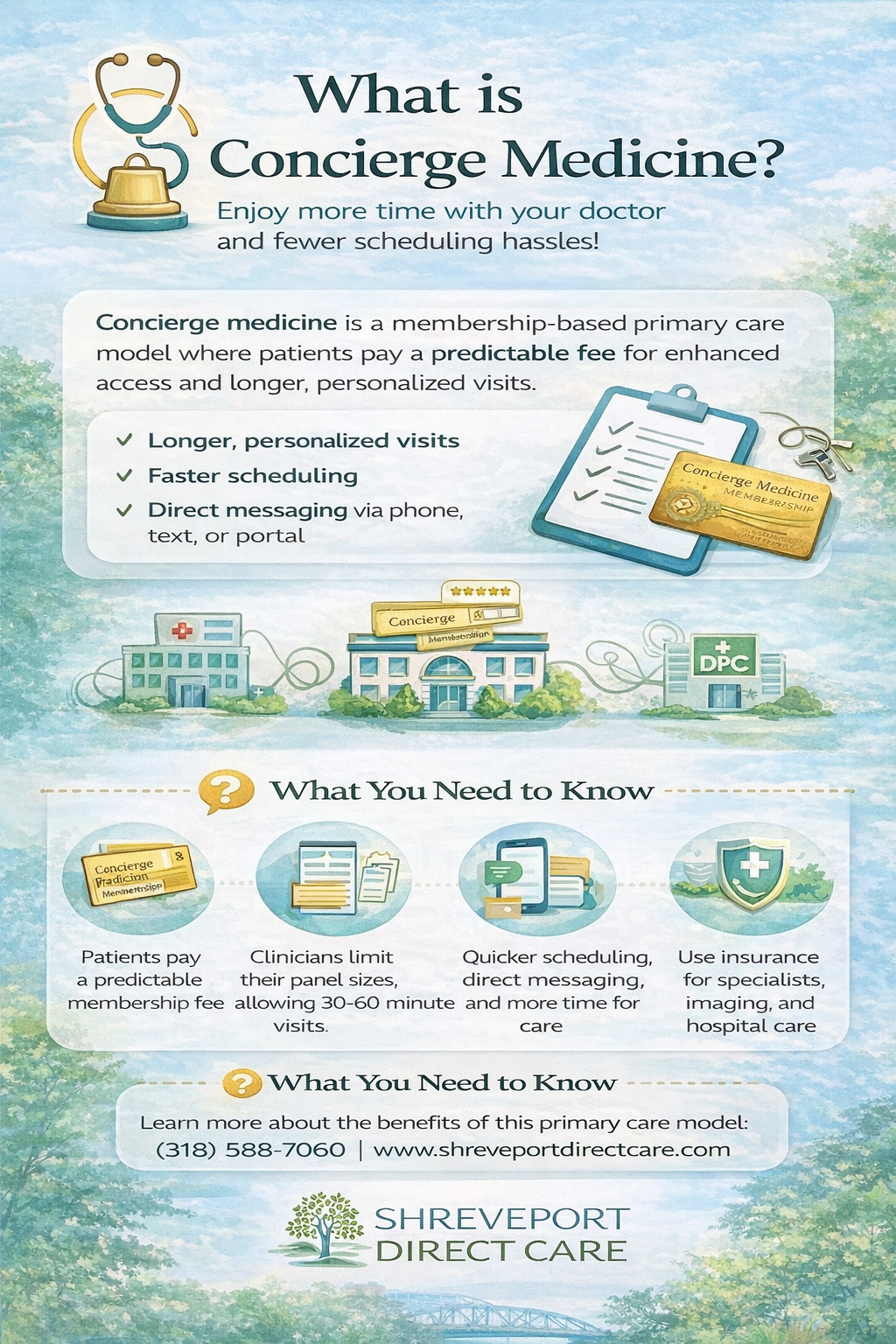
Want more time with your doctor and fewer scheduling hassles? Concierge medicine is a membership-based primary care model where patients pay a predictable fee for enhanced access and longer, more personalized visits. Practices limit panel sizes so clinicians can spend 30 to 60 minutes or more when needed, allowing time for preventive planning, complex symptom evaluation, and medication management. The model sits between traditional primary care and direct primary care (DPC): most concierge practices bundle primary care into the membership while patients continue to use insurance for specialists, imaging, and hospital care.
Daily benefits include faster scheduling, longer appointments, and direct messaging by phone, text, or secure portal. Extra time helps clinicians identify root causes, arrange timely referrals, and reduce repeat visits. Billing varies: some practices use a straight retainer while others use a hybrid model, so membership fees and covered services differ. Concierge medicine suits busy parents who need flexible scheduling, families who want continuous pediatric care when students are away, adults focused on preventive monitoring, and patients with unexplained symptoms who need more follow-up than a typical 15-minute visit.
Shreveport Direct Care memberships provide concierge like care in a DPC model.
What you need to know
Keep these points in mind when you evaluate concierge medicine. They cover the model, access, pricing, and typical coverage limits.
Core model: Membership-based primary care that limits panel size to provide longer, more personalized visits and direct communication.
Faster access: Same-day or next-day appointments plus phone or secure-message access let clinicians address issues sooner and focus on root causes.
Predictable pricing: Monthly or annual retainers (commonly $50 to $300 per month) often bundle primary care while specialists and hospital services remain billed to insurance.
Coverage limits: Memberships typically include preventive care, medication management, messaging, and care coordination; labs, imaging, and specialty care are often billed separately.
Choosing wisely: Prioritize access, visit length, inclusions for children, and continuity when matching membership tiers to your family’s or employees' needs.
What concierge medicine is and how it works
Day to day you'll see fewer administrative delays, quick telehealth check-ins for minor concerns, and active care coordination that speeds specialty referrals. Most memberships use either a straight retainer, bundling primary care into an annual or monthly fee while labs, imaging, specialists, and hospital care remain billed to insurance, or a hybrid model that submits insurance claims for select services. Medicare coverage rules for concierge care mean Medicare patients cannot be required to pay a membership fee for services Medicare covers; clinics that opt out must follow Medicare private contract rules.
Employers can offer or subsidize memberships to improve productivity and lower downstream claims. Your decision should hinge on what the fee covers and how the practice manages outside services and referrals.
How concierge medicine compares with traditional primary care and direct primary care
Payment structure and panel size shape the patient experience across these models. Concierge practices charge a retainer for faster access and longer visits while patients typically keep insurance for outside services. Traditional primary care bills insurance for each visit and handles large panels, which keeps out-of-pocket costs lower but limits time per patient. Direct primary care (DPC) usually charges a lower flat fee that covers most routine primary services and may not bill insurance for primary care visits. For a deeper side-by-side look, see Direct Primary Care vs. Traditional Healthcare.
Concierge primary care: Panels often 400 to 600 patients; retainer plus insurance for outside services.
Traditional primary care: Panels commonly 1,800 to 3,000+ patients; insurance-billed visits and shorter appointment times.
Direct primary care (DPC): Panels typically several hundred to about a thousand patients; modest monthly fee including many office services.
Smaller panels mean longer appointments and faster access. Concierge visits commonly last 30 to 60 minutes with same-day availability. DPC visits often run 20 to 40 minutes at a lower price point, while traditional visits average 10 to 15 minutes. Those extra minutes let clinicians take a fuller history, perform focused exams, and arrange clearer follow-up plans, which can reduce repeat visits and improve diagnosis. If you want to understand how DPC practices reduce patient expenses, read more about how DPC can save you money on healthcare costs.
At Shreveport Direct Care we schedule 60-90 minutes for new patients and 30-60 minutes for routine follow up visits depending on your complexity and needs.
Costs, membership tiers, and what affects price
Concierge medicine fees typically range from about $50 to $300 per month, or roughly $1,200 to $5,000 per year for most practices. Higher fees usually buy faster access, longer visits, and more on-site or after-hours services. When comparing practices, ask for a copy of tiered pricing and a sample year-long cost estimate so you can see likely out-of-pocket spending beyond the retainer. For context on pricing trends and how concierge and direct primary care models are evolving, see discussions from academic and professional sources on how much these models cost and are growing.
Sample tiers illustrate common trade-offs. Basic individual plans near $50 to $100 per month generally cover same- or next-day visits and routine preventive care.
Family or mid-level plans in the $150 to $250 range often add longer visits, limited in-office testing, and extra pediatric visit credits. Premium tiers above $250 per month can include 24/7 phone access, home visits, executive health services, and more in-clinic diagnostics. Employers can negotiate group rates or subsidize memberships to reduce absenteeism and specialty or emergency claims.
In general, our membership options at Shreveport Direct Care are even simpler. We have one price for getting all your care in our office, another that includes a few home visits, and finally one that includes all care at home or your office.
Geography and practice choices also affect price. Urban and higher-cost markets generally list higher fees because overhead and wages are higher. Panel size, included diagnostics, family coverage, and whether the clinic bills insurance for labs or specialists all influence the price, so compare the features you expect to use—visit length, after-hours access, included testing, and pediatric coverage—rather than choosing on price alone.
What membership covers, what insurance still pays, and legal considerations
Before you join, check exactly what's included and what costs extra. A concierge membership typically covers ongoing primary care services designed to make your care timely and personal: longer in-office visits, preventive planning, care coordination, telehealth follow-up, and messaging or phone access. Some practices include basic in-office labs or an annual comprehensive exam, while others list those items as add-ons. Get a written list of included services and common add-on charges.
Extended appointment times and preventive care planning
Care coordination with specialists and telehealth follow-up
Common add-ons: basic in-office labs, vaccines, or comprehensive annual exams (may cost extra)
Major items such as advanced diagnostic imaging, specialty procedures, and hospital stays are typically billed to your health insurance or Medicare. For Medicare patients, clinics must either separate noncovered membership services from Medicare-covered services or follow Medicare private contract rules if they opt out. Ask how the practice handles Medicare billing, who submits claims, and whether any services must be paid out of pocket.
Also check whether membership fees or covered services are eligible for HSA or FSA reimbursement, since policies vary. Ask about test-result turnaround times, prescription refill handling, and whether the practice negotiates pricing for outside testing. Request an itemized statement and a written billing policy so you can avoid surprise charges when imaging or specialist care is required.
Benefits, evidence, trade-offs, and choosing a concierge program
Deciding whether a membership is worth it comes down to benefits, evidence, and trade-offs. Concierge medicine delivers faster access, longer visits, and a closer patient-doctor relationship that many patients prefer. Many patients report higher satisfaction and quicker appointment times, and some small studies show fewer emergency visits and better follow-up for chronic conditions. Industry coverage also notes trends in physician adoption as clinicians weigh workload, panel size, and revenue impacts; see reporting on why more physicians are choosing concierge medicine.
In Shreveport and Bossier City, Shreveport Direct Care lists three transparent tiers so families and individuals can match value to need and budget. Essential is $69 per month and includes same- or nextday visits, telehealth, and secure messaging. Plus is $129 per month and adds a dedicated patient coordinator, an annual comprehensive visit, and prioritized scheduling. Concierge is $225 per month and adds 24/7 phone access, care navigation, and extended home or tele-visit options.
Before you join a program, compare answers across practices. Use the checklist below when you speak with clinics.
Is the membership fee refundable or prorated if I join mid-year?
Exactly which primary care services are included in writing?
Which services will still be billed to insurance, and how are claims handled?
Does the doctor accept Medicare and how does that affect fees?
What is the physician’s panel size and expected wait times?
Who is the patient coordinator and how will I contact them?
Are urgent after-hours calls handled by my physician or a triage team?
How are lab, imaging, and specialist referrals managed and billed?
Is there an initial enrollment or onboarding fee?
Can family members be added and what is the pricing structure?
Paying out of pocket buys predictable time, access, and continuity that traditional insurance-based primary care often cannot provide. Membership fees do not replace insurance for major procedures or hospital stays, so keep your policy for catastrophic coverage. Compare local answers, try a trial visit, and talk with the clinic to decide whether a membership fits your family or company.
Why concierge medicine matters for your care
Concierge medicine changes how primary care works by making it more proactive and personal. Predictable pricing, quick scheduling, and extended visits give clinicians time to find underlying causes rather than just treat symptoms. If those priorities match your needs, schedule a same-day appointment or start a membership to experience longer visits and direct clinician communication.
If you are interested in concierge medicine in Shreveport or Bossier. call or text 318-588-7060 to set up a Meet and Greet to see if Shreveport Direct care might meet your concierge medicine needs.
FAQ: Concierge Medicine Explained (Benefits for Patients)
1) What is concierge medicine?
Concierge medicine is a type of primary care where you pay a monthly or yearly membership fee. In return, you usually get longer visits, easier access, and more personalized care.
2) What are the biggest benefits of concierge medicine for patients?
Most patients choose concierge-style care for faster appointments, longer visits, and better communication. Many people also like the focus on prevention and long-term health planning.
3) What is typically included in concierge medicine?
It depends on the practice, but many include longer visits, same-day or next-day scheduling when available, direct messaging options, preventive care planning, and help managing chronic conditions.
4) Does concierge medicine help with prevention and wellness?
Yes. Concierge-style care often gives your doctor more time to focus on prevention, like blood pressure control, diabetes prevention, cholesterol management, cancer screening planning, sleep, stress, and healthy habits.
5) Can concierge medicine help with weight loss?
It can. Weight loss usually takes time, follow-up, and a plan you can stick with. Concierge-style care often makes it easier to get check-ins, coaching, and support over time.
6) Does insurance cover concierge medicine?
The membership fee is usually not covered by insurance. Many people keep insurance for things like hospital care, specialists, imaging, and emergencies.
7) Is concierge medicine worth it?
It can be worth it if you want faster access, longer visits, and a stronger relationship with your doctor. It may be less worth it if you rarely use care or don’t need extra support.
8) How is Shreveport Direct Care different?
Shreveport Direct Care is membership-based primary care in Shreveport, Louisiana. We focus on easier access, longer visits, prevention, and a personalized plan—without the rushed feel of traditional care.