
What Is Direct Primary Care? How It Works and Who It Helps

What Is Direct Primary Care?
If you are asking what is direct primary care you may not know that your primary care could be a lot better. Most people have a mental picture of primary care that feels familiar: a packed waiting room, a rushed visit, and a follow-up phone tree that makes a simple question take days.
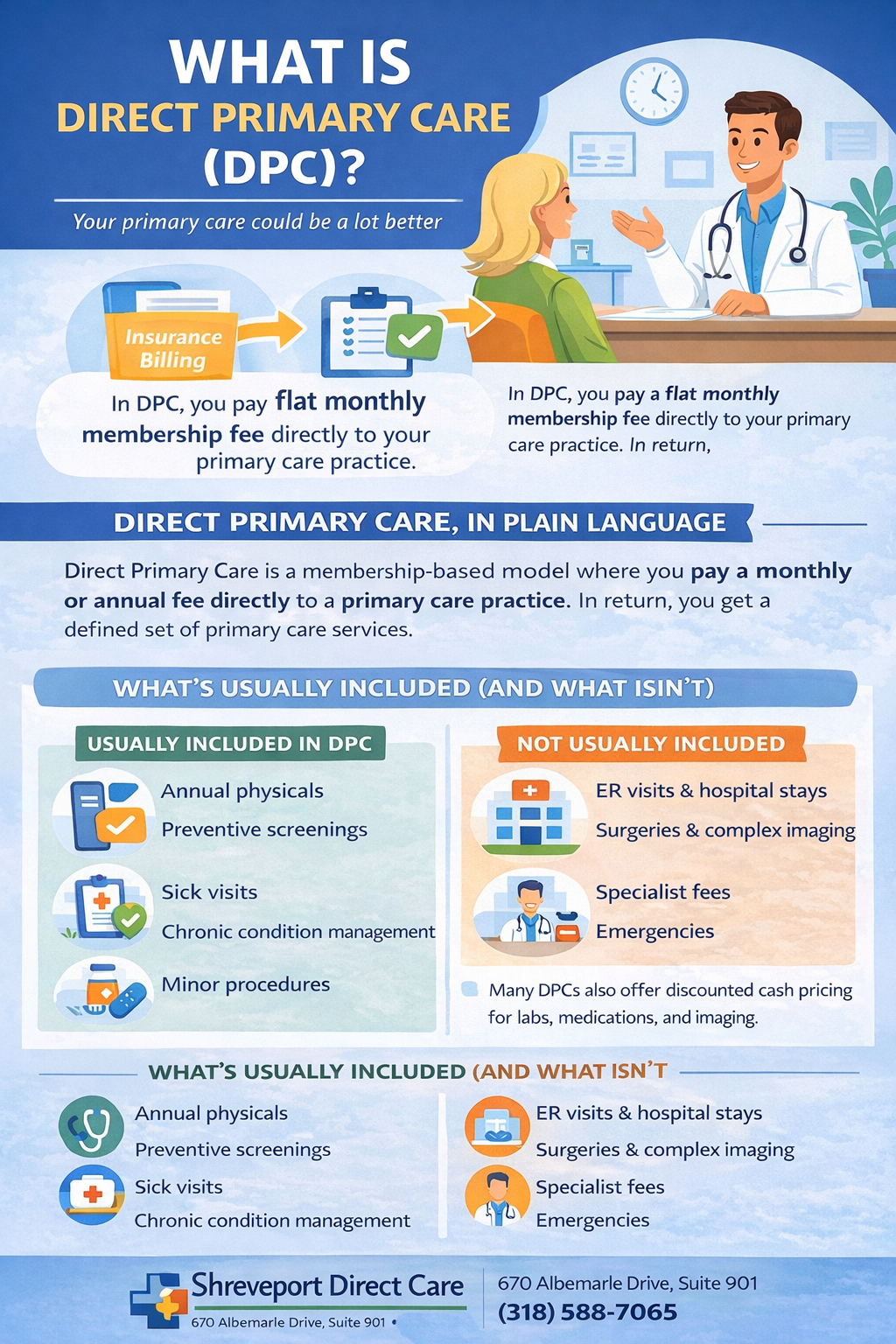
Direct Primary Care (DPC) is built on a different idea. Instead of running your everyday medical care through insurance billing, you pay your primary care practice directly through a simple membership fee. In return, you get a defined set of primary care services and easier access to the clinician who knows you.
Direct Primary Care, in plain language
Direct Primary Care is a membership-based model where patients (or sometimes employers) pay a flat monthly or annual fee directly to a primary care practice. That fee covers a set of primary care services spelled out in a written agreement.
DPC is not the same as “concierge medicine,” though the two can look similar from the outside. DPC fees are often far lower than concierge retainers, and the focus stays on core primary care: prevention, sick visits, chronic condition management, and care coordination.
It also is not health insurance. DPC does not replace coverage for hospital stays, surgeries, specialist care, advanced imaging, or emergencies. Many people pair DPC with a high-deductible health plan, a traditional employer plan, or another form of major medical coverage. We explain all about DPC in several other articles as well.
What Is Direct Primary Care: How DPC works day to day
A DPC practice typically keeps a smaller patient panel than a high-volume insurance-based clinic. That smaller panel is what makes the model feel different in real life: longer visits, quicker scheduling, and simpler communication.
In many DPC offices, you can reach your care team by text, email, phone, or telehealth for quick questions, medication refills, or guidance on whether you need to be seen. Same-day or next-day visits are common because the schedule is not driven by billing codes and throughput targets.
You still get the familiar building blocks of primary care, just with fewer barriers.
A typical membership often includes:
- Annual physicals and preventive care
- Sick visits and urgent concerns
- Chronic condition follow-ups
- Basic in-office procedures
What’s usually included (and what isn’t)
DPC agreements vary by practice, so it’s smart to read the “included services” section closely. Most memberships cover the kinds of care that happen in a primary care office and don’t require a hospital or specialist facility.
Many practices also arrange discounted cash pricing for common labs, medications, and imaging. Some dispense generic medications at cost, and a few include select maintenance medications as part of the membership.
Here’s a helpful way to think about it: DPC tends to cover decisions, evaluation, and ongoing management in primary care. It usually does not cover big-ticket care settings.
In practical terms, that often looks like:
- Included: office visits, telehealth, preventive screenings, chronic disease management
- Usually not included: ER visits, hospitalizations, surgeries, specialist fees, CT/MRI, complex outpatient procedures
At Shreveport Direct Care our members also benefit from a prescription plan that includes more than 1000 medications for common medical conditions like headaches, hypertension, cardiovascular disease, depression, anxiety, diabetes and some common supplements. We can also get cash based prices for many procedures that you would otherwise have a high deductible for.
A quick comparison: DPC vs traditional primary care
People sometimes ask, “Isn’t this just paying twice if I still have insurance?” To better understand, one might inquire, 'what is direct primary care?' It can be, depending on your plan and how often you use care. The tradeoff is that DPC aims to make primary care predictable and accessible, while insurance is still there for expensive, unexpected events.
Who DPC tends to help most
DPC is not one-size-fits-all. It tends to shine when access, time, and predictable costs matter more than “pay only when I go.”
People who often find DPC appealing include:
What is DPC?
- Busy professionals who value quick scheduling
- Remote workers Who need access and flexibility
- Parents juggling school, sports, and sick days
- Adults managing ongoing conditions like hypertension, diabetes, asthma, or anxiety
- People with high-deductible plans who want primary care they will actually use
- Small businesses that want a clearer, more usable benefit for employees
Some DPC practices also care for children and adults, which can simplify life for families. And if a practice offers telehealth with direct clinician messaging, it can be a practical option for a college student who needs continuity while living away from home.
Here are common “good fit” signals:
- You avoid care because it’s a hassle: DPC removes a lot of friction around scheduling and quick questions.
- You want more time in visits: Smaller panels often mean more time to talk through multiple concerns.
- You prefer predictable costs: A flat fee can feel easier to plan around than surprise bills and repeated copays.
- You need frequent touchpoints: Chronic conditions, mental health concerns, and medication adjustments often take more than one rushed visit.
What about people who rarely go to the doctor?
If you almost never need care, a membership can feel unnecessary. Still, many “healthy” people join DPC because they want easier access when something changes, or because they want consistent prevention and baseline lab work without worrying about per-visit costs.
The real question is not “Do I go to the doctor a lot?” It’s “Do I want primary care to be easy enough that I’ll use it when I should?”
A single avoidable urgent care visit can cost more than a month or two of membership in many markets. That won’t make DPC automatically cheaper, but it helps explain why some low-utilizers still find it worth it.
Costs and pricing: what to expect
Across the U.S., DPC memberships often land somewhere around $50 to $150 per person per month, depending on age, services, and local costs. Some practices price children lower, offer family caps, or provide employer group arrangements. The Shreveport Direct Care has one monthly fee for all patients.
What you should look for is not just the monthly fee, but what it replaces in your current routine:
- How much do you spend each year on copays for primary care?
- How often do you use urgent care because you can’t get in quickly?
- Do you delay visits because the billing feels unpredictable?
Also ask about other common costs that sit adjacent to primary care. Many DPC practices negotiate cash rates that can make everyday labs and generic medications much more affordable, even if those items are not fully “included.”
The role of insurance in a DPC setup
A good way to frame DPC is: it covers your front door to the healthcare system. Insurance covers the expensive rooms deeper inside.
Many DPC members keep major medical insurance for:
- Emergency care
- Hospitalization
- Specialist visits
- Surgery
- High-cost imaging and procedures
This pairing can work well for people with high-deductible plans who want to actually use primary care without paying full price until the deductible is met.
It can also work for families who want a reliable pediatric and adult primary care home, while still keeping insurance for the big unpredictable events.
However, some patients need care that don't have insurance. Shreveport Direct Care can help you navigate these waters and even help pair you with several Insurance options You might not be aware of to make sure you have coverage for those unexpected events like car wrecks and other emergencies.
Employers and DPC: why small businesses pay attention
Small employers often struggle with benefits that look good on paper but are hard to use in real life. DPC can be attractive because it is simple: a set monthly fee for primary care access, with no per-visit charges for covered services.
When employees can get same-day care and quick answers, they may miss fewer work hours and take care of issues earlier. That can matter in workplaces where one missed shift creates real operational strain.
A DPC membership is not a full replacement for major medical insurance, but it can be a practical layer that makes the healthcare benefit feel real to employees.
Is DPC allowed, and what does the contract mean?
DPC is legal across the U.S., and many states have passed laws clarifying that a DPC membership is not an insurance product. In Louisiana, state law defines direct patient-provider primary care agreements and requires consumer protections and clear disclosures.
That written agreement matters. It spells out:
- the monthly or annual fee
- what services are included
- what services are not included
- how cancellation and refunds work
- required statements that the agreement is not comprehensive insurance coverage
If you are considering DPC, treat the agreement like you would any service contract. Read it, ask questions, and make sure it matches how you actually want to use care.
Questions to ask a DPC practice before joining
You’ll get the most value from DPC when expectations are clear on both sides.
Here are a few practical questions to bring up after you’ve looked at the pricing page and service list:
- Access rules: How do I reach the clinician after hours, and what counts as urgent?
- Visit logistics: Are same-day or next-day appointments typical, and how long are visits scheduled?
- Care scope: Do you handle pediatrics, women’s health, mental health, and simple procedures in-office?
- Labs and meds: Are there discounted cash prices, in-office dispensing, or included maintenance generics?
- Coordination: If I need a specialist or imaging, will you help coordinate and send records?
If the answers fit your life and your health needs, DPC can make primary care feel like what it was always supposed to be: personal, responsive, and steady.
Looking for a Direct Care Provider in Shreveport?
If you’re looking for Direct Primary Care in Shreveport, our model at Shreveport Direct Care is built for everyone from busy families to modern work schedules. Many remote professionals choose our Direct Primary Care membership for predictable costs and easy access.
📍 Shreveport Direct Care
670 Albemarle Drive, Suite 901
Shreveport, LA
📞 (318) 588-7060
🌐 ShreveportDirectCare.com
Better access. Lower costs. Healthier people.
That’s DPC—done right.