
Fall Prevention in the Elderly
Most people think falling is just something that happens when you get older. It isn’t. Falls are common, but many of them can be prevented. About 1 in 4 adults age 65 and older falls each year, and falls are the leading cause of injury death in that age group.[1] The good news is that the most effective fix is not a gadget or a pill. It is training your balance. Exercise that challenges your balance lowers the rate of falls by about a quarter, and stronger programs do even better.[3][4] Add a careful review of your medicines, a check of your blood pressure when you stand, and a few changes at home, and the risk drops further. This guide covers what works for fall prevention in the elderly, what doesn’t, and how we help patients in Shreveport and Bossier City stay steady on their feet.
Why Falls Are Not Just “Part of Getting Older”
Here is what I hear all the time from families: “Mom is just getting older. She’s a little wobbly.” I understand why people think that way. But what most people don’t realize is how much of that wobble can be improved.
Balance is a skill. It depends on your eyes, your inner ear, the feeling in your feet, the strength in your legs, and your brain pulling it all together. Each of those can slip a little with age. When you stop challenging your balance, your body stops investing in it. That is the part we can change.
The stakes are real. More than 14 million older adults report a fall each year, and the death rate from falls in adults 65 and older rose 21% between 2018 and 2024.[1] Here at home, Louisiana runs a little higher than the national average. In 2023, 28.9% of older adults in Louisiana’s metro areas reported a fall in the past year, compared with 27.8% nationwide.[2]
A bad fall can mean a broken hip, a head injury, or a move out of the home someone loves. That is why I treat a “little wobbly” as a finding worth our time, not a fact of life.
Fall Prevention in the Elderly Starts With Balance You Can Train
If you remember one thing from this article, make it this: you can train your balance at any age.
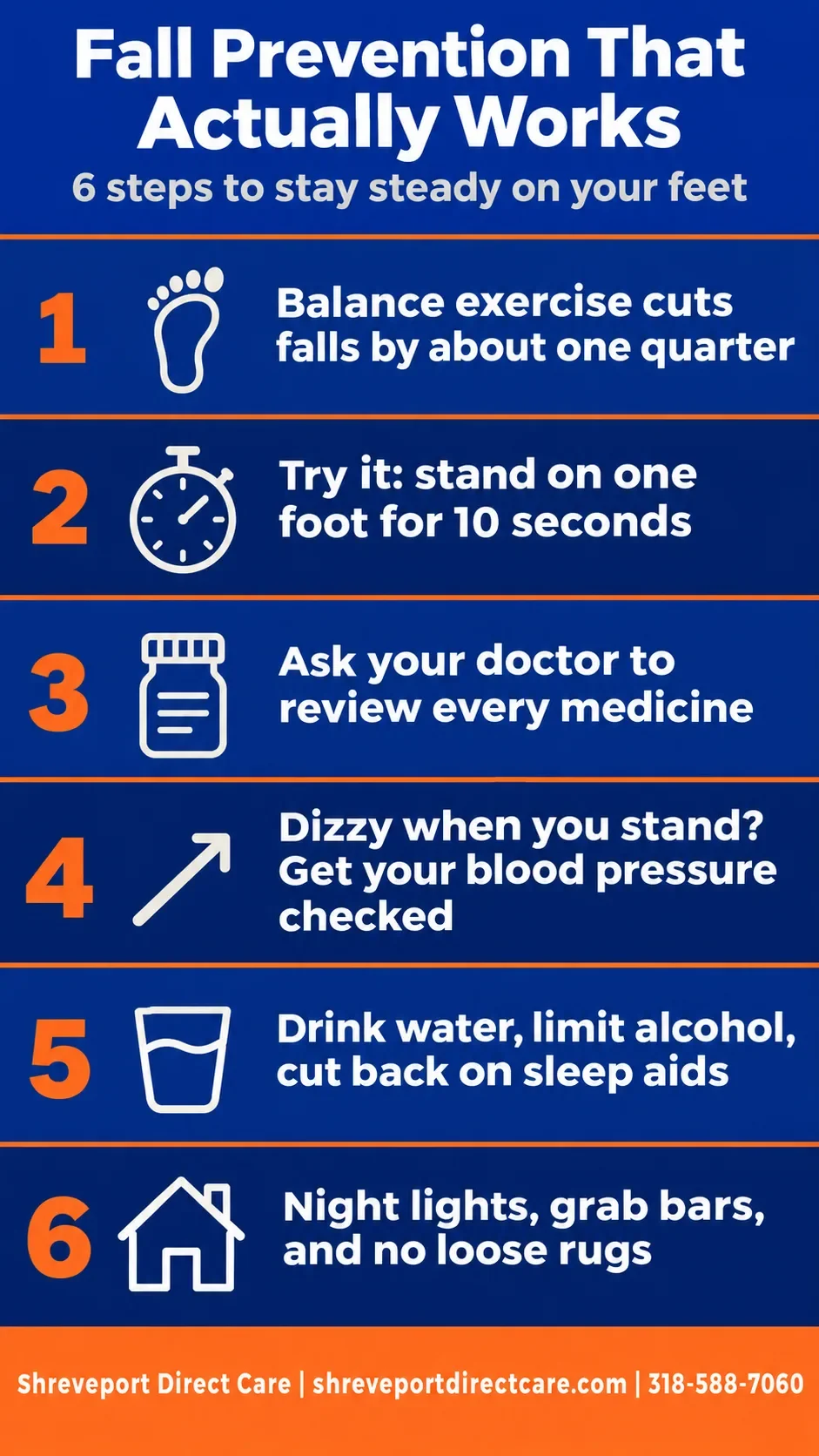
The research is strong. A major review of exercise trials found that exercise lowered the rate of falls in older adults by 23%. Balance and functional exercise alone lowered falls by 24%. Programs that combined balance work with strength training lowered falls by 34%.[3] Programs that really challenged balance and added up to 3 or more hours a week did best of all, with about 39% fewer falls.[4]
That is why the U.S. Preventive Services Task Force recommends exercise for adults 65 and older who are at higher risk of falling.[5] The World Falls Guidelines suggest balance and functional exercise at least three times a week, built up over time.[6]
One important detail: walking is great for your heart, but walking alone is not a balance program. To get better at balance, you have to practice being a little bit unsteady in a safe way.
A Simple Balance Test You Can Try Today
Stand next to a kitchen counter so you can grab it if needed. Lift one foot and try to hold it for 10 seconds. Then switch feet.
In one study of adults ages 51 to 75, people who could not hold a one-leg stand for 10 seconds had a higher risk of dying over the next 7 years.[7] The share of people who couldn’t do it grew with age. About 5% of people in their early 50s failed the test, compared with about half of people in their early 70s.[7] If you can’t hold it, don’t panic. It is a signal, and it is one we can work on.
Everyday Exercises That Build Balance
You don’t need a gym to start. These are the same moves I demonstrate in the clinic:
Toothbrush stands. Stand on one foot while you brush your teeth, near the sink, and switch feet halfway through.
Heel-to-toe walk. Walk down a hallway placing one heel directly in front of the other toes, like walking a line. Keep one hand near the wall if you need it.
Sit-to-stands. Stand up from a sturdy chair without using your hands, then sit back down slowly. Start with 5 and build up.
Tai chi. This slow, flowing exercise lowered falls by about 19% in research, and many people enjoy it enough to stick with it.[3]
I practice what I preach here. I do balance work and resistance training twice a week myself. The habit matters more than the perfect routine.
What Balance Training Looks Like at Every Age
In your 40s and 50s, the goal is to build a reserve. Add strength training twice a week, try the 10-second test, and practice balance during daily routines. This is the cheapest decade to get ahead of the problem.
In your 60s and early 70s, the goal is to screen and strengthen. Aim for balance and strength exercise at least three times a week. This is also when a yearly fall-risk check with your doctor makes sense.
At 75 and older, or after any fall, the goal is to protect your independence. A supervised program, sometimes with a physical therapist, is the safest way to keep challenging your balance while staying safe.
The Hidden Causes of Falls: Medicines, Blood Pressure, and More
Sometimes a fall isn’t really about balance at all. It is about something in the body or the medicine cabinet that makes balance harder. Finding those causes takes time, which is exactly what most short office visits don’t have. (I’ve written before about why the 15-minute office visit fails patients.)
Your Medicine List
Some medicines can make you dizzy, sleepy, or light-headed. The CDC lists sleeping pills, anxiety medicines called benzodiazepines, opioid pain medicines, some antidepressants, seizure medicines, and some blood pressure medicines as drugs linked to falls.[8] Over-the-counter products count too, like nighttime pain relievers and allergy pills that contain diphenhydramine.
At Shreveport Direct Care, every patient worried about falls gets a full medication evaluation. We go through every pill, including the ones in the nightstand. The goal is not to stop medicines for the sake of it. The goal is the right medicine at the right dose. Often the easiest fall to prevent is the one caused by a sleeping pill you may not need anymore.
Blood Pressure That Drops When You Stand
Some people’s blood pressure falls when they stand up. Doctors call this orthostatic hypotension. It can cause dizziness or a gray-out feeling for a few seconds, and it is linked to a higher risk of falls.[9] We check it by measuring your blood pressure lying down and then standing up. It takes a few minutes and is easy to skip in a rushed visit.
Not drinking enough water can make it worse, especially during a hot Louisiana summer. Many older adults drink less on purpose to avoid trips to the bathroom. I often ask patients to drink more water during the day and to sit on the edge of the bed for a minute before standing up at night.
Vitamin D, Alcohol, and Sleep
I check vitamin D levels and recommend a supplement when a level is low. That part matters. What the research does not support is taking vitamin D to prevent falls when your level is already normal.[12] If you’re unsure, our article on how to know if you have a vitamin deficiency walks through it.
Alcohol is another one people don’t think about. Older adults are more sensitive to alcohol’s effects on balance and coordination, and mixing alcohol with sleep aids or other sedating medicines raises the risk even more.[11] Cutting back, especially in the evening, is a simple and practical step.
Vision, Hearing, and Feet
Have your eyes checked every year. Hearing matters too. In one study of adults ages 40 to 69, even mild hearing loss was linked to nearly three times the odds of having fallen.[13] Hearing, balance, and memory are closely connected, which is one reason we pay attention to all three as part of protecting your memory as you age. Numbness in the feet, often from diabetes, also makes it harder to sense where the ground is.
A Story From Our Practice
Ms. Evelyn was 78 when her daughter called me. “She hasn’t fallen yet,” her daughter said, “but she grabs every piece of furniture on the way to the kitchen.”
At her first visit, I watched her walk down our hallway. Then I showed her a few simple exercises and asked her to try them. She couldn’t stand on one foot for more than a second or two, and she needed her hands to get up from the chair. Her blood pressure dropped when she stood. She was taking a nighttime pain reliever with diphenhydramine most nights, plus a prescription sleeping pill. Her vitamin D was low. And she admitted she barely drank water after lunch so she wouldn’t have to get up at night.
We made a plan together. We stopped the over-the-counter sleep aid and slowly tapered the sleeping pill. She started vitamin D and a daily water goal. She practiced toothbrush stands and sit-to-stands every day and joined a weekly exercise class. Then I came to her house. In one visit we found a loose rug in the hallway, a dark path to the bathroom, and nothing to hold onto in the tub.
Months later, she could hold a one-leg stand for several seconds and stand up from a chair without using her hands. Not every patient improves this much, and the results are different for everyone. But this is what fall prevention looks like when you have the time to look at the whole picture.

Tips for Fall Prevention
Fall Prevention at Home: Why a House Call Helps
Most falls happen at home. A review of home safety programs found that fixing hazards in the home lowered the rate of falls, and the benefit was largest for people at high risk, such as those who had already fallen or recently been in the hospital.[10] Interestingly, handing someone a brochure or a gadget by itself did not reduce falls.[10] What worked was someone actually looking at the home and making changes.
Here are the tips for fall prevention I share most often:
Light the path from the bed to the bathroom with night lights. Remove throw rugs or tape them down. Put grab bars in the tub and next to the toilet before you need them. Install rails on both sides of the stairs. Keep the things you use every day within easy reach, so you aren’t climbing on a step stool. Wear shoes with good support and non-slip soles, even inside the house.
This is where home visits make a difference. Our DPC + Home Visits membership lets me see patients where they actually live. When I walk through a patient’s home, I often spot the dark hallway, the slick bathroom floor, or the chair that’s too low long before they do. You can see the full list of what we treat and the services we offer, including house calls.
Fall Prevention Care in Shreveport and Bossier City
If you live in Shreveport, Bossier City, or anywhere in Northwest Louisiana, here is what fall prevention looks like at Shreveport Direct Care.
We start by watching you move. I watch you walk, stand up, and turn. I show you balance exercises and watch you try them, so we know exactly where you are and where to start.
We look for the hidden causes. That means a full medication evaluation, blood pressure lying and standing, vision and hearing questions, a look at your feet, and labs like vitamin D when they make sense.
We build a plan that fits your life. That might be daily balance drills, a strength routine, a class, a referral to physical therapy, changes to your medicines, or a home visit. Then we follow up, adjust, and stay in touch by phone or text between visits.
This kind of care takes time. That is the whole point of our membership model. You pay one flat monthly fee, and you get unhurried visits and direct access to your doctor. It works alongside Medicare, too. You can read more about Dr. Bass’s background, including dual board certification in Internal Medicine and Pediatrics.
Many of the calls we get come from adult children worried about a parent. If that’s you, you don’t have to wait for the first fall. A steadier parent at 80 often starts with one conversation at 75.
Schedule a free meet-and-greet with Dr. Bass. No commitment, no pressure. Just a conversation about your health and how we can help.
Schedule your free visit at Shreveport Direct Care →
Phone/Text: 318-588-7060
Email: info@shreveportdirectcare.com
Modern Medicine. Old-School Experience.

FAQs:
1. Can falls in older adults really be prevented?
Many can. Exercise that challenges balance lowers the rate of falls by about a quarter, and stronger programs lower it even more.[3][4] Combining exercise with a medicine review and home safety changes gives you the best chance.
2. What are the best balance exercises for seniors?
Simple moves done often work well. Try standing on one foot while brushing your teeth, walking heel to toe down a hallway, and standing up from a chair without using your hands. Tai chi is another good option.[3] Always keep something sturdy nearby to hold onto.
3. Which medicines increase the risk of falling?
Sleeping pills, anxiety medicines called benzodiazepines, opioid pain medicines, some antidepressants, seizure medicines, and some blood pressure medicines are linked to falls.[8] Over-the-counter sleep aids and allergy pills with diphenhydramine count too. Don’t stop any medicine on your own. Ask your doctor to review your full list.
4. Does vitamin D prevent falls?
Not if your level is already normal. Experts recommend against taking vitamin D just to prevent falls in people without a deficiency.[12] If your level is low, treating it is reasonable, which is why we test before we recommend a supplement.
5. How often should an older adult be checked for fall risk?
Adults 65 and older should be asked about falls at least once a year, and any time they fall, nearly fall, or feel unsteady.[6] A good check includes watching you walk, testing your balance, and reviewing your medicines.
6. Does Shreveport Direct Care offer home visits for fall prevention?
Yes. Our DPC + Home Visits membership includes house calls for patients in Shreveport, Bossier City, and nearby communities. A home visit lets Dr. Bass spot fall hazards like loose rugs, poor lighting, and missing grab bars where you actually live.
Fall Prevention in the Elderly

References
Centers for Disease Control and Prevention. Older Adult Falls Data. CDC. Accessed November 2026. (1 in 4 adults 65+ fall each year; 14 million+ report falls; fall death rate rose 21% from 2018 to 2024; leading cause of injury death in adults 65+.)
United Health Foundation. America’s Health Rankings: Falls, Ages 65+. CDC Behavioral Risk Factor Surveillance System data, 2023. (Louisiana metro-area adults 65+: 28.9% reported a fall vs. 27.8% nationally.)
Sherrington C, Fairhall N, Wallbank G, et al. Exercise for preventing falls in older people living in the community: an abridged Cochrane systematic review.British Journal of Sports Medicine. 2020. (Exercise lowers fall rate 23%; balance/functional 24%; multiple types 34%; tai chi 19%. Based on the 2019 Cochrane review, older than 5 years but still the reference standard.)
Sherrington C, Michaleff ZA, Fairhall N, et al. Exercise to prevent falls in older adults: an updated systematic review and meta-analysis. British Journal of Sports Medicine. 2017. (Programs with high balance challenge and 3+ hours a week lowered falls about 39%. 2017 source; more recent data may exist.)
US Preventive Services Task Force. Interventions to Prevent Falls in Community-Dwelling Older Adults. JAMA. June 2024. (Recommends exercise for adults 65+ at increased fall risk.)
Montero-Odasso M, van der Velde N, Martin FC, et al. World guidelines for falls prevention and management for older adults: a global initiative. Age and Ageing. 2022. (Balance and functional exercise at least 3 times a week; routine fall-risk screening; assessment for high-risk adults.)
Araujo CG, et al. Successful 10-second one-legged stance performance predicts survival in middle-aged and older individuals. British Journal of Sports Medicine. June 2022. (Inability to hold a 10-second one-leg stand linked to higher mortality; failure rates by age.)
Centers for Disease Control and Prevention, STEADI. Medications Linked to Falls. CDC. 2017. (Medication classes linked to falls; stop, switch, or reduce. 2017 source, still current CDC tool.)
Mol A, Bui Hoang PTS, Sharmin S, et al. Orthostatic hypotension and falls in older adults: a systematic review and meta-analysis. Journal of the American Medical Directors Association. 2019. (Blood pressure drop on standing linked to higher odds of falls. 2019 source; more recent data may exist.)
Clemson L, Stark S, Pighills AC, et al. Environmental interventions for preventing falls in older people living in the community. Cochrane Database of Systematic Reviews, 2023 (summarized in American Family Physician). (Home hazard reduction lowers falls, most in high-risk people; education or devices alone did not.)
National Institute on Alcohol Abuse and Alcoholism. Older Adults. NIH. Updated December 2025. (Older adults more sensitive to alcohol’s effects on balance; alcohol plus sedating medicines raises fall risk.)
US Preventive Services Task Force. Vitamin D, Calcium, or Combined Supplementation for the Primary Prevention of Falls and Fractures (draft recommendation). USPSTF. December 2024. (Recommends against vitamin D to prevent falls in adults 60+ without deficiency. Draft; confirm final version before publishing.)
Lin FR, Ferrucci L. Hearing loss and falls among older adults in the United States. Archives of Internal Medicine. 2012. (Mild hearing loss linked to nearly 3 times the odds of a fall in adults 40 to 69. 2012 source; more recent data may exist.)

*Shreveport Direct Care is a direct primary care practice serving adults and children in Shreveport, Bossier City, and surrounding communities in Northwest Louisiana.
Dr. Pat “Ricky” Bass III is board-certified in Internal Medicine and Pediatrics.*