
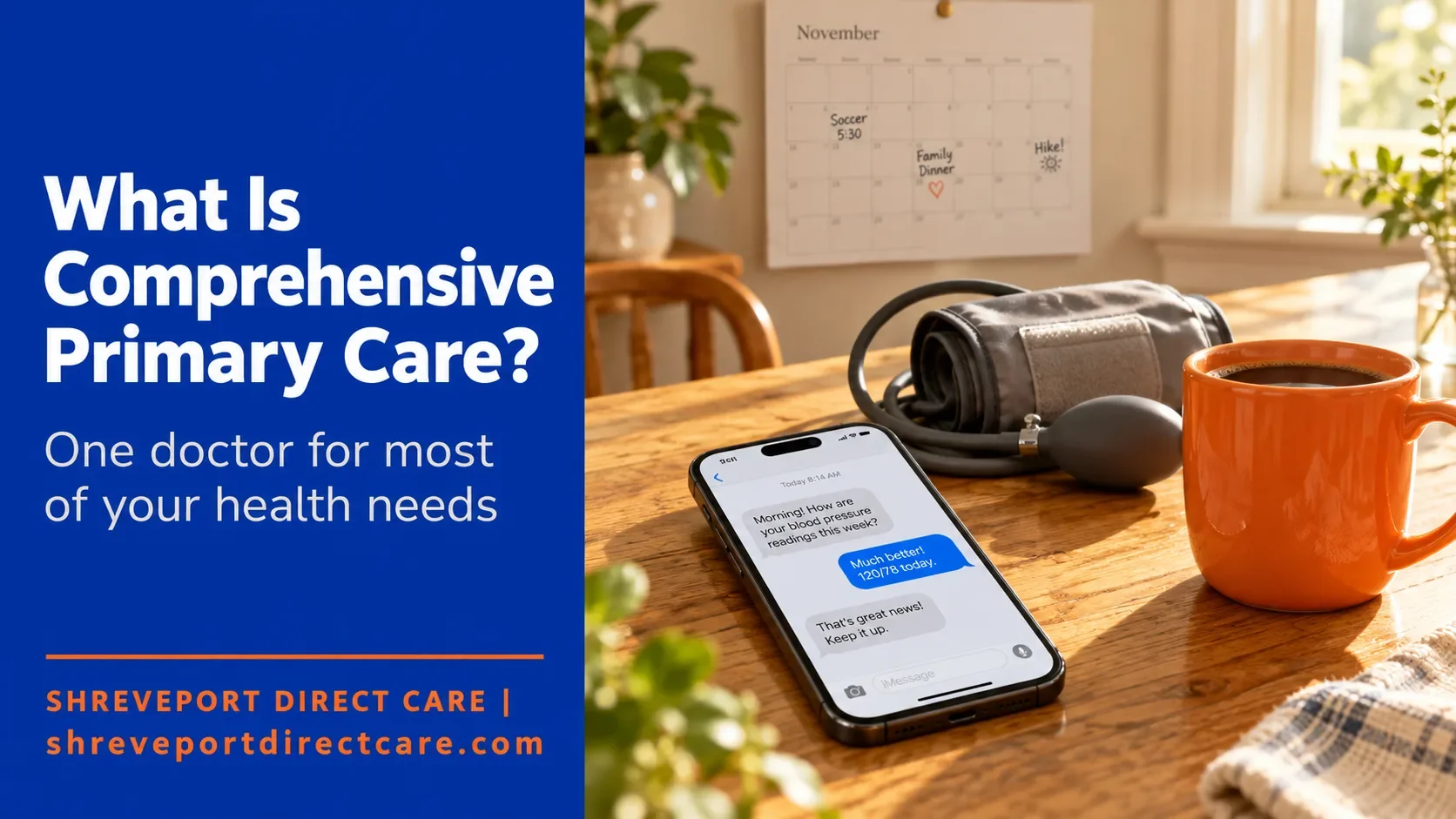
What Is Comprehensive Primary Care
You have a sore throat on a Tuesday. Your blood pressure has been creeping up. You have been feeling down for a few months, and you are not sure who to tell. For many people, that means three different places: an urgent care clinic, a specialist, and maybe nobody at all. It does not have to work that way.
Comprehensive primary care is a type of medical care where one doctor handles most of your health needs in one place.That includes preventive care, chronic disease management, sick visits, mental health care, and coordinating with specialists when you truly need one. It is built on a long-term relationship with a doctor who knows you. It treats the whole person, not just one symptom or one organ. Done well, it can lower your overall health costs and cut down on trips to the emergency room and urgent care.
In this guide, I will explain what comprehensive primary care covers, why so many insured people still cannot get it, and what it looks like here in Shreveport and Bossier City.
What Comprehensive Primary Care Covers
The American Academy of Family Physicians describes primary care as care that includes health promotion, disease prevention, counseling, patient education, and the diagnosis and treatment of both acute and chronic illness.[1] In plain words, your primary care doctor should be your first stop for almost anything. They should not be limited to one body part or one diagnosis.
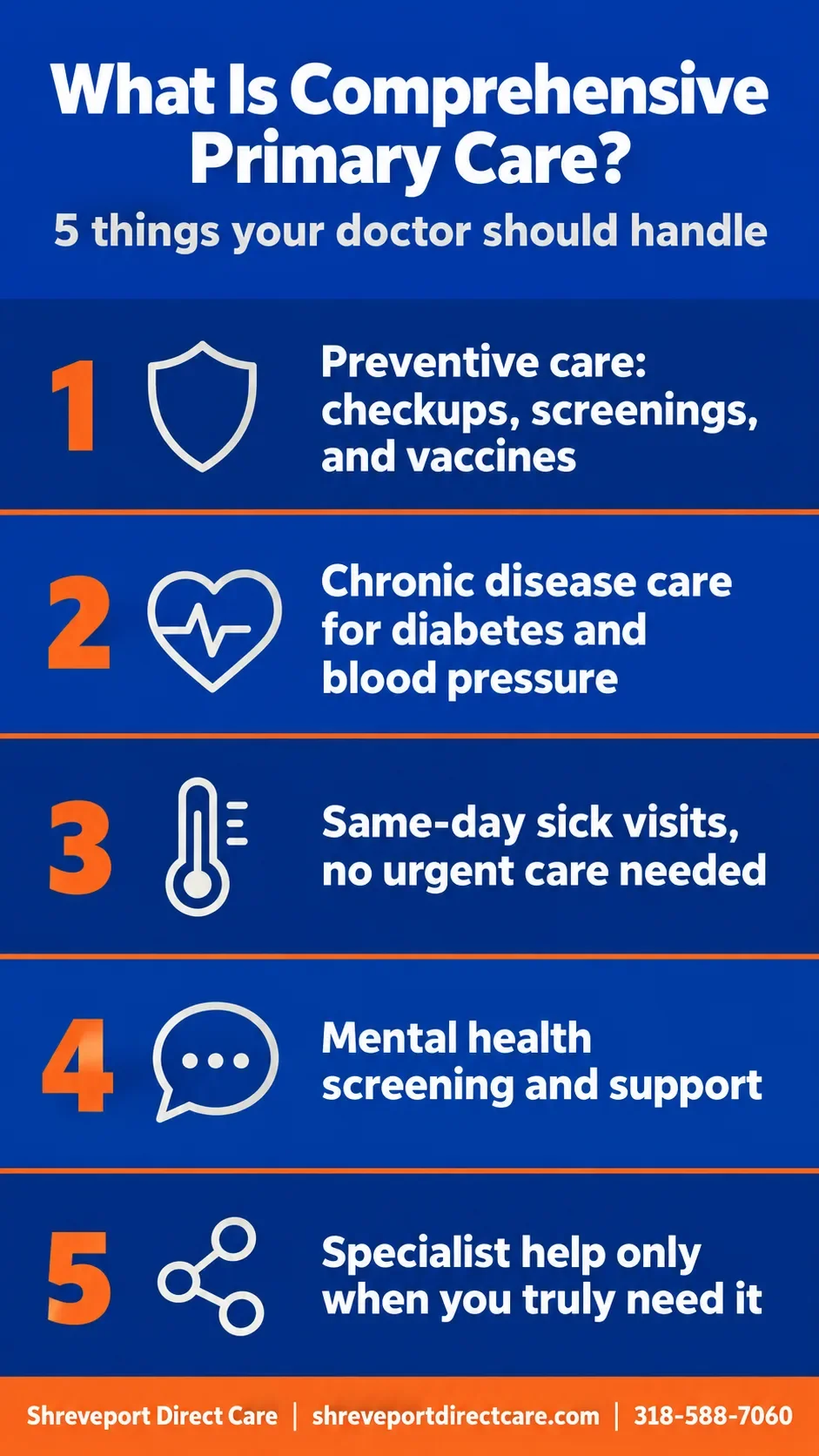
Here are the five core services that make primary care truly comprehensive.
Preventive care
Preventive care helps you stay healthy before problems start. This includes yearly checkups, screening tests, vaccines, and lab work. It also includes honest talks about sleep, food, exercise, and stress. Catching high blood pressure or prediabetes early is much easier than treating a stroke or kidney disease later.
Chronic disease management
A chronic disease is a health problem that lasts a long time, such as diabetes, high blood pressure, high cholesterol, asthma, or thyroid disease. Managing these well takes regular check-ins, medication changes, and follow-up. It works best when the same doctor sees you every time and knows your history.
Acute care
Acute care means treating new problems that come on quickly. Think colds, sinus infections, rashes, urinary infections, minor injuries, back pain, and stomach bugs. In a comprehensive primary care practice, you should be able to get these handled by your own doctor, often the same day.
Mental health care
Anxiety, depression, stress, poor sleep, and ADHD are common. They also affect your physical health. A comprehensive primary care doctor screens for these concerns, starts treatment when it makes sense, and helps you find counseling or a specialist when you need more support.
Care coordination
Sometimes you do need a specialist, a hospital, or a test your doctor cannot do in the office. Care coordination means your primary care doctor helps you get there, shares your records, and stays involved. You are not left to figure out the system alone.
The traits that tie it all together
Those five services matter. But how the care is delivered matters just as much. Comprehensive primary care is relationship-based, meaning you see the same doctor over time. It is holistic, meaning your doctor looks at your whole life, not just today’s complaint. And it is cost-conscious, meaning good primary care should help you avoid expensive emergency visits, hospital stays, and unneeded tests.
Why Comprehensive Primary Care Saves Money and Trips to the ER
Research backs up what many doctors see every day. A study in the Annals of Family Medicine looked at Medicare patients and their family doctors. Patients whose doctors offered the widest range of services had total Medicare costs that were about 10% lower than patients whose doctors offered the narrowest range.[2] The same study found that patients of more comprehensive doctors were less likely to be hospitalized.[2]
Why would that be? When your doctor can handle more, you make fewer trips to other places. Each referral, urgent care visit, or ER trip adds cost and adds risk that something gets missed. One doctor who knows you can connect the dots.
I tell my patients that I can handle about 80% to 90% of their medical issues right here. That is my experience after years of practicing both internal medicine and pediatrics. I bring in a specialist when care gets complicated, when a patient is not getting better, or when someone has more complex needs. That is how it should work. A specialist should be a teammate you call in for a reason, not the default answer for every problem.
To learn more about why this matters for the whole health system, read why primary care doctors are the future of care.
Why Many Insured Patients Still Do Not Get Comprehensive Care
Here is the hard truth. Having health insurance does not mean you have access to a doctor.
Many people have a card in their wallet but cannot get hold of their doctor when they need them. The average wait for a new patient appointment in the U.S. is now 31 days, according to a 2025 national survey.[3] When you are sick today, a month is not an answer. So people go to urgent care, or they wait and get worse.
It is not just wait times. More than 30% of U.S. adults did not have a usual source of care in 2022, the highest level in a decade, according to the 2025 Primary Care Scorecard.[4] That means nearly one in three adults does not have a regular doctor or clinic they go to. Without that relationship, there is no one keeping track of the big picture.
Traditional primary care also runs on short visits. Many doctors are booked in 15-minute slots, so they can only address one or two problems at a time. Follow-up often depends on you calling back, waiting on hold, and hoping for a callback. That is not comprehensive. That is a revolving door.
How direct primary care fills the gap
Direct primary care (DPC) is a different model. Instead of billing insurance for each visit, patients pay a flat monthly membership. That one change frees up the doctor’s time and removes the barriers between you and your care.
In a DPC practice, comprehensive care actually happens because of two things: access and follow-up. Access means you can text, call, or come in when you need to, often the same day. Follow-up means your doctor checks back with you after a visit, adjusts your treatment, and makes sure things are improving. You are not starting over every time.
If you are trying to decide what kind of doctor fits your family, this guide on how to choose a primary care doctorwalks through six key questions to ask.
What Comprehensive Primary Care Looks Like in Real Life
It can help to see how this plays out. The story below is a made-up example, not a real patient, but it reflects the kind of care we provide every week.
Picture a patient named Mark. He is in his early 50s, works long hours, and has not seen a doctor in a few years. One Saturday morning he wakes up with a bad cough and a low fever. In the past, he would have spent two hours at an urgent care clinic, seen someone he had never met, and left with a prescription and no follow-up.
Instead, Mark texts his doctor. They talk through his symptoms, and he comes in Monday morning for a visit with no rush. His doctor treats the cough. While he is there, his doctor also notices his blood pressure is high. They talk about his sleep, his stress at work, and the fact that his dad had a heart attack at 60.
Over the next few weeks, Mark gets basic lab work, starts a plan for his blood pressure, and checks in by text with his home readings. When he mentions feeling burned out, his doctor screens him for depression and talks through options. Months later, his blood pressure is under control and he feels like himself again. He never set foot in an urgent care or ER. One doctor handled all of it.
That is comprehensive primary care. It is not one big moment. It is many small ones, handled by someone who knows you.
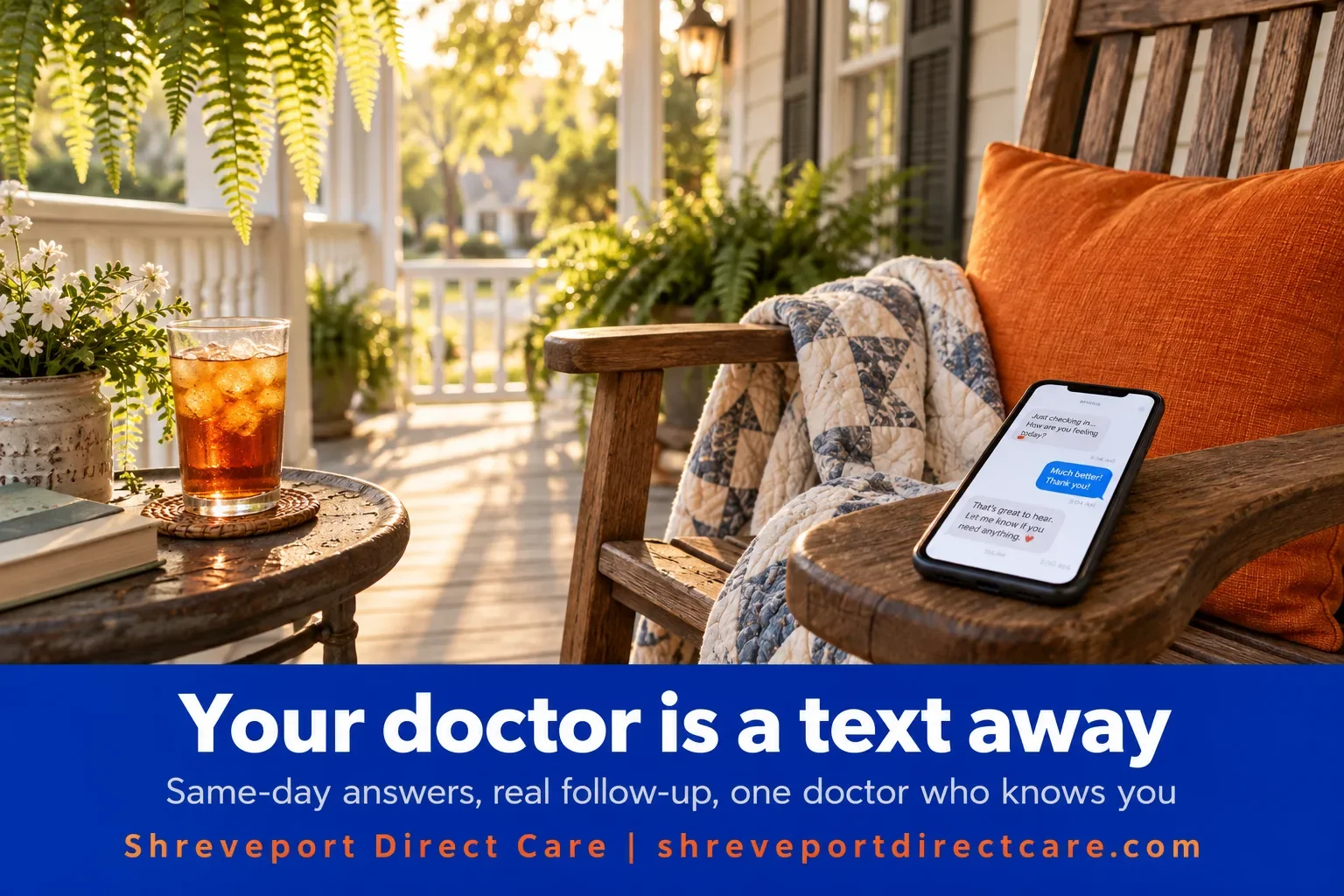
Comprehensive Primary Care in Real Life
Who Benefits From Comprehensive Primary Care?
The short answer is everyone. But here is how it helps different groups.
Individuals get one doctor who knows their history, their goals, and their worries. No more repeating your story to a new face every time.
Families get care for everyone under one roof. As a doctor trained in both internal medicine and pediatrics, I can care for kids, parents, and grandparents in the same practice. That continuity matters, especially when health issues run in families.
Employers get healthier, more present employees. When workers can text their doctor instead of leaving work for a half-day urgent care visit, everyone wins. Fewer sick days, fewer ER bills, and better long-term health all add up. You can see the numbers in our post on how DPC saves Shreveport employers real money.
Comprehensive Primary Care in Shreveport and Bossier City
Access to a doctor is a real problem in our part of the country. Louisiana has about 275 active primary care providers for every 100,000 people, below the national average of about 291, and ranks 38th among states.[5] For families in Shreveport, Bossier City, and across Northwest Louisiana, that gap shows up as long waits, crowded urgent care lobbies, and ER visits for problems that could have been handled in a doctor’s office.
Many people in our area also juggle long commutes, shift work, or caring for aging parents. Taking a whole day off to sit in a waiting room is not realistic. And for folks in smaller towns across the Ark-La-Tex, the nearest clinic may be a drive.
That is why Shreveport Direct Care was built the way it is. We are a membership-based direct primary care practice serving Shreveport, Bossier City, and surrounding communities. Memberships start at $109 per month and include unlimited visits, direct text and email access to your doctor, same-day or next-day appointments, and more than 1,000 generic medications at no extra cost. Visits are long enough to cover everything on your mind, not just one problem.
I am Dr. Pat “Ricky” Bass III, and I am board-certified in both Internal Medicine and Pediatrics. You can read more about my training and approach, or see the full list of what we treat.
Our motto says it best: Modern Medicine. Old-School Experience.
When Comprehensive Primary Care Is Not Enough
Comprehensive primary care can handle most of your health needs, but not all of them. If you have chest pain, trouble breathing, signs of a stroke, a serious injury, or any other emergency, call 911 or go to the nearest emergency room right away.
For everything else, your primary care doctor should be your first call. And if you need a specialist, a good primary care doctor will help you find the right one and stay involved in your care.
5 Things Your Comprehensive Primary Care Doctor Will handle
The Bottom Line
So, what is comprehensive primary care? It is preventive care, chronic disease care, sick visits, mental health care, and care coordination, all delivered by one doctor who knows you well. It is relationship-based and whole-person. And when it is done right, it saves you money, time, and trips to the ER.
Great health care can feel like a distant goal. But it does not have to be. Real support can be just a short text, call, or drive away.
Schedule a free meet-and-greet with Dr. Bass. No commitment, no pressure. Just a conversation about your health and how we can help.
Schedule your free visit at Shreveport Direct Care →
Phone/Text: 318–588–7060
Email: info@shreveportdirectcare.com
FAQs:
What is comprehensive primary care?
Comprehensive primary care is medical care where one doctor handles most of your health needs. That includes preventive care, chronic disease management, sick visits, mental health care, and coordinating with specialists. It is built on a long-term relationship and treats the whole person.
What services are included in comprehensive primary care?
Most comprehensive primary care services include checkups and screenings, vaccines, lab work, management of conditions like diabetes and high blood pressure, treatment for colds, infections, and minor injuries, mental health screening and treatment, and help getting to specialists when needed.
How is comprehensive primary care different from urgent care?
Urgent care treats one problem at a time, usually with a provider you have never met. Comprehensive primary care is ongoing. Your doctor knows your history, follows up after visits, and looks at the big picture, not just today’s symptom.
Can a primary care doctor replace seeing specialists?
Not completely, but a comprehensive primary care doctor can handle most issues. In Dr. Bass’s experience, that is about 80% to 90% of patients’ medical concerns. Specialists are best for complex problems, conditions that are not improving, or care that needs special tools or procedures.
Where can I find comprehensive primary care in Shreveport or Bossier City?
Shreveport Direct Care offers comprehensive primary care through a direct primary care membership. Patients in Shreveport, Bossier City, and the Ark-La-Tex get same-day or next-day visits, direct text access to Dr. Bass, and care for both adults and children.
Does direct primary care work with insurance or Medicare?
Direct primary care memberships cover your everyday primary care for a flat monthly fee, without billing insurance for visits. Many patients keep insurance or Medicare for hospital stays, specialists, and emergencies. Our team can explain how the two work together for your situation.
References
American Academy of Family Physicians. Primary Care (Policy). AAFP. Accessed October 2026.
Bazemore A, Petterson S, Peterson LE, Phillips RL Jr. More Comprehensive Care Among Family Physicians Is Associated with Lower Costs and Fewer Hospitalizations. Annals of Family Medicine. 2015;13(3):206–213. (AMN Healthcare. The Growing Challenges with Physician Appointment Wait Times. AMN Healthcare / 2025 Survey on Physician Appointment Wait Times. June 30, 2025.
American Academy of Family Physicians. 2025 Primary Care Scorecard Weighs ‘Cost of Neglect’. AAFP News. 2025.
United Health Foundation. Primary Care Providers in Louisiana. America’s Health Rankings. Data from September 2025.
Shreveport Direct Care is a direct primary care practice serving adults and children