
How to Choose a Primary Care Doctor: 6 Key Questions
How to Choose a Primary Care Doctor
Choosing a primary care doctor is one of the most important decisions you can make for your long-term health, and most people don’t realize that until something goes wrong. It usually isn’t obvious in the moment. It shows up years later, in a screening that got missed or a condition that got caught late because no one was really watching.
The good news is that you don’t have to guess. A short conversation with a potential doctor, before you ever become their patient, can tell you almost everything you need to know. Here are the questions worth asking, and why each one matters more than it seems.
Why This Decision Matters More Than People Think
Most people spend more time picking a mechanic than picking a doctor. That’s backwards, and the research backs it up. A large study of Medicare patients found that people who saw the same primary care doctor consistently, instead of bouncing between whoever was available, had 7 to 10 percent lower total health care costs and 5 to 9 percent lower odds of being hospitalized. [1] That’s not a small effect. That’s the difference a real relationship with one doctor makes over time.
It matters even more here in Louisiana. The state has about 275 primary care providers for every 100,000 people, a bit below the national average, and ranks 38th among all states for primary care access. [2] When the market is tighter, the doctor you choose, and how available they actually are, matters even more.
Here’s the part most people skip: you’re allowed to interview a doctor before you become their patient. A quick phone call or a meet and greet visit can reveal more about your future care than any online profile or star rating ever will.
The Questions to Ask Before You Choose
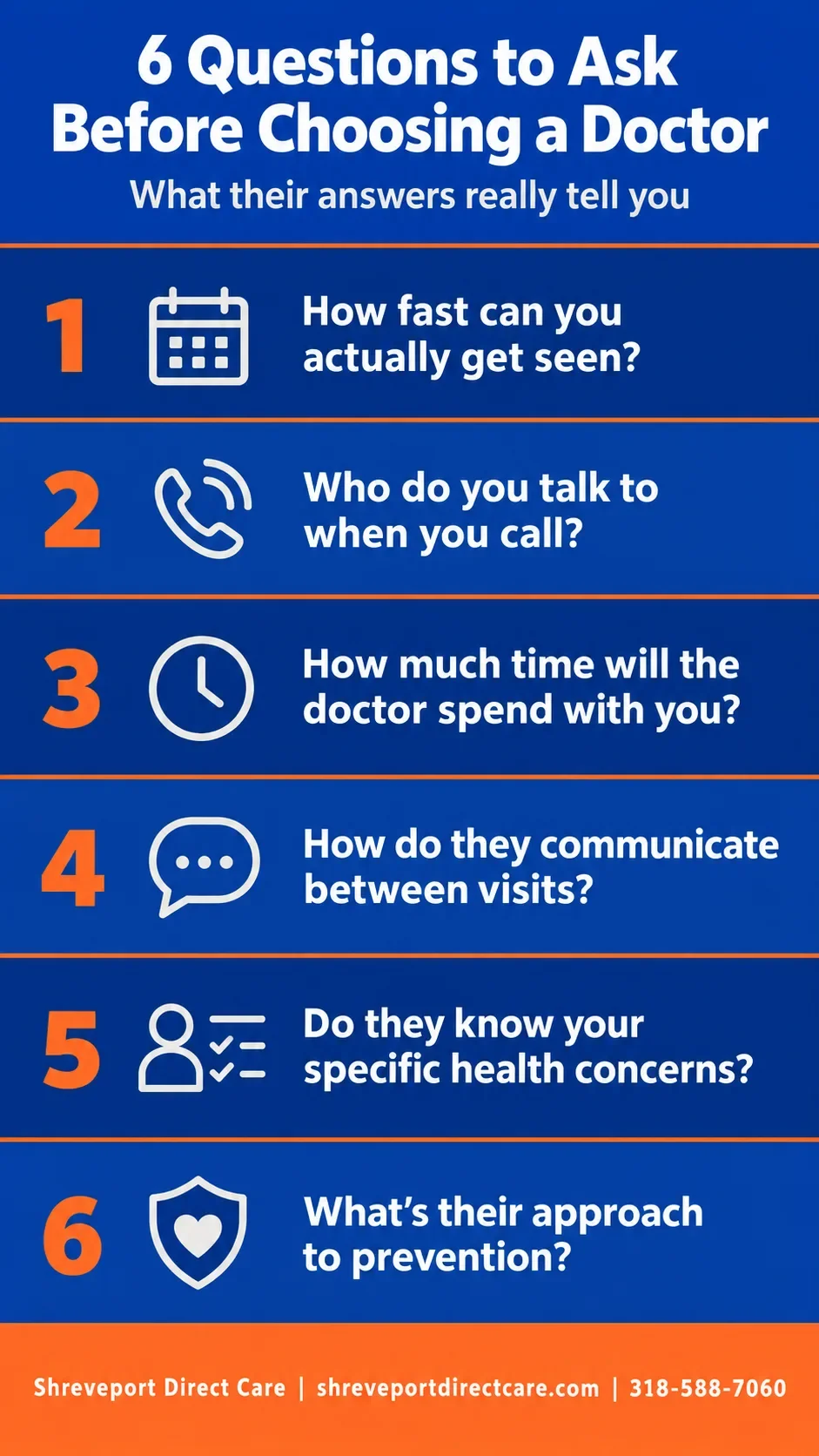
1. How fast can you actually get seen?
Ask what happens when you call with something that can’t wait three weeks, a bad cough, a sprained ankle, a sick kid. Some practices will get you in that day. Others will send you to urgent care because their own schedule is full for the next two weeks. Both answers are honest. Only one of them means the doctor is actually available when you need them.
2. Who do you talk to when you call the office?
This tells you a lot about how the practice actually runs day to day. Do you reach a person, a call center, or a phone tree that takes ten minutes to get through? Will your question even reach the doctor, or does it get filtered through several layers first? A doctor’s office is only as good as how easy it is to actually talk to someone there.
3. How much time will the doctor actually spend with you?
This one is bigger than it sounds. A recent poll of more than 4,500 clinicians found that over half spend 15 minutes or less with each patient. [3] That’s barely enough time to cover one issue, let alone a full physical or a complicated symptom. Ask directly: how long is a typical visit, and how long is a new patient visit? The answer tells you whether your doctor will actually have time to listen.
4. How does the doctor communicate between visits?
Health doesn’t only come up during a scheduled appointment. Ask how you reach the doctor if a question comes up on a Tuesday afternoon, a rash you’re not sure about, a medication side effect, a lab result you don’t understand. Do you get a callback in a day or two, or can you actually text or email and hear back the same day? This is one of the biggest differences between practices, and one people don’t think to ask about until they need it.
5. Does the doctor have real experience with your specific health concerns?
If you have a condition that needs ongoing management, diabetes, high blood pressure, anxiety, ADHD in a child, ask directly how often the doctor treats it and what their approach looks like. A doctor who manages a condition regularly will talk about it differently than one who sees it once a year. You’ll be able to tell the difference in how specific their answer is.
6. What is the doctor’s philosophy on prevention and staying ahead of problems?
This is the question that separates a doctor who reacts to problems from one who helps you avoid them. Ask how they approach screenings, lifestyle changes, and catching risks early, before they become diagnoses. Their answer should match how you actually want to be cared for. If you want a partner in your long-term health and they only talk about treating what’s already wrong, that’s worth knowing before you sign up, not after.

Is Direct Primary Care Worth It? How the Model Changes the Answers
The reason these questions are worth asking at all is that the answer depends entirely on how a practice is built, not just who the doctor is. This is where the direct primary care (DPC) model changes the math.
A traditional insurance-based primary care doctor often carries around 2,500 patients, because that’s what it takes to stay financially viable on insurance reimbursement rates. A direct primary care doctor typically carries a fraction of that, research puts the average around 445 patients. [4] Fewer patients per doctor is the entire reason same-day access and real visit time are even possible. It’s not a marketing claim, it’s math.
There’s also a financial angle that’s new for 2026. As of January 1, 2026, the IRS confirmed that direct primary care membership fees are HSA-eligible under the One Big Beautiful Bill Act, up to $150 a month for an individual or $300 a month for a family. [5] If you have a Health Savings Account, that membership fee can now come out pre-tax, which changes the “is it worth it” math for a lot of families.
None of this means DPC is automatically right for everyone, or that every traditional practice gives short visits and slow callbacks. But asking the six questions above will tell you, fast, which kind of practice you’re actually talking to.
What This Looks Like at Shreveport Direct Care
We built our practice around the answers to these exact questions, because we’ve heard them from patients for years, usually from people who are burned out on their old doctor’s office before they ever call us.
Patients can almost always get seen the same day or next day, including a same-day video visit when an in-person trip isn’t necessary. New patient visits are scheduled for a full 90 minutes, not 15. Follow-up visits typically run 30 to 60 minutes, and annual visits can run up to 90 minutes when there’s a lot to cover. That’s not us trying to be generous. That’s what same-day primary care and a real relationship with your doctor actually require.
As a physician board-certified in both Internal Medicine and Pediatrics, one membership covers your whole family, adults and kids, with the same doctor instead of splitting your care across separate offices. About Dr. Bass’s background and training is worth a look if that dual certification matters to you. Membership starts at $109 a month and includes unlimited visits plus more than 1,000 generic medications at no extra cost, on top of how a DPC membership works day to day.
If you want the fuller picture of what to look for locally, we’ve also written a guide to finding the best primary care doctor in Shreveport, and a breakdown of how direct primary care saves patients money over time. Between same-day access here in Shreveport and telehealth for patients across Northwest Louisiana and the Ark-La-Tex, most of our new patients tell us the same thing: they wish they’d asked these questions years earlier, with whatever doctor they had before us.
The Bottom Line
Choosing a new primary care doctor is one of the biggest health decisions you’ll make, and it deserves more thought than picking a name off an insurance list. Talking directly to the doctor, and asking the questions above, will tell you more about your future care than any website bio or online review ever could.
If you’re in the process of choosing, we’d rather you ask us these same six questions than take our word for it. Schedule a free meet and greet with Dr. Bass, no commitment, no pressure, just an honest conversation about your health and whether we’re the right fit.
Schedule your free visit at Shreveport Direct Care →
You can also call or text us at 318–588–7060, or reach out at info@shreveportdirectcare.com.
FAQs:
Is direct primary care worth it?
For most people, yes. You trade a flat monthly fee for same-day access, longer visits, and direct contact with your doctor, all things a traditional insurance-based practice often can’t offer because of how many patients each doctor has to see. As of 2026, DPC fees are also HSA-eligible, which can lower the real cost further. [5]
What questions should I ask before choosing a new primary care doctor?
Ask how fast you can get an appointment, who you talk to when you call, how long visits actually run, how the doctor communicates between visits, whether they have real experience with your specific health concerns, and how they approach prevention and long-term risk.
How long should a doctor’s visit actually be?
Long enough to actually be heard. National polling shows over half of clinicians spend 15 minutes or less per patient. [3] At Shreveport Direct Care, new patient visits run a full 90 minutes, and follow-ups run 30 to 60 minutes.
How fast should I expect to get an appointment with a new doctor?
At most direct primary care practices, including ours, same-day or next-day appointments are the norm, sometimes as a same-day video visit. If a practice tells you two to three weeks is normal for anything urgent, that’s worth factoring into your decision.
How much does a direct primary care membership cost?
At Shreveport Direct Care, membership starts at $109 a month and includes unlimited visits plus more than 1,000 generic medications at no additional cost.
Does direct primary care work with insurance or Medicare?
Yes. Direct primary care isn’t a replacement for insurance, it covers your primary care, while insurance still handles things like hospitalization, surgery, and specialist care. Our membership is Medicare-compatible as well.
References
Physician- versus practice-level primary care continuity and association with outcomes in Medicare beneficiaries. PMC (National Library of Medicine). 2024. (Supports the statistic that consistent primary care continuity is linked to 7–10% lower costs and 5–9% lower odds of hospitalization.)
Primary Care Providers in Louisiana. America’s Health Rankings. 2026. (Supports Louisiana’s primary care provider rate of 274.6 per 100,000 people, ranked 38th nationally.)
Poll of 4,500 Clinicians: How Much Time Do You Spend With Your Patients?. Doximity Op-Med. 2022. (Supports the finding that over half of clinicians spend 15 minutes or less with each patient.)
The Average Number of Patients for a DPC Practice. Elation Health. Updated 2023. (Supports the average DPC patient panel size of around 445, versus roughly 2,500 for a traditional practice.)
Treasury, IRS Provide Guidance on New Tax Benefits for HSA Participants Under the One Big Beautiful Bill. Internal Revenue Service. 2026. (Supports the HSA eligibility rules for direct primary care fees effective January 1, 2026.)
Shreveport Direct Care is a direct primary care practice serving adults and children in Shreveport, Bossier City, and surrounding communities in Northwest Louisiana. Dr. Pat “Ricky” Bass III is board-certified in Internal Medicine and Pediatrics.