
Health Benefits and Risks of Coffee: What the Evidence Says
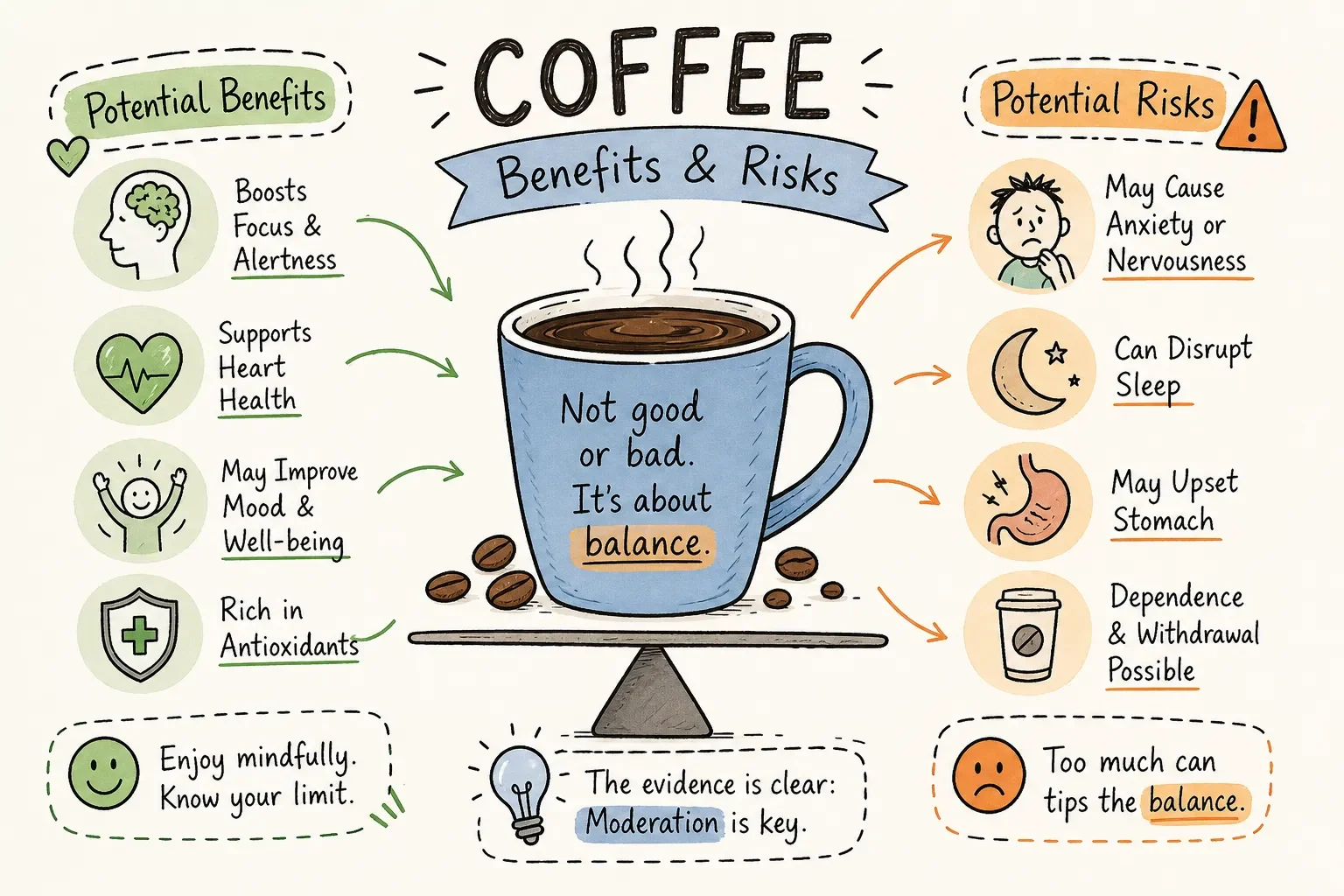
Risks and Benefits of Coffee
Is coffee good for you to drink? Most coffee drinkers aren't really asking that as a yes-or-no question. They're asking whether they need to feel guilty about it. The honest answer: probably not. But "coffee is healthy" and "coffee is fine for everyone" are two different claims, and conflating them causes real problems for real people.
The science on coffee is more developed than most people realize. Large cohort studies covering millions of participants have been tracking coffee intake against disease outcomes for decades. The picture that has emerged is genuinely reassuring for most healthy adults who drink a moderate amount. But the same research makes clear that dose, timing, individual health status, and what you put in the cup all matter. This article covers what the evidence actually shows: the benefits, the risks, the recommended limits, and how to drink coffee in a way that fits your actual health situation. If you're in the Shreveport or Bossier City area and want to connect these findings to your own bloodwork, blood pressure, or medications, Shreveport Direct Care offers membership based primary care, same-day and telehealth visits for exactly that kind of conversation.
Is Coffee Good for You to Drink? What Large-Scale Research Says
The most consistent finding across dozens of meta-analyses is this: moderate coffee intake, roughly three to four cups daily, is associated with lower all-cause mortality compared with drinking little or none. A 2025 meta-analysis found that the highest versus lowest intake group showed approximately 18% lower all-cause mortality risk. That pattern holds after adjusting for smoking, alcohol, body weight, and physical activity. These are observational findings, which means they show associations, not proof that coffee itself is the cause. But the consistency across different populations and study designs is notable.
The disease-risk connection most people don't know about
The diabetes and liver findings are among the strongest in the literature. People drinking three to four cups daily show roughly 20 to 25% lower risk of developing type 2 diabetes compared with non-drinkers. Chronic liver disease, cirrhosis, and liver cancer all follow a similar pattern of inverse association with regular coffee intake. What makes this interesting: both caffeinated and decaffeinated coffee show these associations, which points to polyphenols and antioxidants as the likely mechanism rather than caffeine alone. These findings describe what happens in large populations over time, not what will happen to any specific individual.
Coffee's effects on the brain and mood
Higher coffee consumption is associated with approximately 30 to 40% lower Parkinson's disease risk, particularly in men. The association is consistent enough across studies that researchers take it seriously, though reverse causation and sex differences remain ongoing qualifications. Separately, large cohort studies associate moderate coffee consumption with lower depression risk. The alertness and short-term cognitive performance effects of caffeine are distinct from these long-term associations and are well-documented on their own terms. None of this means coffee treats depression or prevents neurological disease. It means the pattern of association in populations who drink moderate amounts is consistently favorable.
Heart health: not the villain it used to be
For decades, the intuitive concern was that coffee raised cardiovascular risk. The data doesn't support that fear. Large meta-analyses associate moderate coffee intake with roughly 15% lower cardiovascular disease risk. At very high intake levels, the additional benefit disappears, but harm isn't clearly established either. Coffee is not associated with increased cardiovascular risk in the general population at moderate doses. That conclusion contradicts decades of clinical caution, and the evidence behind it is genuinely robust.
The health risks that regular coffee drinkers often ignore
The favorable research doesn't make coffee risk-free. The risks are real, well-documented, and vary significantly depending on the individual. They're also predictable once you understand the underlying mechanisms, which means most of them are manageable.
Sleep disruption and anxiety: the most common complaints
Caffeine has a half-life of roughly five to seven hours, meaning an afternoon cup at 3 p.m. still has meaningful amounts circulating in your system at 9 or 10 p.m. A 2025 controlled study confirmed that 400 mg of caffeine can disrupt sleep when taken within 12 hours of bedtime. Even moderate doses around 300 mg per day increase anxiety, jitteriness, and palpitations in sensitive people. For those with existing anxiety disorders, reactions can occur at 100 to 200 mg or less. These aren't rare side effects, they're predictable outcomes of caffeine at the wrong dose or the wrong time of day.
Blood pressure and palpitations: who needs to pay attention
Caffeine can temporarily raise blood pressure by five to ten mmHg in sensitive individuals, particularly those who don't drink coffee regularly. For people with uncontrolled hypertension or existing arrhythmias, that temporary spike matters more than it would for a healthy adult. High doses and energy drinks carry greater palpitation risk than standard brewed coffee. Regular moderate intake is not consistently linked to chronic hypertension in healthy adults, but individual response varies enough that monitoring is worthwhile if you fall into this category.
Pregnancy, children, and sensitive populations
ACOG advises pregnant women to stay under 200 mg of caffeine daily. For teens between 12 and 18, pediatric guidance generally recommends no more than 100 mg per day. Children should avoid caffeine entirely. These thresholds are straightforward. The practical challenge is that many people in these groups don't realize how much caffeine they're actually consuming, especially when large café drinks and energy drinks are part of the picture.
How Much Coffee Per Day Is Actually Safe?
The FDA and the American Heart Association both consider up to 400 mg of caffeine daily safe for most healthy adults. That translates to roughly three to five cups of brewed coffee, though that range depends heavily on brewing method and serving size. An eight-ounce drip coffee contains approximately 80 to 100 mg of caffeine. A large café cold brew can deliver 250 to 310 mg in a single serving. The math matters because most people significantly underestimate their actual daily intake.
Lower thresholds for specific groups
The 400 mg guideline applies to healthy adults with no complicating conditions. Pregnant women should stay at or below 200 mg. Teens should stay at or below 100 mg. People managing hypertension, anxiety disorders, or arrhythmias, or those taking stimulant medications, need a case-by-case approach, ideally with clinician input. These are calibration points, not warnings designed to scare people off coffee. They exist so the right people drink less.
Why caffeine adds up faster than you think
Cold brew, espresso-based drinks, energy drinks, pre-workout supplements, and even some teas all contribute to daily caffeine load. A person who drinks two cups of morning coffee and then adds a large afternoon cold brew may be well above 400 mg without realizing it. A 16 to 24-ounce cold brew alone can contain 200 to 310 mg before accounting for anything else consumed that day. Tracking total caffeine from all sources, not just coffee cups, gives a much more accurate picture of actual caffeine health effects.
How to get more benefit and less risk from your daily cup
The research points to a few specific levers that matter more than most people realize.
Timing your intake around sleep and cortisol
The single most impactful adjustment most coffee drinkers can make has nothing to do with how much they drink, it's when they stop. Cutting off caffeine intake by early afternoon, using a rough formula of bedtime minus 10 to 12 hours, protects sleep quality more reliably than reducing total cups. For someone going to bed at 10 p.m., that means stopping by noon for the most conservative approach, or by 2 p.m. as a reasonable minimum. Some researchers also suggest waiting 60 to 90 minutes after waking before the first cup, based on cortisol peaking in the early morning, though the evidence for this timing is less definitive than the sleep-cutoff data.
Brewing method, decaf, and what goes in your cup
Paper-filtered coffee removes most diterpenes, compounds that can raise LDL cholesterol. French press leaves those compounds in the cup. For anyone managing cholesterol, that distinction is clinically meaningful. Decaffeinated coffee retains most of the polyphenols and antioxidant compounds found in regular coffee, and large observational studies show similar health associations for decaf and regular. For people sensitive to caffeine, paper-filtered decaf is a practical option worth considering.
On additives: a teaspoon of sugar or a splash of milk is unlikely to meaningfully offset coffee's potential benefits. But multiple flavored syrups, sweetened creamers, or whipped cream can transform the drink nutritionally into something closer to a dessert, adding excess sugar, calories, and saturated fat that independently raise cardiometabolic risk.
A 2022 study found that coffee with about a teaspoon of sugar per cup still showed an association with lower mortality, while heavily sweetened preparations roughly halved the observed benefit. The evidence-consistent approach is straightforward: unsweetened or lightly sweetened, using modest amounts of milk or cream, with syrup-heavy drinks treated as occasional items.
Red flags that mean it's time to rethink your habit or see a doctor
Most people can self-manage their coffee intake once they understand the basics. But some symptoms signal that something needs medical attention, not just a different brand or brewing method.
Symptoms that shouldn't be ignored
Palpitations with chest pain, fainting, or a sustained rapid or irregular heartbeat require urgent medical evaluation. Persistent insomnia, worsening anxiety, or blood pressure readings that keep trending upward despite no other obvious changes are all worth investigating in the context of caffeine intake. These aren't catastrophic scenarios. They're clear signals that something needs to change, and figuring out which change requires a conversation with a clinician, not just more information from the internet.
Drug interactions that change the calculation
Caffeine interacts meaningfully with several common medications. If you're on any of the following, your response to coffee may have shifted without you realizing it:
Fluvoxamine (an SSRI):Strongly inhibits the enzyme that clears caffeine, causing it to accumulate and produce pronounced jitteriness, anxiety, and insomnia at doses that would normally be tolerable.
Stimulant ADHD medications:Combined with caffeine, these amplify central nervous system effects, increasing the risk of restlessness, elevated heart rate, and elevated blood pressure.
Beta blockers:Caffeine's cardiovascular effects can partially work against the intended action of these medications.
Fluoroquinolone antibiotics (including ciprofloxacin):These slow caffeine clearance enough that normal intake can cause unusually intense side effects during a course of treatment.
A brief conversation with a pharmacist or clinician can clarify the specific interaction risk for your situation.
When to get a real opinion from a real doctor
If you've noticed blood pressure changes, sleep problems, worsening anxiety, or weight patterns that might be connected to your coffee habits, that's exactly the kind of question Shreveport Direct Care handles well. Same-day and telehealth appointments mean you don't have to wait weeks for a straight answer. The practice covers blood pressure monitoring, sleep counseling, weight management support, and medication review as part of its membership model, so follow-up is built in rather than treated as an afterthought. If you want to understand how your daily coffee habit fits your actual health picture, reach out directly and get that conversation on the calendar.
The honest bottom line
So is coffee good for you to drink? For most healthy adults, the evidence is genuinely positive at moderate intake, three to four cups daily, timed well, and without a cascade of added sugar. The risks are real but manageable once you know what to watch for. The point isn't to quit coffee or to drink more of it. It's to drink it in a way that fits your actual health situation.
The science gives you the foundation. Your own numbers, your blood pressure, your sleep quality, your medications, give you the specifics. For anyone in Shreveport or Bossier City who wants to connect those two things, Shreveport Direct Care is a direct, accessible option. No long wait, no referral maze. Just a clear conversation with a doctor who has enough time to actually answer the question. If you want to learn about the benefits of a direct primary care practice. You can schedule a Meet & Greet with Dr. Bass.