
How to Improve Memory Naturally, Without the $60 Bottle

If you’ve searched anything about protecting your memory lately, you’ve probably been served an ad for a supplement promising sharper focus, better recall, or a younger brain. Here’s the direct answer: no supplement, no matter the price tag, replaces the basics. The research consistently points to sleep, blood sugar control, and regular movement as the strongest, most natural ways to improve memory. Supplements can help fill real gaps, but they’re a small piece of a much bigger picture.
The Two Myths I Hear Almost Every Week
In my practice, two beliefs come up constantly when patients bring up brain health. The first is that protecting your memory requires an expensive supplement, something with a premium price that must work harder because it costs more. The second is that once you’re taking that supplement, you’ve done your part. Neither is true, and believing them can actually get in the way of what really works.
Supplement pricing has almost no relationship to effectiveness. Some of the best-supported options, like a standard daily multivitamin, cost a few dollars a month. And no supplement, however well-formulated, offsets a chronic lack of sleep, unmanaged blood sugar, or a sedentary week. Brain health researchers from Harvard to Stanford agree on this order of operations: fix the foundation first, then layer in supplements where a real gap exists.
What Actually Moves the Needle
Three things repeatedly show up as the strongest, most natural levers for memory, ahead of anything sold in a bottle.
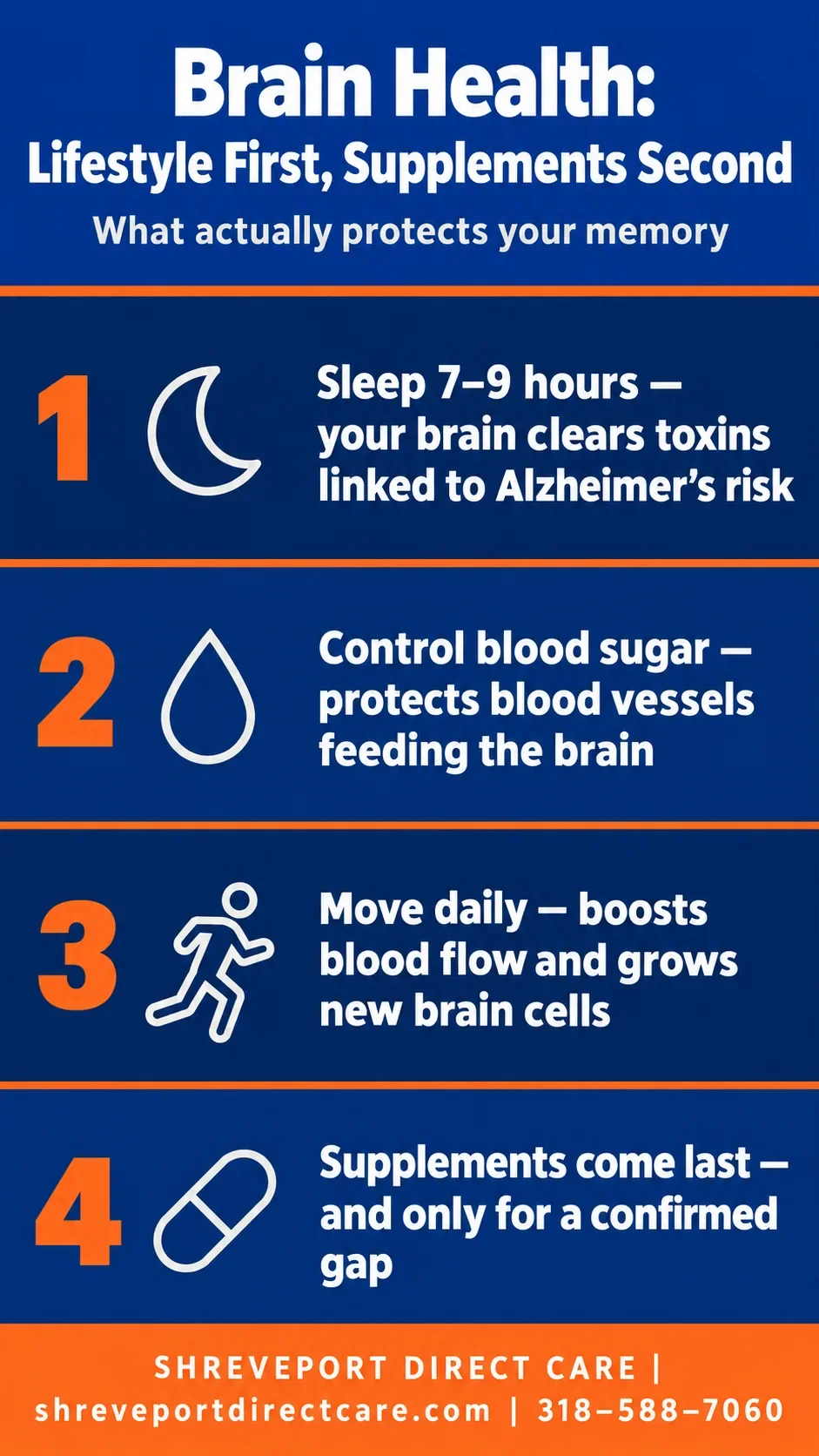
Sleep does more than rest your body. During deep sleep, your brain runs a cleanup process that clears out waste proteins linked to Alzheimer’s risk. In an NIH-funded study, researchers found that losing just one night of sleep caused an immediate increase in beta-amyloid, one of the proteins implicated in Alzheimer’s disease.[1] Consistent, sufficient sleep isn’t a nice-to-have. It’s when your brain does some of its most important maintenance work.
Blood sugar control matters more than most people realize. Mayo Clinic researchers have described a clear link between type 2 diabetes and the brain changes seen in both Alzheimer’s disease and vascular dementia, driven in part by reduced blood flow and impaired insulin signaling in the brain.[2] Managing blood sugar through diet, movement, and, when needed, medication is a direct way to protect brain tissue.
Regular movement increases blood flow to the brain and supports the growth of new neural connections. A Harvard Health review found that cardio exercise strengthens blood flow throughout the body, including to the brain, helping clear toxins and support neurogenesis, the growth of new brain cells.[3] It’s one of the only interventions with this much direct evidence behind it.
For a full breakdown of the research-backed habits that protect memory, from diet to cognitive training to social connection, we’ve put together 8 evidence-based ways to protect your memory. And if you want to understand the broader picture of modifiable dementia risk, our guide on whether dementia is preventable walks through what the Lancet Commission’s research actually recommends.
Where Supplements Actually Fit In
None of this means supplements are pointless. It means they work best as a targeted top-off, not a substitute. A daily multivitamin has real, if modest, evidence behind it for older adults. Correcting a genuine vitamin D or B12 deficiency helps, but only if you’re actually deficient. The honest, evidence-based approach is to get your foundation right first, then ask your doctor which specific gaps, if any, are worth filling with a supplement.
Before your next purchase, ask yourself one question: what would this supplement be replacing? If the honest answer is sleep, movement, or a real meal, save your money. If it’s filling a gap your doctor has actually identified, that’s a different story.
What This Looks Like at Shreveport Direct Care
For patients in Shreveport, Bossier City, and across Northwest Louisiana, sorting through supplement marketing shouldn’t fall entirely on you. As a direct primary care practice, we have the time to talk through what’s actually worth trying, order the labs that tell us what’s really going on, and build a plan around your real risk factors rather than whatever’s trending. Dr. Bass draws on his background in preventive care to help patients focus on what genuinely protects memory over time, not just what’s easiest to sell.
If you’re noticing memory changes and aren’t sure whether they’re worth a closer look, memory loss after 50 covers when it’s time to get evaluated. And if you want a partner in sorting fact from marketing, our membership model gives you the time for that conversation, not just a rushed once-a-year checkup.
Schedule a free meet-and-greet with Dr. Bass, no commitment, no pressure. Just a conversation about your health and how we can help.
Schedule your free visit at Shreveport Direct Care →
Phone/Text: 318–588–7060
Email: info@shreveportdirectcare.com
FAQs
Do I need an expensive supplement to protect my memory?
No. Effectiveness has little to do with price. Some of the best-supported options, like a standard daily multivitamin, are inexpensive. Sleep, blood sugar control, and regular movement do more for memory than any premium-priced brain supplement.
Is it enough to just take a brain supplement and change nothing else?
No. Supplements work best as a targeted addition on top of good sleep, blood sugar control, and regular exercise, not as a replacement for them. Even well-supported supplements show modest benefits, mainly when they’re correcting a real gap.
What actually helps memory more than supplements?
Consistent, quality sleep, steady blood sugar control, and regular aerobic movement all have stronger, more direct evidence behind them than most brain supplements sold today.
Are any brain supplements actually worth taking?
Some are, for the right person. A daily multivitamin has modest but real evidence in older adults, and correcting an actual vitamin D or B12 deficiency helps. The key is confirming a real gap exists before spending money to fill it.
How much sleep do I need to protect my brain?
Most adults need seven to nine hours of quality sleep. Even a single night of sleep loss has been shown to increase levels of a protein linked to Alzheimer’s risk.
Can a primary care doctor in Shreveport help me figure out which supplements I actually need?
Yes. A primary care visit with time built in can review your labs, identify any real nutritional gaps, and help you separate what’s evidence-based from what’s just well-marketed. At Shreveport Direct Care, we build that plan around your actual risk factors.
References
National Institutes of Health. Sleep deprivation increases Alzheimer’s protein. NIH Research Matters. (Source for one night of sleep loss increasing beta-amyloid levels.)
Mayo Clinic News Network. Mayo Clinic Minute: Is Alzheimer’s Type 3 diabetes? (Source for the link between type 2 diabetes, insulin signaling, and Alzheimer’s-related brain changes.)
Harvard Health Publishing. Working out your brain.Harvard Medical School. (Source for exercise improving cerebral blood flow and supporting neurogenesis.)
Shreveport Direct Care is a direct primary care practice serving adults and children