
Why Transparency Builds Trust in Health Care
You can have health insurance and still not be able to afford to see a doctor. That is not a complaint from a frustrated patient. It is what billionaire entrepreneur Mark Cuban told the DPC Alliance in a recent interview, and it points to a bigger problem: most people do not trust the economics of health care, even when they trust their own doctor. Direct primary care in Shreveport and Bossier City was built to fix exactly that gap.
Trust Is a Formula, Not a Feeling
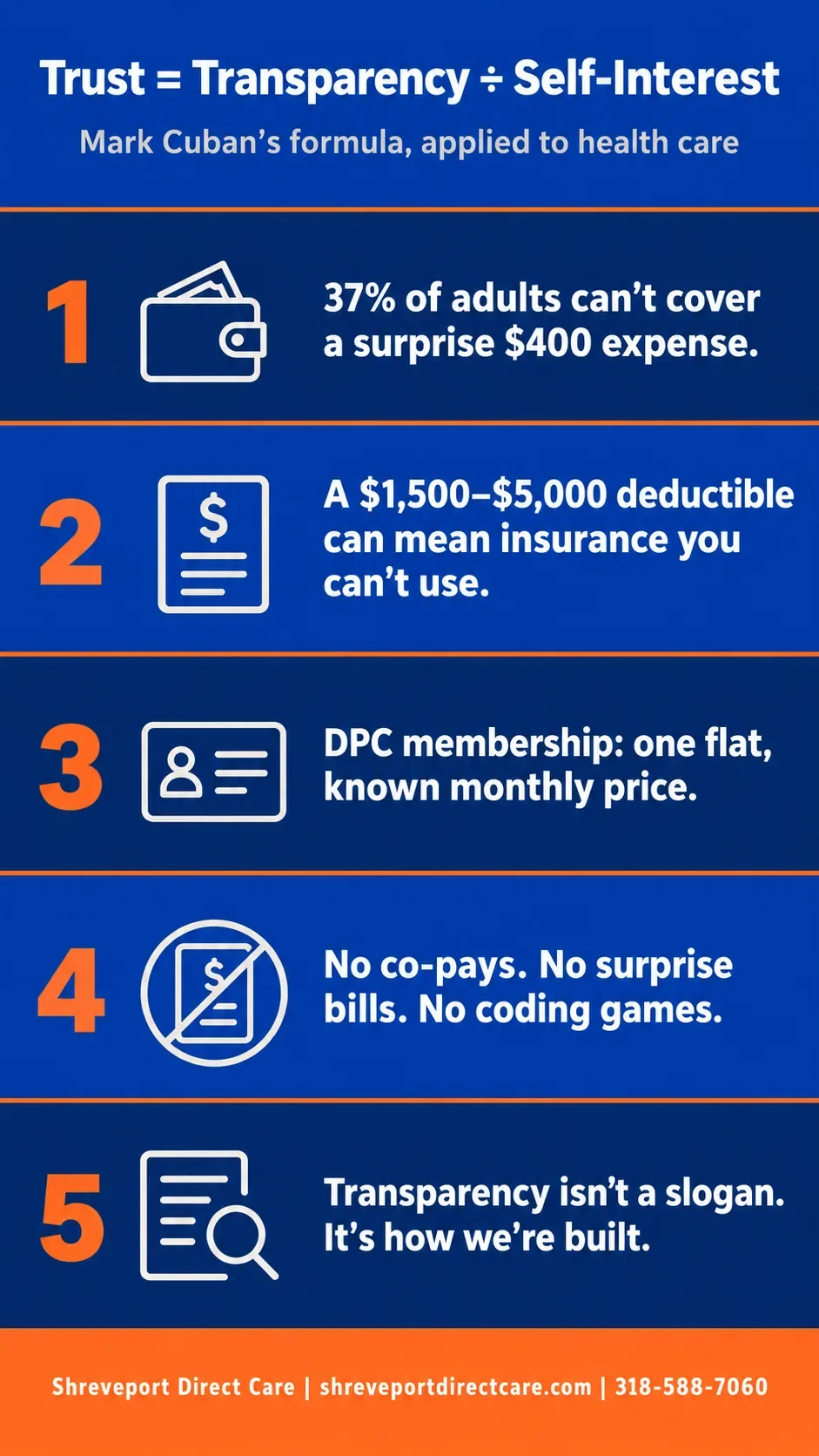
Cuban shared something he heard from a doctor on a podcast that stuck with him: trust equals transparency divided by self-interest. The more open a business is about how it works, and the less it is driven by squeezing extra profit out of you, the more you trust it.
“People trust their doctors,” Cuban said, “but they don’t trust the economics at all.”[1]
That single sentence describes a strange reality in American health care. Patients like their doctor. They believe their doctor wants to help them get better. What they do not believe is that the bill they get afterward reflects anything close to a fair price. Insurance networks, hospital charge masters, and pharmacy benefit managers keep real prices hidden until after the care has already happened, so trust in the system erodes even while trust in the individual doctor holds steady.
Direct primary care flips that formula. When Cuban talked about what makes DPC different, he did not hedge. “For DPC,” he said, “you guys are built on transparency. Patients want to know that it’s $150 a month or $250 a month for their subscription, and that you’re going to get time and you’re going to have access and you’re going to have availability.”[1]
That is not a sales pitch. It is a description of how our membership model actually works. You know your monthly cost before you ever walk in the door. There is no surprise bill three weeks later.
The Big Lie of Health Insurance
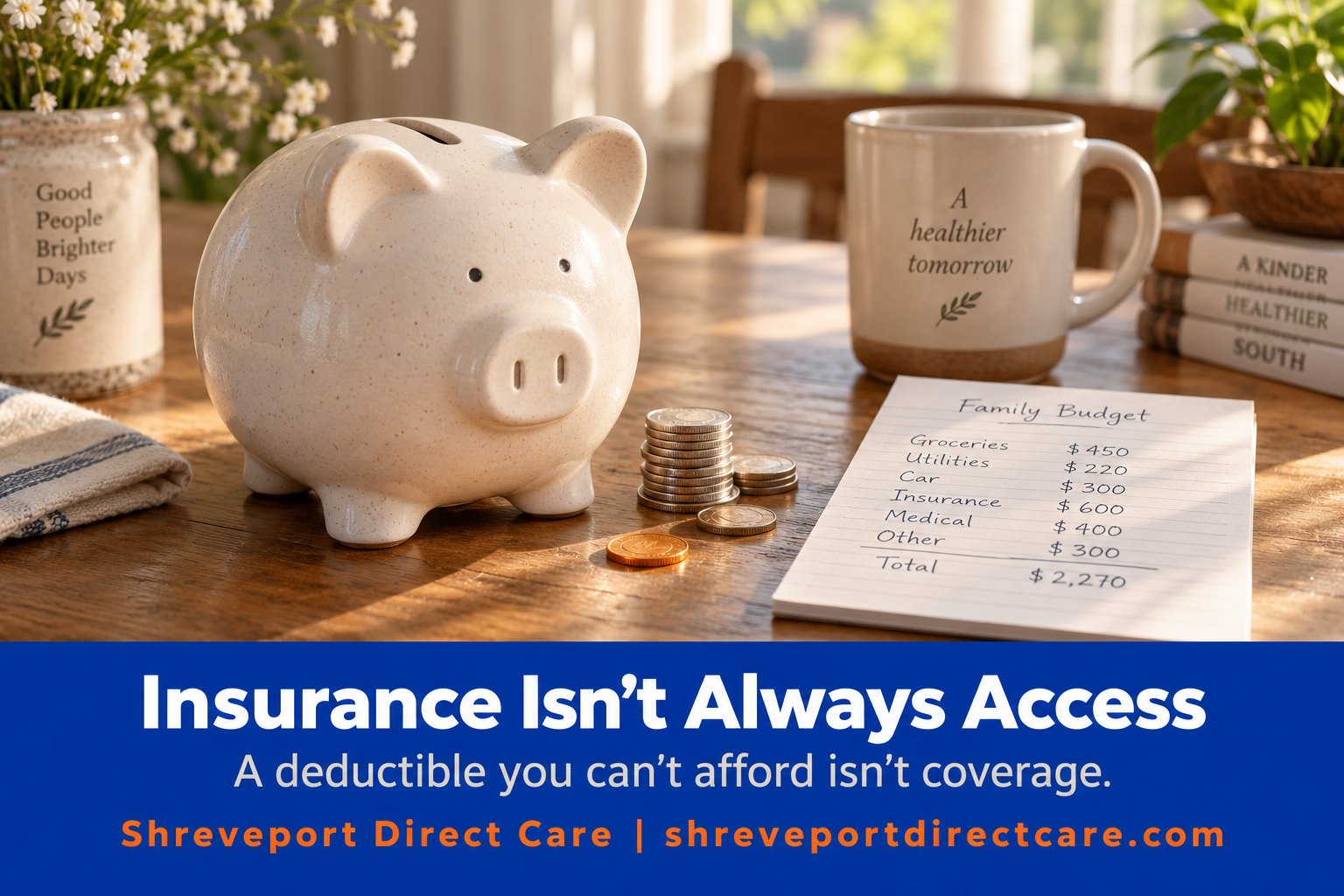
Cuban did not soften his language when talking about traditional insurance. He called out what he considers “the big lie of health care right now,” and it is one every family in Northwest Louisiana has felt at some point: “You can have insurance, but if you can’t afford your deductible, you don’t have insurance.”[1]
He is right that this is a widespread problem. A silver-tier Affordable Care Act plan often carries a family deductible around $5,000, and even a solid employer plan can run $1,500 or more before coverage kicks in.[2] Cuban put it plainly: “If you’re making 40 or 50 grand a year and you have kids and your take-home is far lower, $1,500, you probably don’t have $400 in the bank.”[1]
That is not an exaggeration. Nationally, 37% of adults say they could not cover a surprise $400 expense with cash on hand.[3] For families living paycheck to paycheck, a high deductible is not a safety net. It is a wall standing between them and the care they need. That reality is exactly why more than 4 in 10 U.S. adults now carry some form of medical or dental debt.[4]
Picture a Shreveport family of four on a typical employer plan. Their premium comes out of every paycheck automatically, so it barely registers. Then their child needs stitches after a bicycle accident, and the bill lands in their mailbox three weeks later: $1,100, none of it covered yet, because they have not hit their deductible for the year. On paper, they have insurance. In their bank account, that visit cost the same as if they had none. That is the gap Cuban is describing, and it is exactly the gap a flat monthly membership is built to close, because there is no deductible standing between a Shreveport Direct Care patient and a doctor’s visit.
Why Cuban Wants to Put the Money Back in Your Hands
Later in the interview, Cuban described an idea he is actively developing: separating health savings accounts from high-deductible insurance plans entirely, so people can put money aside in an account they control, use it however they need for care, and keep whatever they do not spend. His reasoning connects directly back to trust and transparency. “The biggest loan people have outstanding isn’t their house, isn’t their car,” he said, “it’s their insurance premiums. You can pay off your house. You can pay off your car. But till the day you die, even when you’re on Medicare, you are paying insurance premiums.”[1]
His proposed fix is simple in concept: let people deposit that same money into an account that is actually theirs, rather than handing it to an insurance company that may or may not pay out fairly when they need it. Whether or not that specific idea ever becomes policy, the instinct behind it is the same one direct primary care already delivers today. When you know exactly where your money is going and exactly what you get for it, you trust the arrangement. When you don’t, you don’t.
What Transparent Pricing Actually Looks Like
At Shreveport Direct Care, a membership starts at $109 a month and includes unlimited visits, no co-pays, and access to more than 1,000 generic medications at no extra cost. There is no separate deductible to hit before your visit counts. There is no coding game determining whether your appointment gets billed as a “problem visit” instead of a “wellness visit.” You pay one flat, known amount, and in exchange you get real access: same-day appointments, hour-long visits instead of the rushed 15-minute norm, and the ability to text or email Dr. Bass directly.
This is the same principle Cuban built Cost Plus Drugs around: show people the real cost, mark it up fairly, and never change the price depending on who is asking or how desperate they are. He extended that same philosophy to primary care contracts through Cost Plus Wellness, encouraging hospitals and physician groups to publish transparent, direct-pay pricing instead of the opaque, insurance-negotiated rates most patients never see. You can read more about how that transparency translates into real savings for employers in Direct Primary Care vs. Traditional Healthcare.
Why This Matters More for Medicare Patients and Families
Trust in pricing is not just a young family’s problem. Patients on Medicare often juggle multiple specialists, prescriptions, and copays, and the uncertainty compounds with every added condition. A direct primary care membership does not replace Medicare, but it removes the guesswork from your primary care relationship. You know exactly what your membership includes, and how concierge medicine works alongside your existing insurance, before you ever need it.
For busy parents in Shreveport and Bossier City, transparency means something slightly different: knowing that a sick visit for your child will not trigger a surprise bill weeks later, and that asking a quick question by text will not cost you an office visit fee. It removes the hesitation that keeps families from calling the doctor until a small problem becomes a big one.
Think about how many small health questions a family has in an average month. Is this rash something to worry about? Does my child need antibiotics, or will this cold run its course? Should I bring my dad in for his blood pressure, or can it wait until his next appointment? Under a traditional insurance model, each of those questions can carry a hidden cost, so families often wait, guess, or turn to a search engine instead of their own doctor. When the price of asking is transparent and included in your membership, you ask sooner. Problems get caught earlier, and earlier care is almost always simpler, safer, and less expensive than care that has been delayed.
Run the Trust Test on Your Own Care
Cuban’s formula gives you a simple way to size up any health care option you are considering, whether it is a primary care practice, a specialist, or a pharmacy. Ask two questions. First, can they tell you the price before you receive the care, not an estimate buried in fine print, but an actual number? Second, does their answer change depending on how badly you need the care, or is the price the same for everyone?
A traditional insurance-based practice usually cannot answer the first question honestly, because the final price depends on your specific plan, your deductible status, and how the claim gets coded after the fact. A direct primary care membership answers both questions before you ever schedule a visit. You know the monthly cost. It does not change based on how sick you are that month or how many questions you ask.
This is also why more patients now research their care the way they research anything else. Cuban pointed out that patients increasingly turn to tools like ChatGPT to understand their options before ever calling a doctor’s office, something that would have been unthinkable a few years ago. That shift only works in a patient’s favor when the underlying pricing is actually transparent enough to research in the first place. Insurance-negotiated rates are not published anywhere a patient can find them. A $109-a-month membership is.
The Bottom Line
Mark Cuban is not a doctor, and he has no financial stake in direct primary care. He is simply a businessman who looked at how health care pricing works and concluded that hiding the cost from patients erodes trust, while showing it builds trust. Direct primary care in Shreveport was built on that same idea long before Cuban started talking about it publicly.
Schedule a free meet-and-greet with Dr. Bass. No commitment, no pressure. Just a conversation about your health, and a clear, upfront answer about what it costs.
Schedule your free visit at Shreveport Direct Care →
Prefer to talk first? Call or text us at 318–588–7060, or email info@shreveportdirectcare.com.
Frequently Asked Questions
Why don’t patients trust health insurance pricing?
Most insurance pricing is negotiated behind closed doors between insurers, hospitals, and pharmacy benefit managers. Patients rarely know the real cost of a service until after it happens, which makes it hard to trust that the price was fair.
What did Mark Cuban mean by “trust equals transparency divided by self-interest”?
It is a way of saying that the more open a business is about its pricing and motives, and the less it is driven purely by profit, the more people will trust it. Cuban applies this to both Cost Plus Drugs and direct primary care.
How does Shreveport Direct Care’s pricing work?
Membership starts at $109 a month and includes unlimited visits, no co-pays, and more than 1,000 generic medications at no extra cost. There are no hidden fees or surprise bills for routine primary care.
Do I still need insurance if I have a DPC membership?
Yes, most patients pair a DPC membership with a lower-cost, high-deductible or catastrophic plan to cover hospitalization, surgery, and emergencies outside primary care.
Is direct primary care available for Medicare patients?
Yes. Direct primary care can work alongside Medicare. Our team can walk you through exactly how membership fees interact with Medicare coverage during your free meet-and-greet.
How is direct primary care different from concierge medicine?
Both involve a membership fee paid directly to your doctor, but traditional concierge medicine often costs several thousand dollars a year. Direct primary care, including Shreveport Direct Care, is designed to be far more affordable while still offering same-day access and longer visits.
References
Cuban, Mark. Interview with the DPC Alliance. YouTube. 2026. (Source of all direct quotes attributed to Mark Cuban.)
2025 Employer Health Benefits Survey. KFF. 2025. (Supports figures on typical employer plan deductibles.)
Economic Well-Being of U.S. Households in 2025. Federal Reserve Board. 2026. (Supports the finding that 37% of adults could not cover a $400 emergency expense with cash.)
Americans’ Challenges With Health Care Costs. KFF. 2025. (Supports the finding that roughly 41% of U.S. adults carry medical or dental debt.)
Shreveport Direct Care is a direct primary care practice serving adults and children