
Mark Cuban is not a doctor. He is a billionaire entrepreneur, the former owner of the Dallas Mavericks, and the co-founder of Cost Plus Drugs, a company that sells prescription medication at a transparent, low markup. Lately, he has been using his platform to talk about something Shreveport Direct Care has believed in since day one: direct primary care (DPC) is a better way to get medical care.
In a recent interview with the DPC Alliance, Cuban laid out, in plain and often blunt language, why the current health insurance system is broken and why doctors who work directly for their patients, not for insurance companies, are the ones getting it right. His comments touch on trust, employer costs, and where primary care is headed next. We are breaking his interview into a short series so Shreveport, Bossier City, and Ark-La-Tex families and business owners can see exactly what he said and what it means for them.
Who Is Mark Cuban, and Why Is He Talking About Your Doctor?
Cuban made his fortune in technology and became a household name through Shark Tank and his ownership of the Dallas Mavericks. In 2022, he co-founded Cost Plus Drugs, a pharmacy that sells generic and brand medications at cost plus a flat 15% markup, with no hidden fees. He built the company outside the traditional pharmacy benefit manager (PBM) system on purpose, because he believes that system is designed to take money from patients and doctors rather than protect them.
That same instinct led him to launch Cost Plus Wellness, a free service that helps employers negotiate direct, transparent contracts with hospitals and physician groups, cutting out the guesswork and games that drive up medical bills. Cuban has no financial stake in direct primary care. He is not selling DPC memberships. He is simply an outside observer, and a very successful businessman, who looked at the numbers and concluded that DPC works.
"You know, the system's upside down," Cuban said. "I'm a big believer that doctors are underpaid. I like my doctors taking off Wednesdays to go golf like they used to. I want you being able to spend as much time with your patients as you possibly can."[1]
That is the heart of the direct primary care model. When your doctor is not squeezed by insurance company rules and volume quotas, they have time for you again.
Cuban did not stop at drug pricing. He has since built a sterile injectable manufacturing plant in Dallas, pushed the FDA to make it easier for domestic companies to manufacture generic tablets in the United States, and personally negotiated with vaccine manufacturers on behalf of independent physicians struggling to afford inventory. None of it makes him money. By his own account, the goal has always been to break even and reinvest, not to build a fortune off patients who are already struggling to pay their bills.
Why an Outsider's Voice Matters
Part of what makes Cuban's comments land differently than the usual health policy debate is that he has nothing to sell you. He is not a hospital executive defending a business model, and he is not a politician chasing a talking point. He is a businessman who ran the numbers on his own company's health spending, did not like what he found, and started asking why.
That outsider position is exactly what the "trust equals transparency divided by self-interest" formula predicts. A voice with less self-interest in the outcome is easier to trust, whether that voice belongs to a billionaire entrepreneur or your own family doctor.
The Scale of the Problem He's Describing
Cuban's frustration is not abstract. Nationally, average annual premiums for employer-sponsored family health coverage reached nearly $27,000 in 2025, with workers themselves contributing close to $6,850 of that.[2] Deductibles on top of those premiums routinely run $1,500 to $5,000 or more before a plan starts paying for care.[2] Roughly 4 in 10 U.S. adults now carry some form of medical or dental debt, and half of them say cost has kept them from getting a test or treatment their doctor recommended.[3]
Those numbers explain why Cuban keeps returning to the same theme throughout the interview: a system this expensive and this opaque cannot be trusted, no matter how good any individual doctor is. Direct primary care is one of the few models built from the ground up to fix both problems at once, cost and trust, together.
The Big Idea: Trust Is a Formula
One of the most striking things Cuban said in the interview was something he heard from a doctor on a podcast: trust equals transparency divided by self-interest. The more transparent a business is, and the less it is motivated by its own profit, the more people trust it.
"People trust their doctors," Cuban said, "but they don't trust the economics at all."[1]
That distinction matters. Patients generally believe their doctor wants to help them. What they do not trust is the invisible pricing behind insurance, hospital billing, and pharmacy benefit managers, where nobody can tell them what anything actually costs until the bill arrives. Cuban pointed directly at direct primary care as the exception. "For DPC," he said, "you guys are built on transparency. Patients want to know that it's $150 a month or $250 a month for their subscription, and that you're going to get time and you're going to have access and you're going to have availability."[1]
We dig deeper into this idea, including Cuban's blunt take on high-deductible insurance plans, in Why Health Care Transparency Builds Trust: A Lesson From Mark Cuban.
Transparency Builds Trust
What It Costs Employers When Health Care Doesn't Work
Cuban did not stop at patients. He spent a good part of the interview talking to employers, because he thinks most business owners have no idea how much money they are losing on health benefits. He told a story about his own insurance broker of many years, who he trusted completely, until Cuban ran the numbers himself. Comparing generic drug costs the Dallas Mavericks had paid over 18 months against what Cost Plus Drugs would have charged for the same medications, he found the team had paid $169,000 for drugs that should have cost $19,000.
"My guy is not my guy anymore," Cuban said.[1]
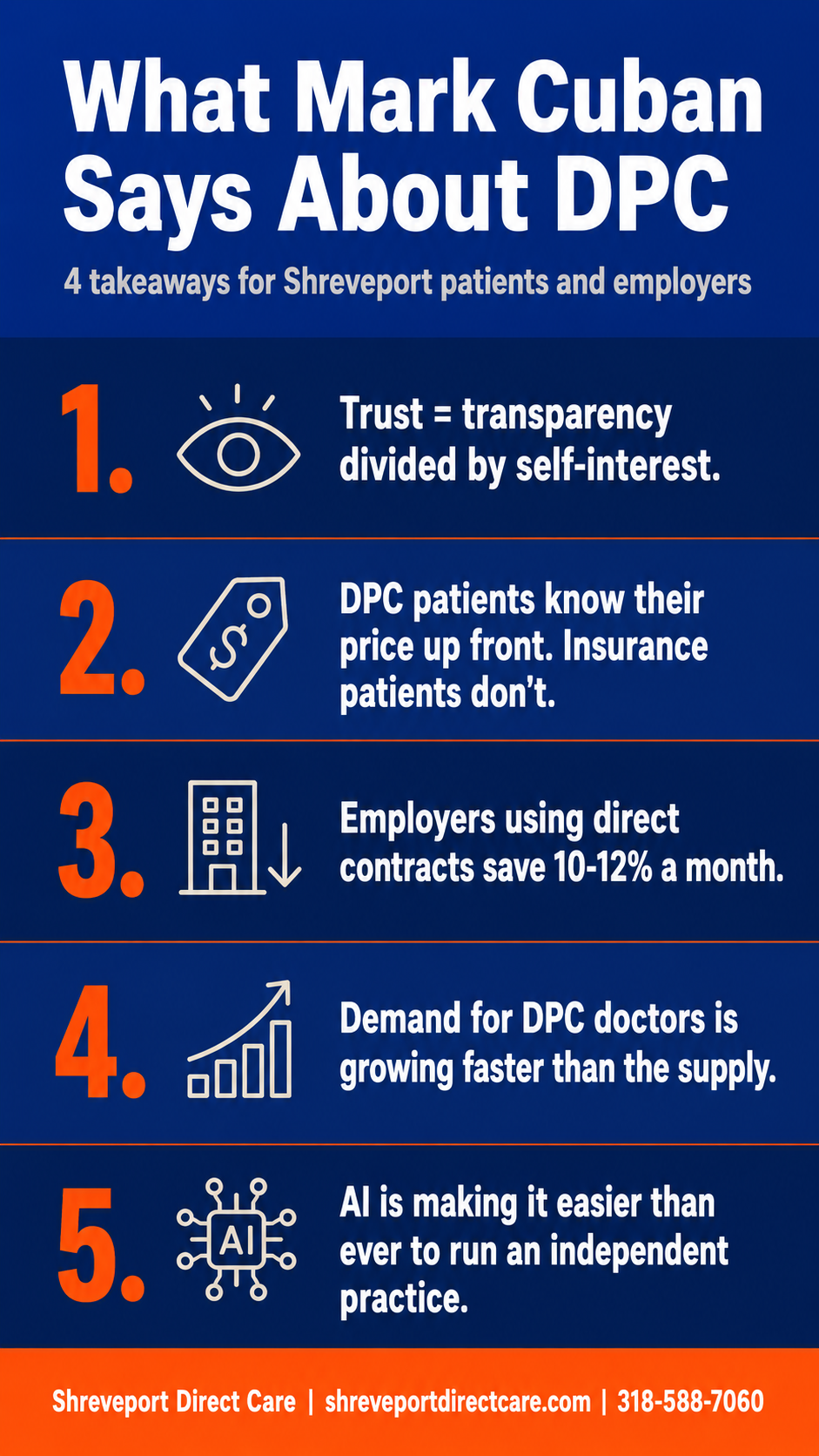
Through Cost Plus Wellness, Cuban now helps employers of all sizes build the kind of direct, cash-pay relationships with primary care and specialty providers that used to only be available to giant self-insured corporations. He says the businesses using it are saving 10 to 12% a month on health costs, often more.
For Shreveport and Ark-La-Tex employers wondering whether direct primary care membership makes financial sense for their team, How Direct Primary Care Saves Shreveport Employers Real Money walks through the math Cuban laid out and what it looks like for a small business.
Primary Care Doctors: The Gatekeepers of What's Next
Toward the end of the interview, Cuban was asked directly what he sees ahead for direct primary care physicians. His answer was optimistic. "You guys truly are the right gatekeepers at the right time," he said, "and it's incredibly affordable."[1]
He went further, predicting that the demand for DPC will outpace the number of doctors available to provide it, because each practice can only care for so many patients well. "Being a direct primary care physician," Cuban said, "this is just the first inning of the first preseason game."[1]
We unpack what that means for patients in Shreveport and Bossier City looking for a doctor who has time for them, now and in the years ahead, in Why Primary Care Doctors Are the Gatekeepers of Health Care's Future.
Why Cuban Says Now Is the Moment
The interviewer asked Cuban directly why he has become so vocal about health care lately, especially given the risk of picking public fights with powerful pharmacy benefit managers and insurance executives. His answer was simple: the people closest to patients, doctors, pharmacists, and families themselves, are not getting fair results at fair prices, and someone with nothing to lose by speaking up needed to say so plainly.
That is also why this series exists. Dr. Bass did not need a billionaire to tell him direct primary care works. He sees it in Shreveport and Bossier City every week, in patients who finally get same-day answers instead of a week-long wait, and in families who stop dreading the mailbox because there is no surprise bill coming. But hearing an outside, financially disinterested voice describe the same problems and the same solution is worth sharing, because it confirms this is not just a sales pitch from inside the industry. It is what an honest look at the numbers actually shows.
What This Means for Northwest Louisiana Families
Shreveport Direct Care is a membership-based direct primary care practice serving Shreveport, Bossier City, and communities across Northwest Louisiana and the Ark-La-Tex. Dr. Pat "Ricky" Bass III, MD, MS, MPH, is board-certified in both Internal Medicine and Pediatrics, a rare combination that lets him care for your whole family under one roof.
We already operate the way Cuban describes: a flat monthly membership, no insurance billing games, no surprise bills, and enough time in every visit to actually get to the bottom of a problem. Cuban is simply putting language and a national spotlight on something our patients have told us for years, that knowing exactly what you are paying for, and getting real time with your doctor, changes how you feel about your own health care.
For a busy parent juggling school physicals, sick visits, and the occasional 2 a.m. worry about a fever, that means being able to text Dr. Bass directly instead of navigating a phone tree. For a Medicare-age patient managing several chronic conditions, it means one doctor who actually has the time to coordinate your care instead of rushing you out the door in 12 minutes. For a small business owner in Shreveport or Bossier City, it means predictable costs and a healthier team without taking on a full insurance department. Cuban's interview simply confirms, from a completely independent perspective, that this approach holds up under scrutiny.
You do not need to take a billionaire's word for it, or ours. Learn how our membership model works, see the services we provide, or read more about Dr. Bass's training and approach.
Mark Cuban on Benefits of DPC For Small Businesses
Frequently Asked Questions
1. Is Mark Cuban a doctor or affiliated with Shreveport Direct Care? No. Mark Cuban is a businessman and entrepreneur, best known for Shark Tank and his ownership of the Dallas Mavericks. He co-founded Cost Plus Drugs and Cost Plus Wellness, companies focused on drug and health care pricing transparency. He has no financial relationship with Shreveport Direct Care. We are simply highlighting his public comments about direct primary care because they line up with how our practice already operates.
2. What is Cost Plus Drugs? Cost Plus Drugs is an online pharmacy Cuban co-founded in 2022 that sells medications at their actual cost plus a flat 15% markup, with full price transparency. It has helped many patients, especially those with high deductibles or no insurance, pay far less for prescriptions than they would through a traditional pharmacy.
3. What is Cost Plus Wellness? Cost Plus Wellness is a free service that helps employers negotiate direct, transparent contracts with hospitals and physician groups instead of going through traditional insurance networks. Cuban says participating employers typically save 10 to 12% a month on health costs.
4. Is direct primary care the same as concierge medicine? They are related but not identical. Both models involve a monthly or annual membership fee paid directly to the doctor. Direct primary care memberships, like the one Shreveport Direct Care offers, tend to be far more affordable, often a few hundred dollars a month, while traditional concierge medicine can run several thousand dollars a year.
5. Do I still need health insurance if I join a DPC practice? Most patients pair a direct primary care membership with a low-cost, high-deductible or catastrophic insurance plan to cover hospitalization, surgery, and emergencies. Your DPC membership covers your everyday primary care, so you are not paying insurance prices for routine visits.
6. How do I get started with Shreveport Direct Care? Schedule a free meet-and-greet with Dr. Bass. There is no commitment and no pressure, just a conversation about your health and whether our membership is a good fit for you and your family.
References
Cuban, Mark. Interview with the DPC Alliance. YouTube. 2026.
2025 Employer Health Benefits Survey. KFF. 2025.
Americans' Challenges With Health Care Costs. KFF. 2025.
Shreveport Direct Care is a direct primary care practice serving adults and children in Shreveport, Bossier City, and surrounding communities in Northwest Louisiana. Dr. Pat "Ricky" Bass III is board-certified in Internal Medicine and Pediatrics.