
How DPC Saves Shreveport Employers Real Money
Mark Cuban has run companies his entire adult life, and for years he trusted his insurance broker completely, the same way most Shreveport business owners trust theirs. Then he did the math himself. What he found should make every small business owner in Northwest Louisiana take a second look at what they are paying for employee health benefits, and what direct primary care could save them instead.
The Story That Changed Cuban’s Mind
In his interview with the DPC Alliance, Cuban described how, for years, his broker would tell him, “Mark, everybody else is paying an 8% increase. I got you for 6%.” He never questioned it. Running his companies was his focus, not auditing health benefits line by line.
That changed after he co-founded Cost Plus Drugs. He ran a simple comparison: the generic medications the Dallas Mavericks had purchased over 18 months through their normal insurance channel, versus what those same drugs would have cost through Cost Plus Drugs.
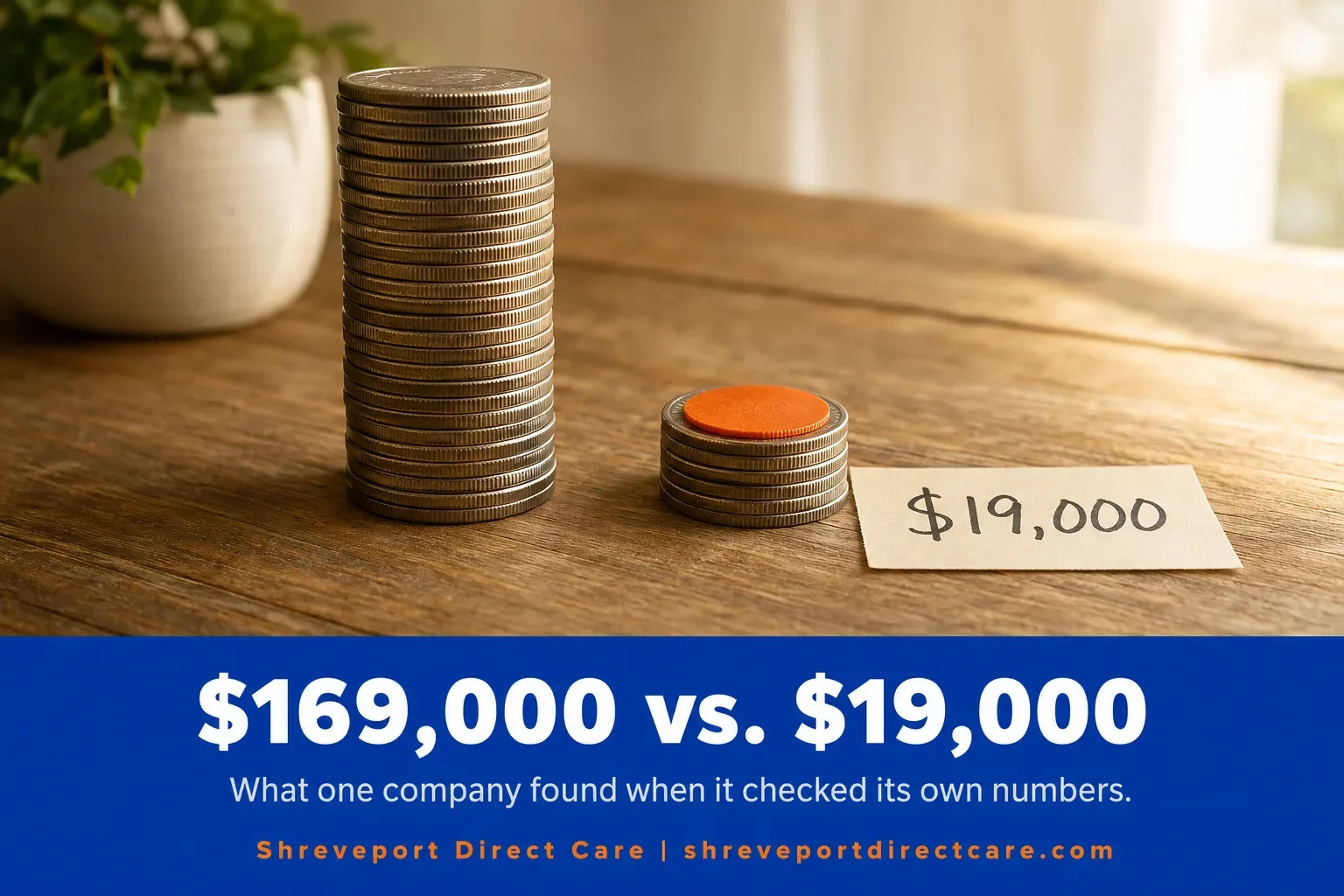
“It was $169,000 that the Mavs paid,” Cuban said, “and it would have been $19,000 with Cost Plus. My guy is not my guy anymore.”[1]
That is not a rounding error. That is a business paying nearly nine times more than it needed to, for years, without anyone catching it. Cuban’s point was not that his broker was dishonest. It was that most business owners simply do not have the time or expertise to catch these gaps, and the system is not built to make it easy to find them.
Why Employers Don’t See It Coming
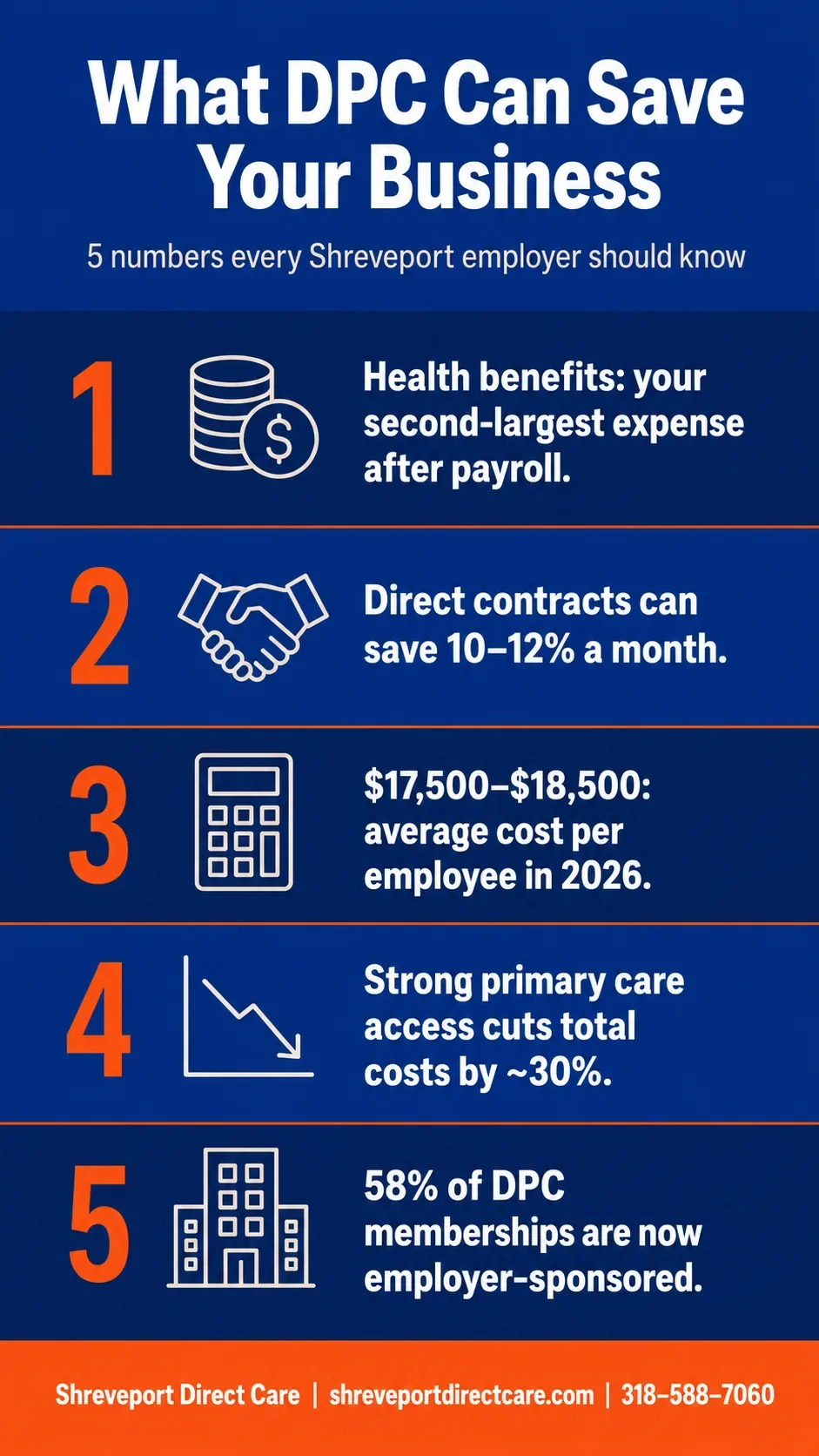
“Most CEOs for any size company,” Cuban said, “they’re just trying to run their business and do as best they can. It’s hard to learn this stuff, to make one of your core competencies your benefits, but you almost don’t have a choice anymore because after payroll, it’s your second largest expense.”[1]
He put it even more bluntly when asked whether employers understand what is happening with their health benefits. “The employers don’t get it,” he said. “Not at all.”[1]
That gap is exactly why direct primary care has become one of the fastest-growing employer benefit strategies in the country. Employer-sponsored DPC memberships now make up 58% of all DPC enrollment nationally, an 18% jump since 2022, as more businesses look for a way to control costs without cutting coverage.[2] Small businesses using DPC report meaningfully fewer emergency room visits and hospital admissions compared to traditional plans, which is where the real savings show up on a company’s bottom line.[3]
What Cuban’s Own Numbers Show
Through Cost Plus Wellness, the free employer service Cuban’s company runs, businesses negotiate direct, transparent contracts with hospitals and physician groups instead of going through standard insurance networks. Cuban described the results for the companies using it, including his own.
“We’re saving 10, 12% in any given month,” he said. “And our members love it, because in order to take part in all that, you have to do a DPC, the DPC program we have, and you have to see them before you’re eligible. And when you use our cost plus wellness providers, there’s no out of pocket for you at all. That’s how much money we save.”[1]
That last point is worth sitting with. Not a lower copay. No out-of-pocket cost at all, because the primary care relationship at the center of the plan is doing enough of the work upfront that expensive downstream care becomes far less common. This mirrors what a national 2024 study of more than 200,000 people found: patients with strong primary care access had roughly 30% lower total health costs annually, driven by fewer ER visits and far fewer hospital admissions.[4]
For a closer look at how this plays out for a Shreveport-area business specifically, see Significant Cost Savings — Why DPC Makes Financial Sense for Small Businesses.
How Much Money Can Business Save?
What This Could Look Like for a 20-Person Shreveport Business
Numbers are easier to trust when they are concrete. Take a hypothetical 20-employee company in Shreveport paying a typical group premium of roughly $700 per employee per month, or about $168,000 a year. Pairing a direct primary care membership with a leaner, high-deductible group plan often runs meaningfully less per employee per month, while covering the visits that matter most, routine checkups, sick visits, chronic condition management, and same-day access, without deductibles or copays standing in the way.
The savings do not come from cutting care. They come from cutting waste: fewer unnecessary ER visits because employees can reach a real doctor the same day, fewer specialist referrals for problems primary care can handle directly, and none of the administrative overhead of chasing down claims, prior authorizations, or late payments that Cuban describes eating into every traditional plan.
A Care Navigator for Everything DPC Can’t Handle
Cuban also floated a practical idea for employers in cities with a growing number of direct primary care practices: pairing DPC with a care navigator or third-party administrator whose only job is helping employees find high-quality, fairly priced care once something exceeds what primary care alone can manage. “It’s like, hey, I can’t do this surgery,” he explained, describing how a practice might respond, “but we’ve got this care navigator that’ll help you schedule where they think is a high quality, best price, and it’s free because you work with us and we pay them.”[1]
The logic is simple. A DPC doctor already handles the large majority of what comes up for most patients, Cuban put that figure at 70 to 90% of the time. For the smaller share of cases that need a specialist, an outpatient surgery center, or a hospital stay, having someone who already knows cash-pay pricing and quality data can save an employer real money on exactly the claims that tend to be the most expensive. Shreveport Direct Care can help point employees toward the right next step when care goes beyond primary care, using the same transparency-first approach Cuban describes.
The Second Largest Line Item on Your Budget
For most small businesses in Shreveport and Bossier City, health benefits are the second biggest expense after payroll. The average employer now pays roughly $17,500 to $18,500 per employee per year in total health benefit costs, and that number keeps climbing faster than inflation.[5] For a business with 10, 20, or 50 employees, even a modest percentage in avoidable waste adds up to real money that could go toward wages, growth, or simply staying competitive.
Cuban’s advice to business owners was direct: “Every company needs to go in that direction,” treating health benefits like a core competency instead of an afterthought handled entirely by a broker. He described how his own companies now have someone internally, alongside a third-party administrator, whose job is negotiating cash prices and avoiding prior authorizations wherever possible.
Most Shreveport small businesses do not need to build that infrastructure themselves. A direct primary care membership does much of that work automatically, because your employees have a doctor who knows them, has time for them, and is not incentivized to order unnecessary tests or referrals. You can compare how this stacks up against a traditional group plan in Direct Primary Care vs. Traditional Healthcare.
How Shreveport Direct Care Works for Local Employers
Shreveport Direct Care offers employer membership options for small businesses across Northwest Louisiana and the Ark-La-Tex, pairing a flat monthly rate per employee with unlimited visits, same-day access, and more than 1,000 generic medications included at no extra cost. Employees get a doctor who actually has time to know them. Employers get predictable costs and, over time, fewer sick days and lower claims tied to conditions that go untreated too long.
Dr. Pat “Ricky” Bass III, MD, MS, MPH, is board-certified in both Internal Medicine and Pediatrics, which means one membership can cover employees and their families, from kids to grandparents.
Why Cuban Thinks Benefits Shouldn’t Be Tied to Your Job
Cuban raised a bigger question during the interview: should health care be tied to your employer at all? He pointed out that large insurance companies now function less like risk-bearing insurers and more like banks, with a large share of their revenue coming from government programs like Medicare Advantage rather than true insurance risk. His conclusion was that employers end up absorbing costs and complexity that were never really about protecting employees’ health in the first place.
For a small business owner in Shreveport, that observation matters less as policy commentary and more as a practical nudge: the traditional group insurance model was not built with a 10-person or 20-person company in mind. It was built for large corporations that could spread risk across thousands of employees. Direct primary care, paired with a lean catastrophic plan, is one of the few benefit structures actually designed to work at small business scale, which is part of why adoption among small employers has grown so quickly.
The Bottom Line for Business Owners
Cuban is not selling direct primary care, and he has no financial reason to talk it up. He simply ran the numbers on his own company’s health benefits and did not like what he found. Every small business owner in Shreveport and Bossier City has the same opportunity to check their own numbers before assuming the status quo is the best they can do.
Ready to see what direct primary care could save your business? Schedule a free consultation with Dr. Bass to talk through employer membership options.
Prefer to talk first? Call or text us at 318–588–7060, or email info@shreveportdirectcare.com.
Frequently Asked Questions
How much can a small business save by offering direct primary care?
Savings vary by business, but employers using direct, transparent primary care contracts report savings in the range of 10 to 12% a month on health costs, largely from fewer ER visits and hospital admissions.
Is direct primary care a replacement for group health insurance?
Not usually. Most employers pair a direct primary care membership with a lower-cost, high-deductible group plan or stipend for catastrophic coverage, using DPC to handle everyday primary care more efficiently.
How does an employer set up a DPC membership for employees?
Shreveport Direct Care works directly with local employers to set up group membership pricing. Schedule a consultation to discuss the number of employees, family coverage options, and monthly cost per employee.
Why do small businesses see fewer emergency room visits with DPC?
When employees have a primary care doctor who is easy to reach and has time for real visits, small problems get caught and treated early, before they turn into emergencies or hospital stays.
Is direct primary care tax-deductible for a business?
In many cases, yes, similar to other employee health benefits. Talk with your accountant or benefits advisor about how a DPC membership fits into your specific tax situation.
Does Shreveport Direct Care work with businesses outside Shreveport?
Yes. We serve employers across Northwest Louisiana and the Ark-La-Tex, including Bossier City, and offer telehealth options for employees who travel or work remotely.
References
Mark Cuban. Interview with the DPC Alliance. YouTube. 2026.
Employer Trends in Direct Primary Care 2025. Hint Health. 2025.
Direct Primary Care: An Alternative Way to Curb Health Care Costs. SHRM. 2025.
New Study by Premise Health Finds Advanced Primary Care Saves Employers and Unions 30% on Total Healthcare Costs for Attributed Members. Premise Health, methodology validated by Milliman. 2024.
US Employers and Workers Will Face Affordability Crunch as Health Insurance Cost Is Expected to Exceed $18,500 per Employee in 2026. Mercer. 2025.
Shreveport Direct Care is a direct primary care practice serving adults and children