
Does Ozempic Slow Aging? What a New Study Found
Does Ozempic Slow Aging?
No, Ozempic doesn't reverse aging or make anyone younger, but a new randomized, placebo-controlled trial found that semaglutide, the active ingredient in Ozempic and Wegovy, may slow certain markers of biological aging at the cellular level. The finding is real and clinically interesting, but it comes from a specific patient population, and the researchers who ran the study are the first to say it isn't proof of a broad anti-aging effect yet.
Ozempic and Wegovy have already reshaped how we think about weight loss, blood sugar, and heart disease risk. Now this study is raising a bigger question: could these same drugs slow down aging itself? A trial out of UC San Diego provides the first real clinical evidence pointing in that direction, but the honest answer is more nuanced than the headlines suggest.
What the Study Actually Did
Researchers at UC San Diego analyzed data from a clinical trial of 108 adults with HIV-associated lipohypertrophy, a condition where excess fat accumulates around the abdomen.[1] About half received weekly semaglutide injections; the rest received placebo. Over 32 weeks, the research team tracked several "epigenetic clocks," tools that measure chemical marks on DNA, called methylation patterns, that shift in predictable ways as cells age.[1]
Epigenetic clocks work differently than a birthday. Your chronological age just counts years. An epigenetic clock estimates your biological age, how worn or resilient your cells actually look at a molecular level, based on patterns of DNA methylation that tend to track with inflammation, organ function, and disease risk. Two people who are both 50 years old on paper can have meaningfully different biological ages depending on genetics, lifestyle, and chronic disease burden. Rather than just watching the number on the scale, this study let researchers measure something closer to biological age at the cellular level.
What They Found
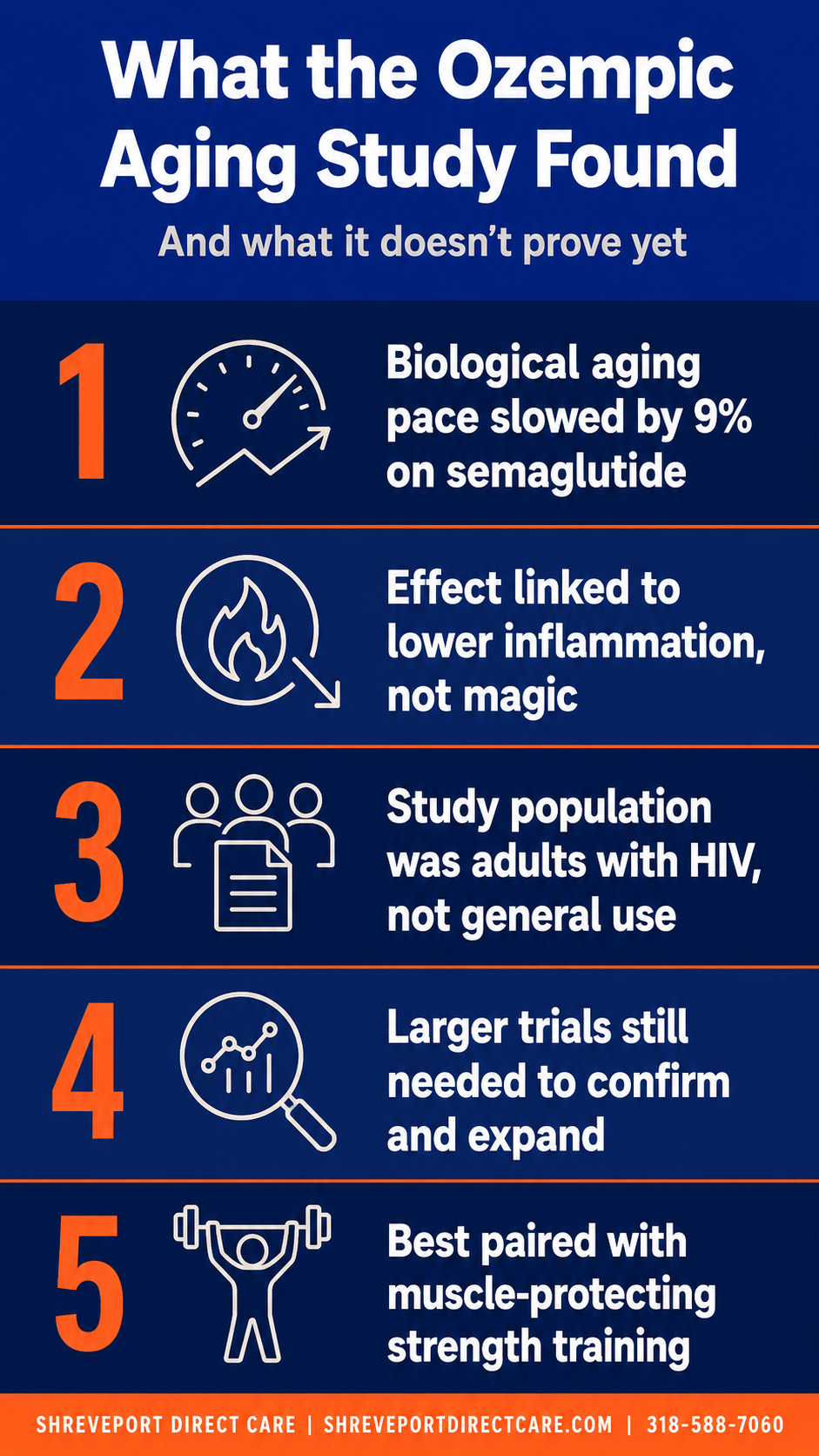
Compared to placebo, participants on semaglutide showed a broad pattern of slower biological aging across clocks linked to inflammation, and to blood, brain, heart, kidney, liver, and metabolic health.[1] The pace of biological aging slowed by 9%, as measured by the DunedinPACE clock.[1] Semaglutide also significantly slowed processes linked to the risk of all-cause mortality and age-related disease, as measured by the PCGrimAge clock.[1]
A related pilot study from the same research group, published in npj Aging, found that after 24 weeks of semaglutide, a meaningful share of participants with HIV and fatty liver disease showed a slower pace of biological aging, reduced mortality-associated aging markers, and longer telomeres, the protective caps on the ends of chromosomes that tend to shorten with age.[2] Participants with longer telomeres after treatment also tended to walk faster, a marker of physical function.[2]
Why This Might Be Happening
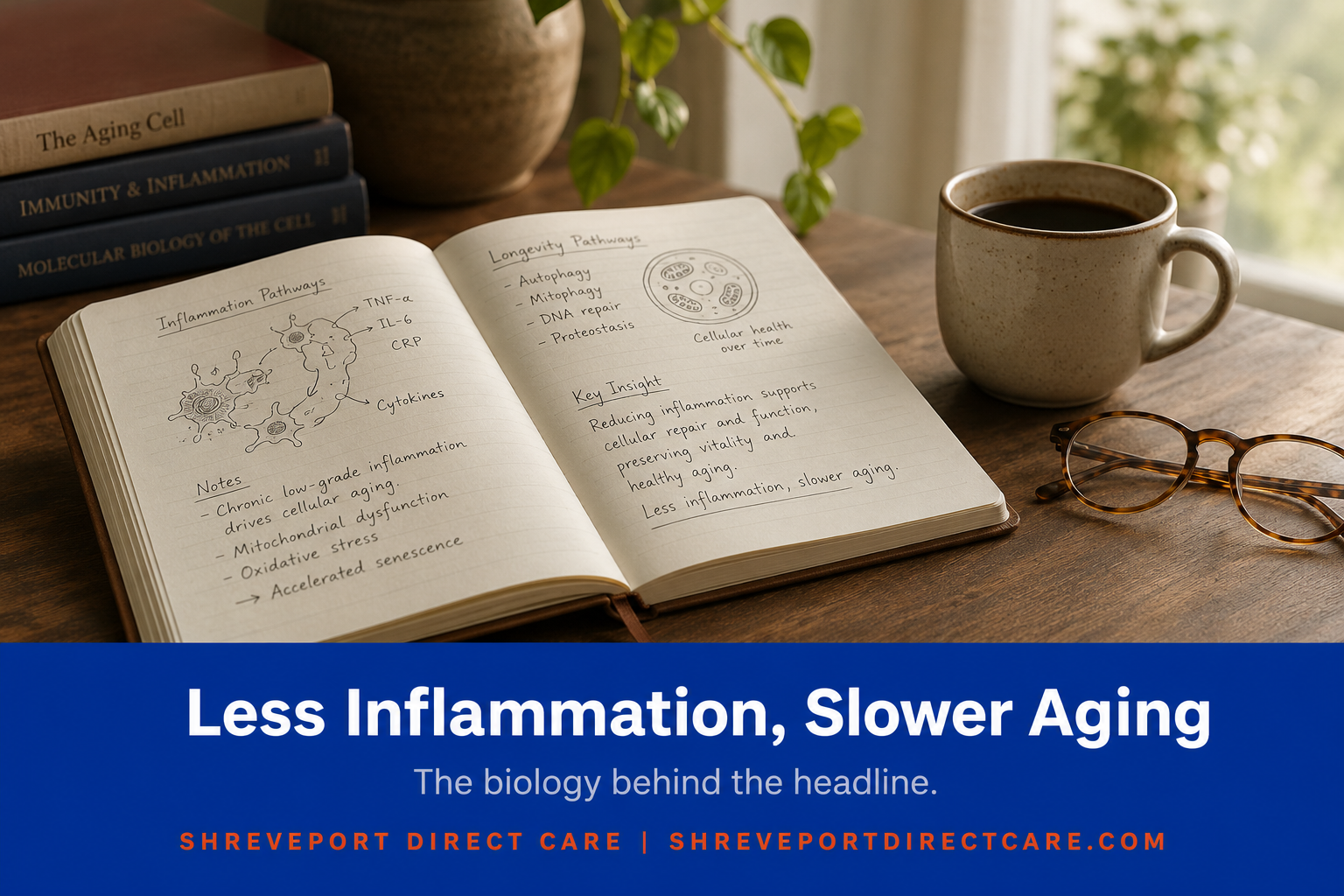
Researchers believe the effect isn't magic. It likely traces back to mechanisms GLP-1 drugs are already known for. By reducing chronic inflammation and metabolic stress, and by shrinking the visceral and organ-associated fat that drives much of that inflammation, semaglutide may be quieting some of the biological signals that accelerate aging.[1] People with HIV often experience accelerated aging even when their infection is well controlled, which is part of why this population was a useful place to first detect the signal.[1]
This lines up with what we already understand about visceral fat, the fat that surrounds internal organs rather than sitting just under the skin. Visceral fat is metabolically active in a bad way. It releases inflammatory signaling molecules that circulate throughout the body, straining the cardiovascular system, disrupting insulin sensitivity, and putting chronic low-grade stress on organs like the liver and kidneys. Anything that meaningfully reduces visceral fat, whether that's a GLP-1 medication, sustained weight loss through other means, or a combination, tends to lower that inflammatory burden. Slower biological aging, in that light, looks less like a separate drug effect and more like a downstream consequence of treating the underlying metabolic problem.
Less Inflammation. Slower Aging.
What This Study Doesn't Prove
This is where the nuance matters, and it's worth being direct about it. This study was conducted in adults with HIV-associated lipohypertrophy, not a general population of people using semaglutide for weight loss. Lead researcher Michael Corley, PhD, was explicit on this point: the findings show semaglutide may slow certain biological aging processes, not that it reverses aging or makes anyone younger.[1] Larger trials in broader populations are needed to confirm the findings, determine how long any effect lasts, and identify optimal dosing.[1]
Still, the underlying biology, reduced inflammation, reduced visceral fat, reduced metabolic stress, isn't unique to people with HIV. It's a reasonable, evidence-informed hypothesis that similar effects could extend more broadly, which is exactly why researchers are pursuing larger studies.
The Practical Takeaway for Patients in Shreveport
If you're already a candidate for GLP-1 therapy because of obesity, prediabetes, or metabolic syndrome, this research adds another data point in favor of treatment, not because it promises a longevity miracle, but because it reinforces that the metabolic and inflammatory improvements these drugs produce may reach deeper than the scale suggests. It's not a reason to start a GLP-1 medication if you don't otherwise have a metabolic indication for one, and it shouldn't be marketed that way.
This is exactly the kind of nuance that matters in a real GLP-1 program. Matching the right patient to the right medication, monitoring the right labs, and pairing treatment with the habits, sleep, strength training, nutrition, that protect the muscle and function most likely to determine how well you actually age. If you're new to this class of medication, our guide to GLP-1 weight loss in Shreveport walks through how semaglutide and tirzepatide work and what to expect from treatment.
Why This Belongs in a Physician-Led Weight Loss Program
At Shreveport Direct Care, we treat GLP-1 therapy as one part of a broader metabolic health plan, not a standalone prescription. That means real lab monitoring over time, not a one-time weigh-in, and it means pairing medication with the resistance training and protein intake that protect lean muscle mass while the metabolic benefits described in this research take hold. Patients across Shreveport, Bossier City, and the Ark-La-Tex region come to us specifically because our weight loss program is built around this kind of ongoing, physician-supervised approach rather than a quarterly check-in.
That's the same philosophy behind our physician-led weight management program more broadly: GLP-1 medications are powerful tools, but they work best inside a plan built and adjusted by a doctor who knows your full history, not a subscription app.
Ozempic and Aging
The Bottom Line
The early evidence that semaglutide may slow biological aging is genuinely interesting, and it adds to a growing body of research suggesting GLP-1 medications do more than move the number on the scale. But it's early evidence, drawn from a specific patient population, not a green light to treat these drugs as anti-aging medicine on their own. The most responsible way to think about it: another reason, among several, that a well-monitored GLP-1 program can benefit metabolic health beyond weight loss for patients who already have a clinical indication for one.
If you're curious whether GLP-1 therapy fits your metabolic health goals, schedule a visit with Shreveport Direct Care to talk through your labs, history, and options. You can also learn more about Dr. Bass's background and training in Internal Medicine and Pediatrics.
Ready to get started with a physician-led weight loss plan? Schedule a free meet-and-greet with Dr. Bass and find out if our program is right for you. Book your free consultation →
Phone/Text: 318-588-7060 Email:info@shreveportdirectcare.com
FAQs:
1. Does Ozempic actually slow down aging? A new randomized trial found that semaglutide, the active ingredient in Ozempic, may slow certain markers of biological aging in adults with HIV-associated lipohypertrophy. It's early evidence, not proof that it reverses aging or works this way in the general population.
2. What is an epigenetic clock? It's a lab tool that estimates biological age based on chemical marks on your DNA called methylation patterns, which tend to shift in predictable ways as cells age and as inflammation and disease risk change.
3. Why would a weight loss drug affect biological aging? Researchers believe the effect is linked to reduced chronic inflammation and reduced visceral fat, the metabolically active fat around your organs that drives much of the body's inflammatory burden.
4. Should I start Ozempic just to slow aging? No. This research applies to people who already have a metabolic reason to consider GLP-1 therapy, such as obesity, prediabetes, or metabolic syndrome. It isn't a reason to start the medication without a clinical indication.
5. Does semaglutide cause muscle loss? GLP-1 medications can reduce lean muscle mass alongside fat if weight loss isn't paired with resistance training and adequate protein intake. A well-designed program addresses this directly rather than tracking only the scale.
6. How is GLP-1 therapy monitored at Shreveport Direct Care? Treatment includes ongoing lab monitoring, dose adjustments based on your response, and a plan built around resistance training and protein targets to protect muscle while you lose fat, all overseen directly by Dr. Bass.
References
Corley M, et al. New study shows popular GLP-1 weight loss drug may slow biological aging. University of California News. June 11, 2026. (Primary source for the epigenetic clock findings and researcher caveats.)
Corley M, et al. Pilot study on semaglutide, epigenetic aging, and telomere length in HIV and MASLD. npj Aging. 2026. (Supports the telomere length and physical function findings.)
Shreveport Direct Care is a direct primary care practice serving adults and children in Shreveport, Bossier City, and surrounding communities in Northwest Louisiana. Dr. Pat "Ricky" Bass III is board-certified in Internal Medicine and Pediatrics.