
Why Primary Care Doctors Are the Future of Care
Near the end of a long conversation about health care economics, Mark Cuban was asked a simple question: where does he see direct primary care headed? His answer was not cautious. He believes primary care doctors, especially those working outside the traditional insurance system, are only becoming more essential, not less. For families across Shreveport, Bossier City, and the wider Ark-La-Tex, that is worth paying attention to.
"The Right Gatekeepers at the Right Time"
Cuban did not hedge when describing where he thinks direct primary care fits in the health care system going forward. "I think you guys are in a great position," he told the DPC Alliance, "because more and more research comes out and data comes out that working through a DPC saves everybody money and improves wellness and care."1
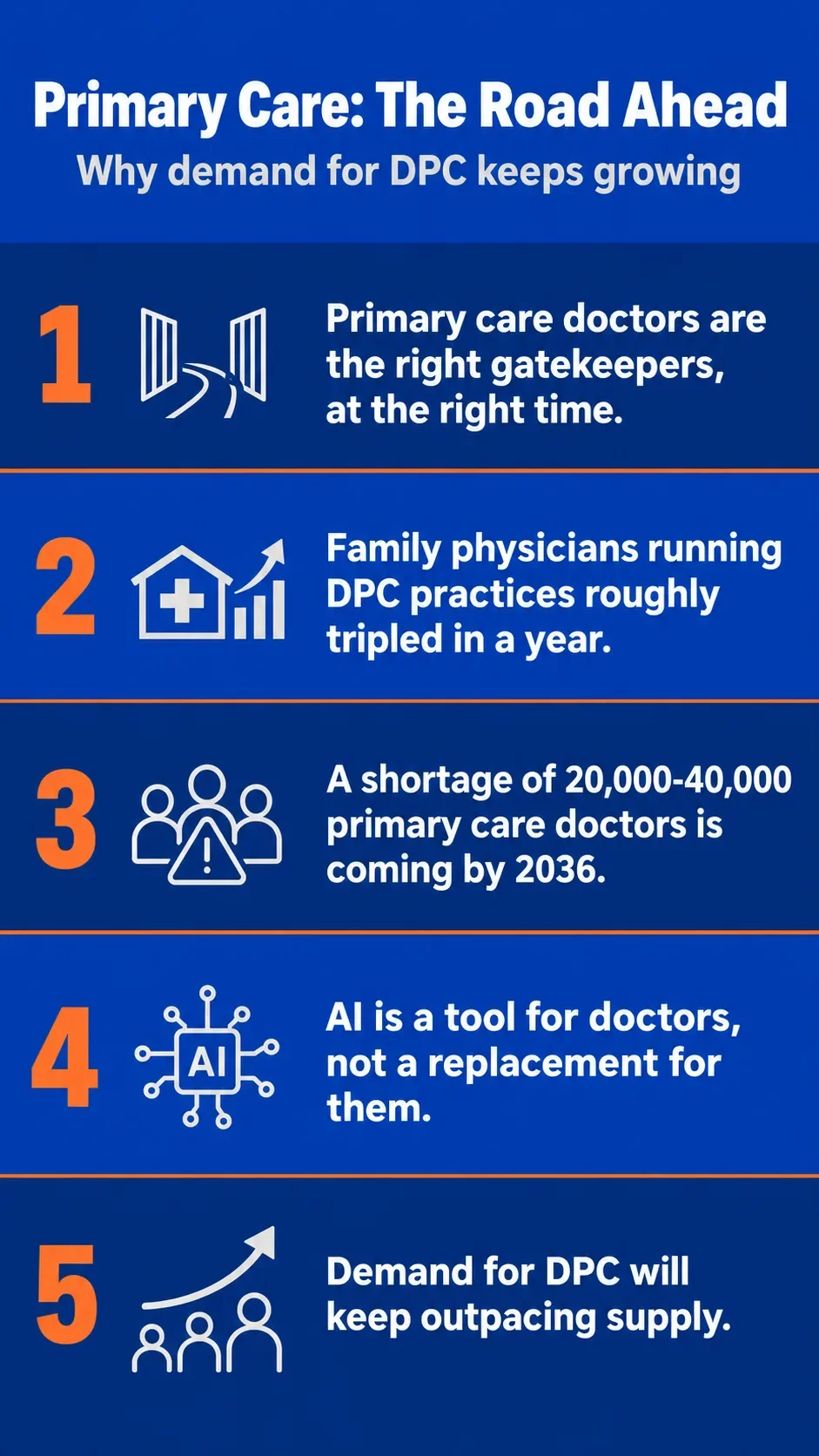
He went further, describing primary care physicians as the natural front door to the entire health system. "You guys truly are the right gatekeepers at the right time," he said, "and it's incredibly affordable."1
That phrase, gatekeeper, is worth sitting with. It does not mean someone who blocks access to care. It means someone who helps you find the right care, at the right time, without wasting money or time on the wrong path first. Cuban described how a strong primary care relationship means a patient's doctor handles 70 to 90% of what comes up day to day, and helps guide the rest, whether that means finding the right specialist, the right surgery center, or the right cash price for something more complex.1
"This Is Just the First Inning"
Cuban's most quoted line from the interview may be his baseball metaphor. "Being a direct primary care physician," he said, "this is just the first inning of the first preseason game."1
His reasoning is straightforward. As more patients experience what real access and real time with a doctor feels like, word spreads. "As their comfort level grows," he said, "they'll tell other people about what a great deal and what great service direct primary care is."1 He also pointed to a simple supply and demand problem working in DPC's favor: "The number of people who want it are going to exceed the number of people who can provide it, because there is a cap on the number of people any given practice can support."1
The data backs him up. The share of family physicians reporting they operate a direct primary care practice tripled in just one year, and DPC memberships have grown steadily as more patients look for an alternative to rushed, insurance-driven visits.2 At the same time, the country is heading toward a real shortage of primary care physicians, with projections showing a gap of 20,200 to 40,400 primary care doctors nationally by 2036.[3] Fewer doctors and rising demand means practices like Shreveport Direct Care, ones built around access and continuity, are only going to matter more over the coming decade.
To see what that access looks like today, read Why Same-Day Primary Care Matters.
Why Time With Your Doctor Is Becoming the Scarcest Resource in Medicine
Part of what makes Cuban's optimism about direct primary care believable is a trend most patients already feel but rarely see described in numbers. The average primary care visit in the traditional system runs about 18 minutes.[4] For a single complaint, that might be enough. For an older patient managing three chronic conditions, or a parent with a long list of questions about their child's development, 18 minutes is barely enough time to get through the basics, let alone actually think through a diagnosis together.
A shrinking pool of primary care doctors combined with a growing, aging population means that squeeze is likely to get worse in traditional practices, not better. Direct primary care solves this differently, not by working harder within the same broken structure, but by carrying far fewer patients per doctor in the first place. That is the tradeoff behind the hour-long visits Shreveport Direct Care offers. Fewer patients, but far more time for each one.
AI Is a Tool for Independent Doctors, Not a Threat
One of the more surprising parts of the interview was Cuban's take on artificial intelligence. Many physicians worry AI will replace the doctor-patient relationship. Cuban sees it the opposite way.
"AI is not a competitor to independent physicians or DPC," he said. "It's a compliment because it makes your patient smarter."[1] He described how patients used to walk in repeating something they saw from an influencer online. Increasingly, they arrive having asked a more capable AI tool a real question first, arriving with better context and more useful questions for their doctor.
He also predicted that AI will make the administrative side of running an independent practice, the paperwork that scares many doctors away from going independent in the first place, dramatically easier over the next few years. "All these things you hear about AI agents," he said, "are going to do all the stuff that a year ago or two years ago, you'd have to have five staff people in order to deal with."[1] That matters for patients too. Less time spent on paperwork means more time available for the parts of medicine that actually require a human doctor: listening, examining, and thinking through a diagnosis.
For patients, the practical effect shows up in small ways that add up. A question that once required scheduling a full office visit can often be handled by text. A prescription refill does not require a separate trip. None of that replaces an actual physical exam or a physician's judgment, but it does mean the in-person time you do spend with your doctor is used on what actually matters, not on paperwork that a well-designed system should handle automatically.
What This Means for Shreveport Families
For a busy parent in Shreveport, this trend means something practical. The same-day appointment and the hour-long visit you get today at Shreveport Direct Care is not a temporary perk. It is part of a model that is structurally built to keep working as the rest of the health system gets more strained. You can read more about what a full-service primary care relationship covers, from kids to grandparents, in Comprehensive Primary Care in Shreveport, LA.
For Medicare-age patients managing multiple conditions, having one doctor who knows your full history and has time to coordinate your care matters even more as the system around you gets more crowded. Continuity with a primary care doctor who has known you for years is one of the clearest predictors of better long-term outcomes, and it is exactly what a direct primary care membership is designed to protect.
Dr. Pat "Ricky" Bass III, MD, MS, MPH, is board-certified in both Internal Medicine and Pediatrics, a dual certification that lets one doctor serve your entire family, from a newborn's first well visit through a grandparent's Medicare years. Learn more about what makes that combination rare in Best Primary Care Doctor In Shreveport.
A Word for Doctors Considering the Leap
Cuban's interview closed with a message aimed less at patients and more at physicians still working inside traditional, insurance-driven practices, wondering whether independent direct primary care is realistic. His answer: the fear that once made sense is fading fast. "What might have been a fear a year ago," he said, "will become less and less of a fear going forward."[1] Between shrinking administrative burden, growing patient demand, and a health system that increasingly rewards transparency over volume, the timing for independent primary care has rarely looked better.
That matters to patients too, even if the message was aimed at doctors. Every physician who makes the move to independent, direct primary care is one more doctor with real time available for patients in Shreveport and the surrounding Ark-La-Tex. As Cuban put it, this is still the first inning. The more doctors who step into that model, the more families get access to the kind of care that used to be the exception and is quickly becoming what patients expect.
The Bottom Line
Mark Cuban is not predicting a trend. He is describing something already happening in Shreveport, Bossier City, and communities across the Ark-La-Tex: patients are choosing doctors who have time for them, and that choice is only going to become more common.
Curious what that kind of primary care relationship feels like? Schedule a free meet-and-greet with Dr. Bass.
Schedule your free visit at Shreveport Direct Care →
Prefer to talk first? Call or text us at 318-588-7060, or email info@shreveportdirectcare.com.
Frequently Asked Questions
1. What did Mark Cuban mean by calling primary care doctors "gatekeepers"? He meant that a strong primary care doctor helps guide patients to the right care at the right time, whether that is handling most day-to-day needs directly or pointing patients toward the right specialist or facility when something more complex comes up.
2. Is there really a shortage of primary care doctors coming? Yes. National projections show a shortage of roughly 20,200 to 40,400 primary care physicians by 2036, driven largely by a growing and aging population.
3. Will AI replace primary care doctors? No. AI is increasingly used as a tool that helps patients arrive better informed and helps doctors spend less time on paperwork, but it does not replace the exam, the conversation, or the clinical judgment of a physician who knows you.
4. How is direct primary care different from a traditional doctor's office? Direct primary care replaces per-visit insurance billing with a flat monthly membership, which typically means same-day appointments, longer visits, and direct access to your doctor by text or email.
5. Can one doctor really treat my whole family? In most practices, no, because most doctors are trained in only one specialty. Dr. Bass is board-certified in both Internal Medicine and Pediatrics, so he can care for children, adults, and seniors within the same practice.
6. How do I know if direct primary care is right for my family? The best way to find out is a free, no-pressure meet-and-greet with Dr. Bass to talk through your family's needs and see if our membership is a good fit.
References
- Cuban, Mark. Interview with the DPC Alliance. YouTube. 2026. (Source of all direct quotes attributed to Mark Cuban.)
- Q+A: Is the Growth of Direct Primary Care Expanding Health Care Access Where It's Needed Most?. Drexel University News Blog. 2024. (Supports the finding that the share of family physicians reporting a DPC practice roughly tripled year over year.)
- The Complexities of Physician Supply and Demand: Projections From 2021 to 2036. Association of American Medical Colleges (AAMC). 2024. (Supports the projected shortage of 20,200 to 40,400 primary care physicians nationally by 2036.)
- Average Primary Care Exam Lasts Less Than 20 Minutes. Healio, citing analysis published in JAMA Internal Medicine. 2021. (Supports the figure of roughly 18 minutes as the average length of a primary care visit.)
Shreveport Direct Care is a direct primary care practice serving adults and children in Shreveport, Bossier City, and surrounding communities in Northwest Louisiana. Dr. Pat "Ricky" Bass III is board-certified in Internal Medicine and Pediatrics.