

What Are the Benefits of Tirzepatide?
If you live with type 2 diabetes or extra weight, you have probably tried a lot of things. Diets, pills, apps, and plenty of willpower. When those don’t work, it is easy to feel like you failed. You didn’t. Type 2 diabetes and obesity are chronic diseases, and they often need medical treatment.
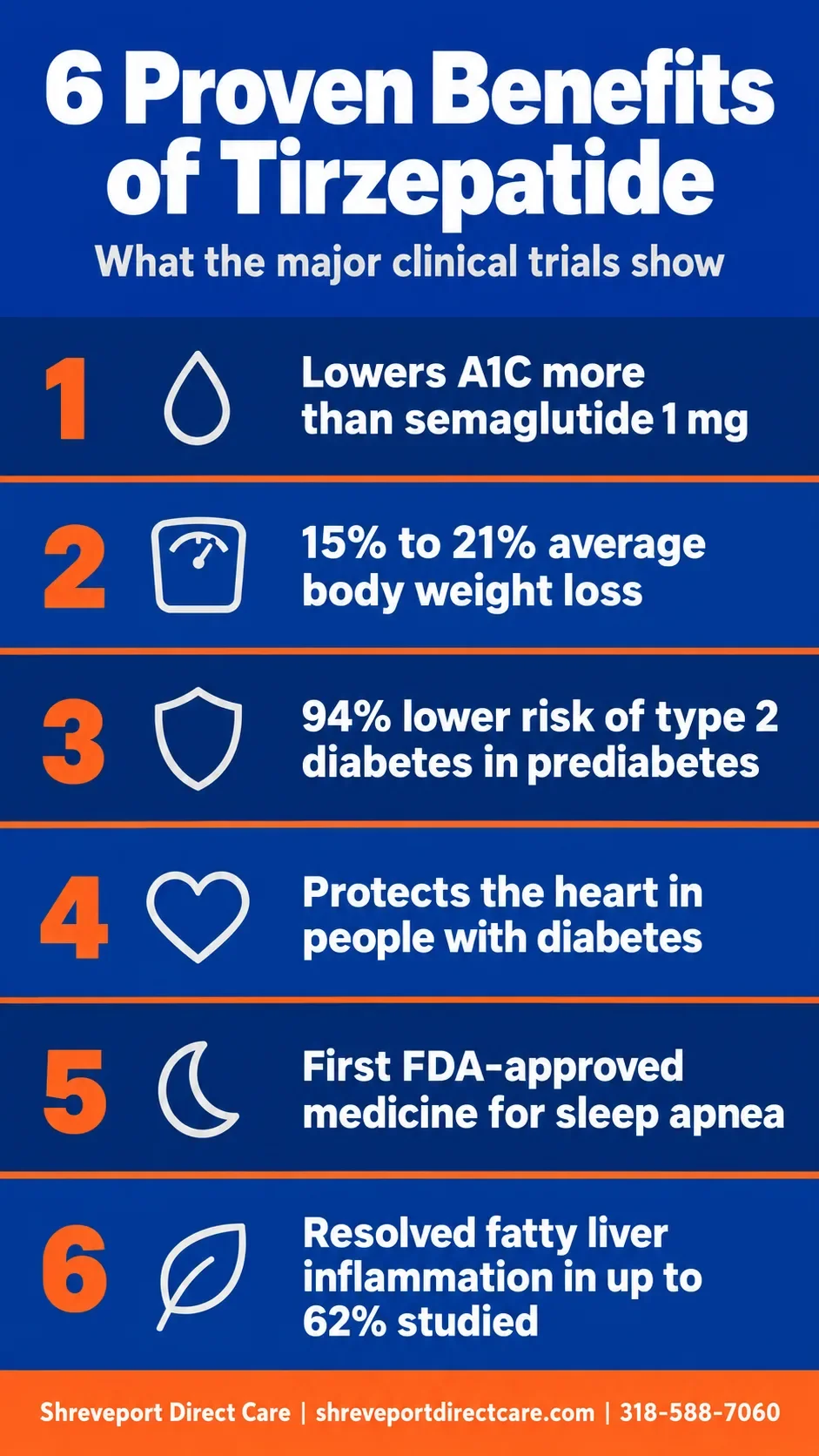
So, what are the benefits of tirzepatide? Tirzepatide is a once-weekly shot sold as Mounjaro for type 2 diabetes and Zepbound for weight management. In large studies, it lowered A1C (a 3-month blood sugar average) more than semaglutide 1 mg.[3] People without diabetes lost about 15% to 21% of their body weight in 72 weeks.[4] In adults with prediabetes, it cut the risk of getting type 2 diabetes by 94% over about 3 years.[5] Newer studies also show benefits for the heart, heart failure, sleep apnea, and fatty liver disease.[6][7][8][10]
Tirzepatide is not right for everyone, and it works best with a doctor who follows you closely. Below, Dr. Pat “Ricky” Bass III, MD, MS, MPH, explains how it works, what the research shows, what side effects to expect, and how patients in Shreveport, Bossier City, and the Ark-La-Tex can get the most from it.
How Tirzepatide Works: Two Hormones Instead of One
Your gut makes hormones after you eat. Two of them, called GIP and GLP-1, are known as incretins. They tell your pancreas to release insulin when your blood sugar rises. They also help you feel full.
Most older drugs in this class, like semaglutide and dulaglutide, copy only GLP-1. Tirzepatide is different. It acts on both the GIP and GLP-1 receptors at the same time.[2] That is why some people call it a “dual agonist” or a “twincretin.”
Here is what that means in plain words. Tirzepatide helps your body release insulin when blood sugar is high, but not when it is normal. That lowers the risk of low blood sugar when it is used by itself.[2] It also lowers glucagon, a hormone that pushes blood sugar up. It slows how fast your stomach empties, so you feel full longer. And it acts on appetite centers in the brain, so food “noise” often gets quieter.
Research also suggests tirzepatide helps the insulin-making cells in the pancreas, called beta cells, work better. In one study of people with type 2 diabetes, tirzepatide improved markers of beta-cell function and insulin sensitivity more than dulaglutide.[11] We don’t yet know if this slows the disease over many years. Still, it is a promising sign.
At Shreveport Direct Care, we spend real time explaining how a medicine works before you start it. When patients understand why they feel less hungry, they are more likely to stick with the plan. That kind of teaching is easier when visits aren’t rushed, which is a big part of how a DPC membership works.
Mounjaro vs. Zepbound: Same Medicine, Different Labels
Patients often ask us if Mounjaro and Zepbound are different drugs. They are not. Both contain tirzepatide, and both come in the same doses. The difference is the FDA approval on the label.
Mounjaro is approved to lower blood sugar in adults with type 2 diabetes, along with diet and exercise.[2] Zepbound is approved for long-term weight management in adults with obesity, or overweight with at least one weight-related health problem. Zepbound is also approved for moderate to severe obstructive sleep apnea in adults with obesity.[9]
Why does that matter? The label can affect insurance coverage, which pharmacy fills it, and how your doctor documents your care. It does not change how the medicine works in your body. When we talk about the benefits of tirzepatide in this article, we mean the medicine itself, whichever name is on the box.
What Are the Benefits of Tirzepatide for Blood Sugar and Weight?
The best-known benefits of tirzepatide are better blood sugar and real weight loss. These two goals go hand in hand. Losing weight often makes the body more sensitive to insulin, and better blood sugar control protects your eyes, kidneys, nerves, and heart.
Lower A1C
A1C shows your average blood sugar over about 3 months. Lowering it reduces the risk of diabetes problems over time.
The SURPASS-2 trial compared tirzepatide to semaglutide 1 mg in 1,879 adults with type 2 diabetes over 40 weeks.[3] All three tirzepatide doses lowered A1C more than semaglutide. At the highest dose, A1C dropped by about 2.3 to 2.5 points, compared with about 1.9 points on semaglutide.[3] For many patients, that is the difference between “still high” and “at goal.”
Meaningful Weight Loss
In SURPASS-2, people with diabetes on the highest tirzepatide dose lost about 11 to 12 kilograms (roughly 25 pounds). People on semaglutide 1 mg lost about 6 kilograms (about 13 pounds).[3]
Results were even larger in people with obesity who did not have diabetes. In the SURMOUNT-1 trial, adults lost an average of 15% to 21% of their body weight over 72 weeks, depending on dose. People on placebo lost about 3%.[4] For someone who weighs 250 pounds, a 20% loss is 50 pounds.
If you want to see how tirzepatide stacks up against semaglutide at weight-loss doses, read our breakdown of the head-to-head tirzepatide vs. semaglutide trial.
Preventing Type 2 Diabetes
This may be one of the most important benefits of tirzepatide. In SURMOUNT-1, about 1,000 adults also had prediabetes. Researchers followed them for 176 weeks, a little over 3 years.[5]
People on tirzepatide had a 94% lower risk of developing type 2 diabetes than people on placebo.[5] Those on the 15 mg dose lost about 23% of their body weight at 3 years.[5] Most people with prediabetes never get that kind of protection from diet changes alone.
This matters a lot here at home. In Louisiana, about 15.4% of adults have been told they have diabetes, compared with 12.0% nationally. That ranks Louisiana 47th among states.[1] Many more people in Shreveport and Bossier City have prediabetes and don’t know it. Catching it early, and treating it, can change the story.
Why It Matters Beyond the Number on the Scale
Weight loss with tirzepatide also improved blood pressure, cholesterol, and triglycerides in clinical trials.[4][6] Patients often tell us they have more energy, less joint pain, and an easier time keeping up with their kids or grandkids. Those changes are hard to measure, but they are real.
Tirzepatide Benefits Besides Weight Loss
Many people search for tirzepatide benefits besides weight loss. That’s a smart question. Over the last two years, large studies have shown benefits that reach well past the scale.

Other Tirzepatide Benefits
Heart Protection in People With Type 2 Diabetes
People with type 2 diabetes have a higher risk of heart attack and stroke. So any diabetes drug needs to be safe for the heart, and ideally helpful.
The SURPASS-CVOT trial answered that question. It followed 13,299 adults with type 2 diabetes and known heart or blood vessel disease for a median of 4 years.[6] It compared tirzepatide to dulaglutide, a GLP-1 drug already proven to protect the heart.
Tirzepatide did at least as well as dulaglutide at preventing heart attacks, strokes, and heart-related deaths. Major heart events happened in 12.2% of people on tirzepatide and 13.1% on dulaglutide.[6] Deaths from any cause were also lower with tirzepatide.[6] People on tirzepatide lost more weight (11.6% vs. 4.5%) and had bigger drops in A1C.[6]
In plain terms, tirzepatide matched a heart-protective drug and did better on blood sugar and weight. That’s good news for patients with diabetes and heart disease.
Help for a Common Type of Heart Failure
Some people have a type of heart failure called HFpEF, or heart failure with preserved ejection fraction. The heart pumps, but it is stiff and doesn’t fill well. It often shows up with obesity and causes shortness of breath and swelling.
In the SUMMIT trial, 731 adults with HFpEF and obesity took tirzepatide or placebo for about 2 years.[7] Tirzepatide lowered the risk of heart-related death or worsening heart failure by 38%.[7] People also walked farther, felt better day to day, and had less inflammation in their blood.[7]
Obstructive Sleep Apnea
Obstructive sleep apnea (OSA) happens when your airway closes off again and again during sleep. It causes loud snoring, poor sleep, daytime tiredness, and raises the risk of high blood pressure and heart disease.
In December 2024, the FDA approved Zepbound (tirzepatide) as the first medicine for moderate to severe OSA in adults with obesity.[9] In the SURMOUNT-OSA trials, tirzepatide cut breathing pauses by about 25 to 29 events per hour, compared with about 5 to 6 on placebo.[8][9] Many people’s sleep apnea improved to mild or went away.[9]
Tirzepatide does not replace a CPAP machine for everyone. But for many patients in Northwest Louisiana who struggle with CPAP, it offers another path.
Fatty Liver Disease
Fatty liver disease is now called MASLD. A more serious form, called MASH, causes liver inflammation and scarring. It is common in people with diabetes and obesity, and it can lead to cirrhosis.
In the SYNERGY-NASH study, 190 adults with MASH and liver scarring took tirzepatide or placebo for 52 weeks.[10] MASH went away without worse scarring in up to 62% of people on tirzepatide, compared with about 10% on placebo.[10] This was a smaller, earlier-phase study, so larger trials are still needed. But the early results are encouraging.
Kidneys and Blood Pressure
Weight loss with tirzepatide lowered blood pressure in the SURMOUNT-1 trial.[4] Results from SURPASS-CVOT also suggest tirzepatide may help protect the kidneys in people with diabetes.[6] Researchers are still studying this, so we treat it as a likely bonus rather than a main reason to start.
What This Means for Patients in Northwest Louisiana
Heart disease, diabetes, sleep apnea, and fatty liver disease often travel together. In our part of the state, they are very common. Many of our patients in Shreveport and Bossier City live with two or three of these conditions at once and take a long list of medicines for them.
For these patients, one weekly medicine that helps several problems at the same time can be a real advantage. It can sometimes mean fewer pills, simpler routines, and lower doses of other drugs as health improves. Those decisions should always be made with your doctor, one step at a time. But it’s a big reason we are excited about this class of medicines.
A Word of Caution About “Miracle Drug” Claims
You will see a lot of bold claims online. Some say tirzepatide fixes everything from aging to memory. The real research is exciting enough without hype. At Shreveport Direct Care, we stick to what the studies show and tell you plainly what we don’t know yet.
Tirzepatide Side Effects, Safety, and Who Should Avoid It
Every medicine has trade-offs. Knowing them up front helps you stay safe and stick with treatment. For a deeper look, see our guide to tirzepatide risks you should know before starting.
Common Side Effects
The most common side effects involve the stomach and gut. These include nausea, diarrhea, less appetite, vomiting, constipation, heartburn, and stomach pain.[2] They are usually mild to moderate. They show up most often when the dose goes up and tend to fade over a few weeks.
Simple habits help. Eat smaller meals. Stop eating when you feel full. Go easy on greasy and fried foods. Drink plenty of water. If side effects linger, your doctor can hold the dose steady longer instead of moving up.
In SURPASS-CVOT, about 13% of people stopped tirzepatide, mostly because of stomach side effects.[6] That’s why a slow, guided start matters so much.
Serious Warnings
Tirzepatide carries a boxed warning about thyroid C-cell tumors. These tumors happened in rats. We don’t know if tirzepatide causes them in people.[2] Call your doctor if you notice a lump in your neck, trouble swallowing, hoarseness, or shortness of breath.
Other warnings on the label include:[2]
Pancreatitis. Stop the drug and get care right away for severe stomach pain that may spread to your back, with or without vomiting.
Gallbladder problems. Fast weight loss can raise the risk of gallstones.
Low blood sugar. The risk is higher if you also take insulin or a sulfonylurea, such as glipizide. Your doctor may need to lower those doses.
Kidney problems. Vomiting and diarrhea can lead to dehydration, which can strain the kidneys.
Eye changes. In people with diabetic eye disease, fast drops in blood sugar can briefly make it worse.
Birth control pills. They may not work as well for 4 weeks after starting tirzepatide and after each dose increase. A backup method is advised during those times.
Surgery and anesthesia. Because tirzepatide slows the stomach, tell your surgeon and anesthesia team that you take it.
Who Should Not Take Tirzepatide
You should not take tirzepatide if you or a family member has had medullary thyroid cancer, or if you have a condition called MEN 2 (multiple endocrine neoplasia syndrome type 2).[2] You also should not take it if you have had a serious allergic reaction to tirzepatide.[2]
Tirzepatide is not recommended during pregnancy. People with a past history of pancreatitis, severe stomach emptying problems, or advanced kidney or eye disease need a careful talk with their doctor first.[2] This is where a doctor who knows your full history makes a big difference.
Dosing Basics
Tirzepatide is a shot you give yourself under the skin once a week, in the belly, thigh, or upper arm.[2] Most people start at 2.5 mg for 4 weeks. The 2.5 mg dose is a starter dose to help your body adjust. The dose then goes up by 2.5 mg no faster than every 4 weeks, up to a maximum of 15 mg.[2]
If you miss a dose, take it as soon as you can within 4 days (96 hours). If more than 4 days have passed, skip it and take your next dose on your usual day.[2] Never take two doses to catch up. Your doctor will decide your dose and pace based on your goals and how you feel. To learn more, read our post on tirzepatide for weight loss, including benefits, risks, and what to expect.
Getting the Most From Tirzepatide in Shreveport and Bossier City
Tirzepatide works best as part of a full plan. Medicine quiets the hunger. Healthy habits protect your muscle, your energy, and your results over time.
What to Expect in the First Few Months
Knowing what is normal helps you stay the course. Here is the general pattern we see, though every person is different.
In the first month, on the 2.5 mg starter dose, most people notice they get full faster and think about food less. Weight loss is often small at this stage. That’s okay. The goal of the first month is to let your body adjust, not to lose a lot of weight.
From about month two through month six, the dose usually steps up every 4 weeks or more. This is when most people see steady weight loss and better blood sugar readings. It is also when stomach side effects are most likely, usually for a few days after each dose increase. If side effects are hard to manage, we can stay at the same dose longer. There is no prize for getting to the top dose quickly.
After six months, weight loss tends to slow, and most people reach a plateau somewhere between 12 and 18 months. In SURMOUNT-1, average weight loss leveled off around week 72.[4] A plateau is not failure. It usually means your body has found a new, healthier set point. This is a good time to focus on strength training, protein, and keeping your new habits steady.
What Happens If You Stop Tirzepatide?
This is one of the most important questions to ask before you start. Obesity is a chronic disease, much like high blood pressure. When the treatment stops, the condition often comes back.
The SURMOUNT-4 trial tested this directly. Adults took tirzepatide for 36 weeks and lost about 21% of their body weight. Then half switched to a placebo shot without knowing it.[13] Over the next year, people who stopped tirzepatide regained about 14% of their weight. People who stayed on it lost about 5.5% more.[13] Blood pressure, cholesterol, and blood sugar gains also faded in many people who stopped.
That doesn’t mean you have to take tirzepatide forever. Some patients lower their dose over time, and some can stop with a careful plan. But it does mean you should go in with eyes open. We talk through a long-term plan with every patient before the first dose, so there are no surprises later.
Food: Protein First, Then Plants
When appetite drops, it is easy to under-eat protein. That can lead to muscle loss. We encourage patients to build each meal around a lean protein, then add vegetables, beans, fruit, and whole grains. Cutting back on sugary drinks, sweets, and fried food also helps with both weight and blood sugar.
You don’t need a perfect diet. You need a steady one you can live with, including on a Friday night out in Shreveport or at a crawfish boil in Bossier City.
Movement and Strength
Adults should aim for at least 150 minutes a week of moderate activity, like brisk walking, plus muscle-strengthening work at least 2 days a week.[12] Strength training is extra important on tirzepatide because it helps you keep muscle while you lose fat. Start small. A 10-minute walk after dinner is a great first step.
Sleep and Stress
Poor sleep and high stress raise blood sugar and drive cravings. Getting 7 or more hours of sleep, keeping a regular bedtime, and finding a stress outlet that works for you all support your results. If you snore loudly or wake up tired, ask about sleep apnea. As noted above, tirzepatide may help with that too.
Why Close Medical Follow-Up Matters
Tirzepatide is a powerful medicine. It needs a doctor who watches your blood sugar, kidney function, blood pressure, and other medicines as your weight comes down. For example, people on insulin or blood pressure pills often need those doses lowered as tirzepatide starts working. Without close follow-up, that can be missed.
That’s where Shreveport Direct Care comes in. We are a membership-based Direct Primary Care clinic serving Shreveport, Bossier City, and the Ark-La-Tex. Our members get unhurried visits, same-day or next-day appointments, and direct text access to Dr. Bass. Ongoing monitoring and medication management are part of the membership, not an extra bill.
Dr. Bass is board-certified in both Internal Medicine and Pediatrics. You can read more about Dr. Bass’s backgroundand how he approaches chronic disease. If you want to see everything we treat, from diabetes to sleep apnea to high blood pressure, take a look at our services.
Benefits of Tirzepatide
Is Tirzepatide Right for You?
Tirzepatide may be a good fit if you have type 2 diabetes that isn’t at goal, obesity, or overweight with a weight-related health problem. It may also help if you have prediabetes and extra weight, or sleep apnea with obesity. It is not a good fit for everyone, and the only way to know is a full, honest conversation with your doctor.
At Shreveport Direct Care, we look at your whole health, not just one number. Modern medicine, old-school experience. That’s how we help patients across Northwest Louisiana reach goals that once felt out of reach.
Ready to get started with a physician-led weight loss plan? Schedule a free meet-and-greet with Dr. Bass and find out if our program is right for you.
Phone/Text: 318–588–7060
Email: info@shreveportdirectcare.com
FAQs:
What are the benefits of tirzepatide?
Tirzepatide lowers A1C, helps people lose about 15% to 21% of their body weight, and reduced the risk of type 2 diabetes by 94% in adults with prediabetes. It also showed benefits for the heart, a type of heart failure called HFpEF, sleep apnea, and fatty liver disease in clinical trials.
What are the benefits of tirzepatide besides weight loss?
Beyond weight loss, tirzepatide improves blood sugar, blood pressure, and triglycerides. It matched a heart-protective drug in preventing heart attacks and strokes in people with diabetes, reduced heart failure events in people with HFpEF and obesity, and is FDA-approved for moderate to severe sleep apnea in adults with obesity.
Is tirzepatide better than semaglutide?
In head-to-head studies, tirzepatide led to more weight loss and larger drops in A1C than semaglutide. Both are effective. The right choice depends on your health history, side effects, goals, and access to the medicine.
How long does it take for tirzepatide to work?
Many people notice less hunger within the first few weeks. Blood sugar often improves within weeks, while most weight loss happens gradually over 12 to 18 months as the dose increases.
What are the most common side effects of tirzepatide?
The most common side effects are nausea, diarrhea, constipation, vomiting, heartburn, and less appetite. They usually happen when the dose goes up and often fade over a few weeks.
Can I get tirzepatide care in Shreveport or Bossier City?
Yes. Shreveport Direct Care offers physician-led weight loss and diabetes care for patients in Shreveport, Bossier City, and the Ark-La-Tex. Dr. Bass will review your history, decide if tirzepatide is a safe fit, and follow you closely as part of your membership.
References
United Health Foundation. Explore Diabetes in Louisiana, 2026 Annual Report. America’s Health Rankings. 2026 (2024 data). (Louisiana adult diabetes rate of 15.4% vs. 12.0% U.S.; ranked 47th.)
Eli Lilly and Company. Mounjaro (tirzepatide) Prescribing Information. U.S. Food and Drug Administration–approved label. Current version. (Mechanism, dosing and titration, 4-day missed-dose rule, boxed warning, contraindications, warnings, and common side effects.)
Frías JP, Davies MJ, Rosenstock J, et al. Tirzepatide versus Semaglutide Once Weekly in Patients with Type 2 Diabetes (SURPASS-2). New England Journal of Medicine. 2021;385:503–515. (A1C and weight reductions vs. semaglutide 1 mg over 40 weeks in 1,879 adults.)
Jastreboff AM, Aronne LJ, Ahmad NN, et al. Tirzepatide Once Weekly for the Treatment of Obesity (SURMOUNT-1).New England Journal of Medicine. 2022;387:205–216. (15% to 21% weight loss over 72 weeks; improvements in blood pressure and lipids.)
Jastreboff AM, le Roux CW, Stefanski A, et al. Tirzepatide for Obesity Treatment and Diabetes Prevention. New England Journal of Medicine. 2025;392:958–971. (94% lower risk of progression to type 2 diabetes over 176 weeks in adults with prediabetes; ~23% weight loss at 15 mg.)
Nicholls SJ, et al. Cardiovascular Outcomes with Tirzepatide versus Dulaglutide in Type 2 Diabetes (SURPASS-CVOT). New England Journal of Medicine. 2025;393:2409–2420. (13,299 adults; MACE 12.2% vs. 13.1%; lower all-cause death; greater weight and A1C reductions; discontinuation rates.)
Packer M, Zile MR, Kramer CM, et al. Tirzepatide for Heart Failure with Preserved Ejection Fraction and Obesity (SUMMIT). New England Journal of Medicine. 2025;392:427–437. (38% lower risk of cardiovascular death or worsening heart failure; better function and symptoms.)
Malhotra A, Grunstein RR, Fietze I, et al. Tirzepatide for the Treatment of Obstructive Sleep Apnea and Obesity (SURMOUNT-OSA). New England Journal of Medicine. 2024;391:1193–1205. (Reduction in breathing events per hour vs. placebo.)
American Academy of Sleep Medicine. Zepbound Approved by FDA as First Sleep Apnea Medication. AASM. December 2024. (FDA approval date and indication; SURMOUNT-OSA event reductions and remission rates.)
Loomba R, Hartman ML, Lawitz EJ, et al. Tirzepatide for Metabolic Dysfunction–Associated Steatohepatitis with Liver Fibrosis (SYNERGY-NASH). New England Journal of Medicine. 2024;391:299–310. (MASH resolution in up to 62.4% vs. 9.8% placebo at 52 weeks; phase 2.)
Thomas MK, Nikooienejad A, Bray R, et al. Dual GIP and GLP-1 Receptor Agonist Tirzepatide Improves Beta-cell Function and Insulin Sensitivity in Type 2 Diabetes.Journal of Clinical Endocrinology & Metabolism. 2021;106(2):388–396. (Beta-cell function and insulin sensitivity. Note: 2021 study; longer-term data still emerging.)
Centers for Disease Control and Prevention. Adult Activity: An Overview. CDC. (150 minutes of moderate activity weekly plus 2 days of muscle strengthening.)
Aronne LJ, Sattar N, Horn DB, et al. Continued Treatment With Tirzepatide for Maintenance of Weight Reduction in Adults With Obesity: The SURMOUNT-4 Randomized Clinical Trial. JAMA. 2024;331(1):38–48. (About 14% weight regain after stopping vs. about 5.5% further loss when continuing.)
Shreveport Direct Care is a direct primary care practice serving adults and children