
Family Doctor Shreveport: One Doctor for Every Age
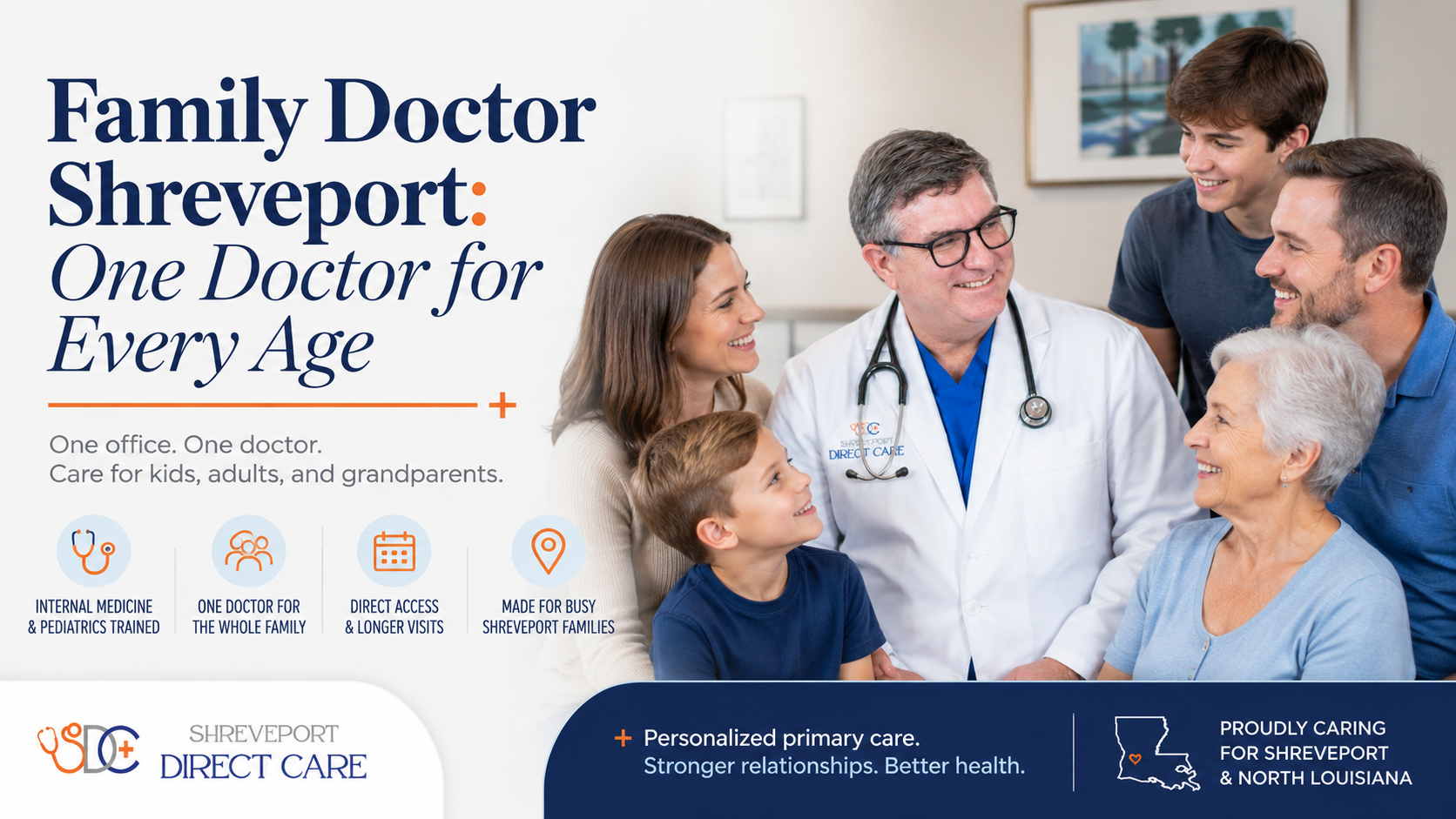
Are you looking for a family doctor in Shreveport?
If you're searching for a family doctor in Shreveport, you probably want something simple. One office. One phone number. One doctor who knows your kids, your spouse, and you. A doctor who can handle the toddler ear infection on Monday and your dad's blood pressure check on Tuesday — without sending you to three different clinics across town.
That kind of care is harder to find than it should be. Wait times are growing. Visits are shorter. And many primary care clinics are now built around one age group at a time. At Shreveport Direct Care, we built a different model on purpose. I'm Dr. Pat "Ricky" Bass III, and I'm board-certified in both Internal Medicine and Pediatrics. That dual training lets me serve as the family doctor for everyone in your home — newborns, teens, working adults, and grandparents — under one roof.
This post explains what a Med-Peds doctor is, how that training compares to traditional family medicine, and why pairing it with a Direct Primary Care membership in Shreveport may be the most practical answer for busy families today.
What "Family Doctor" Really Means in Shreveport Today
The phrase "family doctor" used to be simple. It meant a single physician who took care of everyone in the household. They knew your story. They came to your wedding. They saw your baby in the nursery and your grandfather in the hospital.
Today, that picture is harder to find. Across the country, the average wait to see a doctor in a major metro area is now 31 days, up 19% in just three years. Family medicine appointment waits have climbed to about 23 days on average. And here in Louisiana, parts of every parish, including Caddo and Bossier, are designated by the federal government as Health Professional Shortage Areas — meaning there are simply not enough primary care doctors to go around.
The result is that many families end up split across multiple clinics. The kids see a pediatrician across town. Mom sees an internist on her lunch break. Dad sees whoever can fit him in. Grandma is at a different practice altogether. Each visit means new paperwork, a new chart, and a doctor who doesn't really know the family.
A true family doctor in Shreveport — one who can see everyone, knows your history, and is easy to reach — is what most patients tell me they really want. The good news is that model still exists. You just have to know where to look.
Med-Peds: A Different Kind of Family Doctor
Med-Peds is short for Internal Medicine and Pediatrics. It's a four-year residency where physicians train fully in both adult medicine and pediatric medicine, then sit for and pass two separate board certifications. We're not pediatricians who also see adults, and we're not internists who also see kids. We're trained from day one to do both.
Med-Peds is also rare. There are only about 5,700 practicing Med-Peds physicians in the entire United States — less than 1% of all active doctors. Roughly 400 new Med-Peds residents finish training each year nationwide. In a city the size of Shreveport, you can usually count the dual-trained Med-Peds doctors on one hand.
Family medicine doctors are wonderful, and they care for families across the lifespan too. The training paths are simply different. Family medicine residency is three years and includes obstetrics, gynecology, and surgical exposure that Med-Peds does not. Med-Peds is four years, with deeper time spent in adult internal medicine and inpatient pediatrics. Both can serve as your family doctor in Shreveport. Med-Peds tends to lean a little harder on complex adult conditions like diabetes, heart disease, and cognitive decline, while keeping full pediatric care in the same toolkit.
The bottom line is that "family doctor" is a job description, not a board certification. Several types of physicians can fill that role well. What matters is whether the doctor in front of you has the training, the time, and the relationship to actually be that person for your family.
Why I Trained in Internal Medicine and Pediatrics
People ask me all the time why I picked the longer residency. The honest answer is that I love both halves of the work, and I didn't want to give either one up.
Internal medicine pulls me in because of the complexity. Adult patients come in with layered stories — high blood pressure tangled up with sleep, weight, stress, and family history. Helping someone slowly unwind a complicated picture and get back to feeling like themselves is some of the most satisfying work in medicine.
Pediatrics pulls me in because of the joy. There is nothing like watching a kid grow up. Catching a developmental concern early. Coaching a nervous teenager through their first big decision. Being the steady voice in a parent's ear at 9 p.m. when they don't know if a fever is a "wait it out" or a "head to the ER."
Med-Peds let me have both. And it turned out to be the perfect training for the kind of practice I wanted to build — one where families don't have to be carved up across specialties just to get good care.
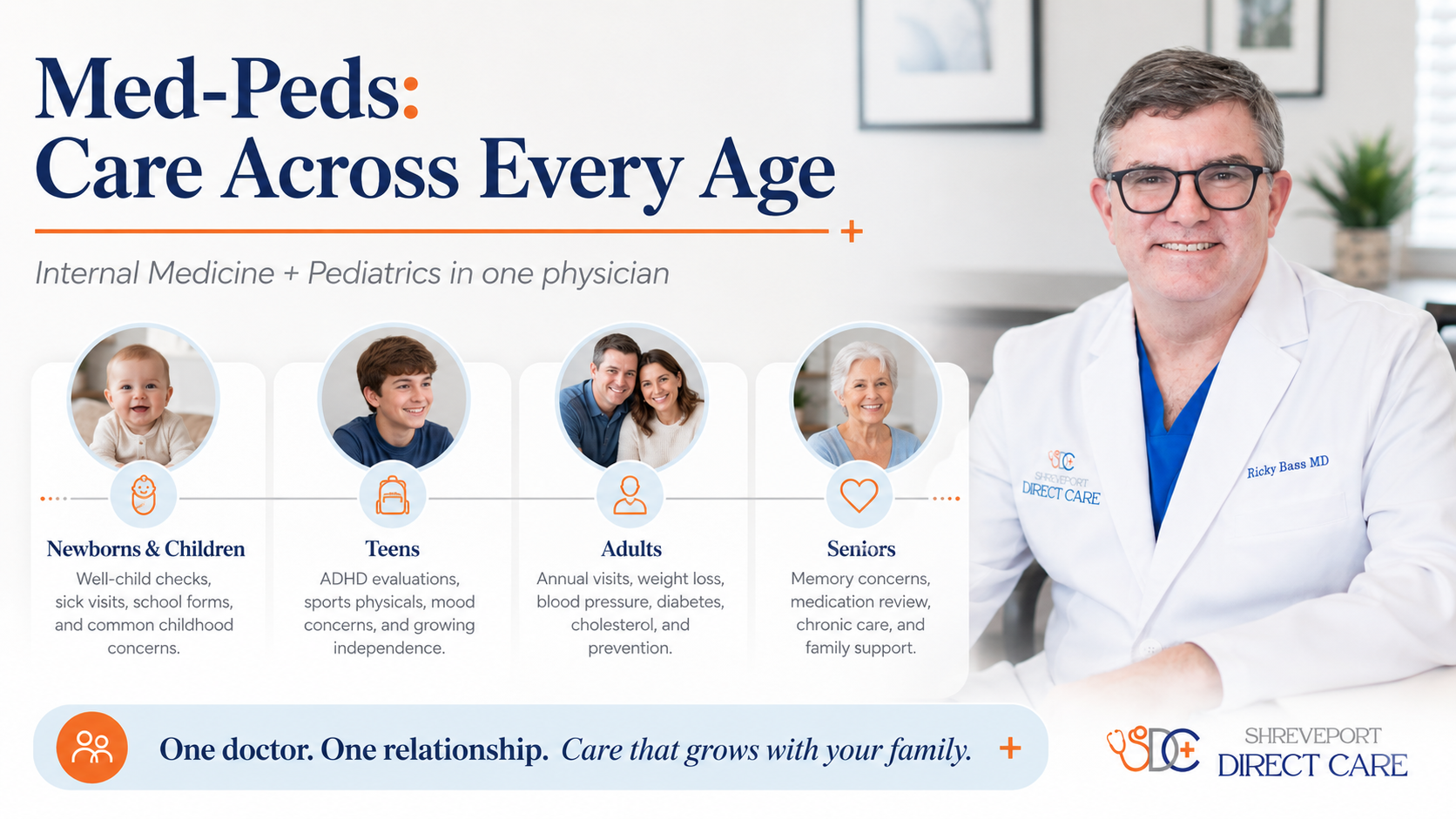
Med Peds- your family doctor across all ages.
What You Get With One Doctor for the Whole Family
Having one physician for your whole household is more than a convenience. It changes the quality of the care.
Continuity of care — the simple act of seeing the same doctor over time — is one of the most studied and most underappreciated factors in medicine. Research published through the American Board of Family Medicine has found that patients with the highest level of physician continuity have about 14% lower healthcare costs and roughly 16% lower odds of being hospitalized compared to patients with the lowest continuity. Other studies have linked continuity to lower mortality. The doctor who already knows you catches things faster, orders fewer unnecessary tests, and explains decisions in the context of your real life.
When that continuity stretches across the whole family, the benefits multiply. I see patterns inside the home that a single-age clinic would miss. A child's frequent stomach aches start to make more sense when I also know that mom is being treated for anxiety after a recent job change. A grandfather's medication list matters when his teenage grandson, who lives in the same house, comes in asking about ADHD treatment. Family histories don't have to be re-collected at four different clinics — they live in one chart, with one doctor who connects the dots.
There's a logistical win, too. One phone number for everyone. One portal. One doctor to text when something comes up. Parents tell me regularly that this alone has given them hours back in their week.
It also makes the harder seasons easier. When a parent gets sick, the same doctor is already caring for their kids. When a grandparent moves in, we already know the household. When a teenager is struggling, the conversation isn't starting from scratch. Family medicine done well isn't really about a specialty name — it's about a doctor who has earned the trust of the whole house and is easy to reach when you need them. That's the version of "family doctor in Shreveport" we're trying to be.
The Shreveport Reality: Wait Times, Shortages, and What to Do About It
Northwest Louisiana has a real primary care access problem. The federal Health Resources and Services Administration tracks something called Health Professional Shortage Areas, and Louisiana relies heavily on these designations because so much of our state qualifies. Nationwide, the number of designated primary care shortage areas grew from about 7,700 in 2024 to more than 8,400 in 2025, now covering over 92 million Americans. Our region is squarely inside that picture.
What this looks like in real life: families calling around for a new pediatrician and being told the next opening is in three months. Adults trying to establish with an internal medicine doctor and being routed to whoever has availability. Older patients waiting weeks for a follow-up after a hospital stay — exactly the window when good primary care matters most.
A direct primary care clinic in Shreveport doesn't solve the national doctor shortage. But it does solve the day-to-day version of it for the families who are members. By keeping the patient panel small on purpose, we can offer same-day or next-day visits, longer appointments, and direct access to the doctor by phone, text, and email. When a child spikes a fever Friday night, you don't sit in a packed urgent care. You text us.
How Direct Primary Care Makes Family-Wide Care Work
Direct Primary Care, or DPC, is the membership model that makes all of this practical. Instead of running every visit through insurance, our patients pay a flat monthly membership starting at $109 a month. That membership includes unlimited office visits, longer appointments (most run 30 to 60 minutes), and direct access to me by text and email. It also includes more than 1,000 generic medications at no extra cost, in-house labs at wholesale prices, and the kind of relationship that disappeared from most clinics decades ago.
For families, this matters in a few specific ways:
When you don't have to think about a copay, you bring the kid in earlier. The visit that catches the strep throat on Monday saves you a sicker child and a missed week of school later.
When the doctor has 45 minutes instead of 12, real conversations happen. We can actually talk about a teenager's mood, an adult's weight goals, or a parent's worry about their own aging mom — in the same visit, if needed.
When everyone in the home shares one doctor, you stop repeating yourselves. I already know the family pattern. I already have the chart. I already know who lives with whom and who is helping who.
We also build family memberships to be affordable. Children's memberships are deeply discounted when at least one parent is also a member, because we want this to be a real option for households, not a luxury. Many of our patients keep a high-deductible health plan or a health-sharing plan for the big stuff — hospitalizations, surgeries, specialists — and use Shreveport Direct Care for everything else. For Medicare-aged parents and grandparents, our model is fully Medicare-compatible.
A family doctor in Shreveport who can see your six-year-old, your sixteen-year-old, and your sixty-year-old, who answers your texts, and who actually knows your family — that's the practice we're trying to be.
Pediatrics & family health for Shreveport and Bossier City
We see kids of all ages, from newborn well-child checks through the teen years. We handle the everyday stuff — fevers, ear infections, sports physicals, ADHD evaluations, school forms — and the harder stuff, like adolescent mental health and complex chronic conditions. Because I'm also boarded in Internal Medicine, I can keep caring for those same kids as they grow into adults without ever having to "transition" them out of the practice. That continuity is uncommon, and patients tell us it matters.
For the adults in the household, we cover the full scope of primary care: annual physicals, chronic disease management (diabetes, blood pressure, cholesterol, thyroid), weight loss including GLP-1 medications when appropriate, memory and cognitive concerns, men's and women's preventive care, mental health support, and minor procedures. Anything we can't do in-house, we coordinate — and we stay involved through the process.
If you're in Shreveport, Bossier City, or anywhere in Northwest Louisiana and you've been searching for a family doctor who can really be that for your whole family, we'd love to meet you.
Ready to Find a Family Doctor in Shreveport?
Looking for a direct primary care doctor for your family in Shreveport? Schedule a free family meet-and-greet with Dr. Bass today. There's no commitment and no pressure — just a chance to ask questions and see if this is the right fit for your household.
Book your free visit at Shreveport Direct Care →
You can also reach us directly:
- Phone or text: 318-588-7060
- Email:info@shreveportdirectcare.com
FAQs
1. Q: What is a Med-Peds doctor? A: A Med-Peds doctor is a physician who completed a four-year residency in both Internal Medicine and Pediatrics, then passed two separate board certifications. We're trained to care for patients from birth through older adulthood, which makes Med-Peds physicians a natural fit to serve as a family doctor.
2. Q: How is Med-Peds different from family medicine? A: Both can serve as a family doctor. Family medicine is a three-year residency that includes obstetrics and some surgical exposure. Med-Peds is a four-year residency with deeper time in adult internal medicine and inpatient pediatrics. Either type of doctor can be a great fit for your family — the right choice depends on the doctor and the practice, not just the specialty name.
3. Q: Can one doctor really care for my whole family in Shreveport? A: Yes. At Shreveport Direct Care, Dr. Bass cares for newborns, children, teenagers, adults, and seniors — all in the same practice. Many of our patients sign up as a household and use one phone number for everyone.
4. Q: Do you take insurance? A: We don't bill insurance for our membership care, which is what allows us to offer longer visits and direct access. Most patients keep a health insurance plan for hospital care, specialists, and emergencies, and use Shreveport Direct Care for everything else. Our model is also Medicare-compatible.
5. Q: How much does a family membership cost? A: Adult memberships start at $109 per month and include unlimited office visits, direct access to Dr. Bass, and more than 1,000 generic medications at no extra cost. Children's memberships are discounted when a parent is also a member. We're happy to walk you through the family pricing on a free meet-and-greet.
6. Q: How do I get started? A: The easiest first step is a free meet-and-greet visit. You can book online at shreveportdirectcare.com/get-started, call or text 318-588-7060, or email info@shreveportdirectcare.com. There's no obligation to join.
References
AMN Healthcare. 2025 Survey of Physician Appointment Wait Times. AMN Healthcare. 2025. https://ir.amnhealthcare.com/news-releases/news-release-details/new-survey-shows-physician-appointment-wait-times-surge-19-2022 (Used for the 31-day average wait time and 19% increase since 2022.)
Health Resources and Services Administration. Designated Health Professional Shortage Areas Statistics. U.S. Department of Health and Human Services. 2025. https://data.hrsa.gov/topics/health-workforce/shortage-areas (Used for national HPSA growth from 7,718 in 2024 to 8,467 in 2025 covering 92.3 million people.)
Well-Ahead Louisiana. Health Professional Shortage Areas in Louisiana. Louisiana Department of Health. https://wellaheadla.com/healthcare-access/health-professional-shortage-areas/ (Used for Louisiana-specific HPSA context.)
Coyle, C., et al. The Evolving Landscape of the Medicine-Pediatrics Workforce: Lessons From the Last 10 Years. PMC / National Library of Medicine. 2024. https://pmc.ncbi.nlm.nih.gov/articles/PMC11909622/ (Used for Med-Peds workforce size of approximately 5,700 dual-trained physicians.)
Bazemore, A., et al. Higher Primary Care Physician Continuity is Associated With Lower Costs and Hospitalizations. Annals of Family Medicine / American Board of Family Medicine. https://www.theabfm.org/research/research-library/higher-primary-care-physician-continuity-is-associated-with-lower-costs-and-hospitalizations/ (Used for the 14% lower cost and 16% lower hospitalization findings tied to physician continuity.)
American Board of Family Medicine. Primary Care Physician Continuity Is a Consistent Measure Associated with Lower Costs and Hospitalizations. Journal of the American Board of Family Medicine. 2026. https://www.jabfm.org/content/early/2026/01/02/jabfm.2025.250056R1 (Recent confirmation of the continuity-cost-hospitalization relationship.)
Shreveport Direct Care is a direct primary care practice serving adults and children in Shreveport, Bossier City, and surrounding communities in Northwest Louisiana. Dr. Pat "Ricky" Bass III is board-certified in Internal Medicine and Pediatrics.