
How Is ADHD Diagnosed in Children and Adults?
If you are asking, “How is ADHD diagnosed?” the short answer is this: ADHD is diagnosed through a careful medical evaluation, not with one blood test, one brain scan, or one quick checklist. A doctor looks at symptoms, how long they have been going on, how much they affect daily life, and whether something else like anxiety, depression, poor sleep, or stress could be causing similar problems. In children, the evaluation often includes parent and school input. In adults, it also includes looking back for signs that symptoms started earlier in life.
At Shreveport Direct Care, we take a patient-friendly approach. Longer visits make it easier to listen carefully, look at the full picture, and sort out ADHD from other issues that can look similar. That matters because the right diagnosis leads to better treatment and less frustration. If you are looking for primary care in Shreveport and want a more thoughtful ADHD evaluation, this is exactly the kind of problem that benefits from a less rushed visit.
How Is ADHD Diagnosed? What Doctors Look For
ADHD is a clinical diagnosis. That means a doctor diagnoses it by talking with the patient, reviewing symptoms, learning how those symptoms affect daily life, and checking whether the symptoms fit established diagnostic criteria. It is not confirmed by a single lab test or imaging study.
Doctors usually look for patterns such as trouble paying attention, forgetfulness, losing things, poor follow-through, impulsive behavior, or feeling very restless. The symptoms must be more than an occasional bad day. They need to be ongoing and significant enough to affect school, work, home life, relationships, or day-to-day functioning.
For children and teens, the American Academy of Pediatrics guideline covers evaluation and treatment from ages 4 through 18. For adults, the process is a little different, but one important point stays the same: the clinician looks for evidence that symptoms were present earlier in life, because ADHD begins in childhood even if the person is not diagnosed until adulthood.
A good ADHD evaluation should not feel rushed. It should feel like a careful conversation that helps you understand what is really going on. At Shreveport Direct Care we utilize online testing that aides us in making a diagnosis over and above our clinical evalulation.
ADHD Symptoms in Children and Adults Can Look Different
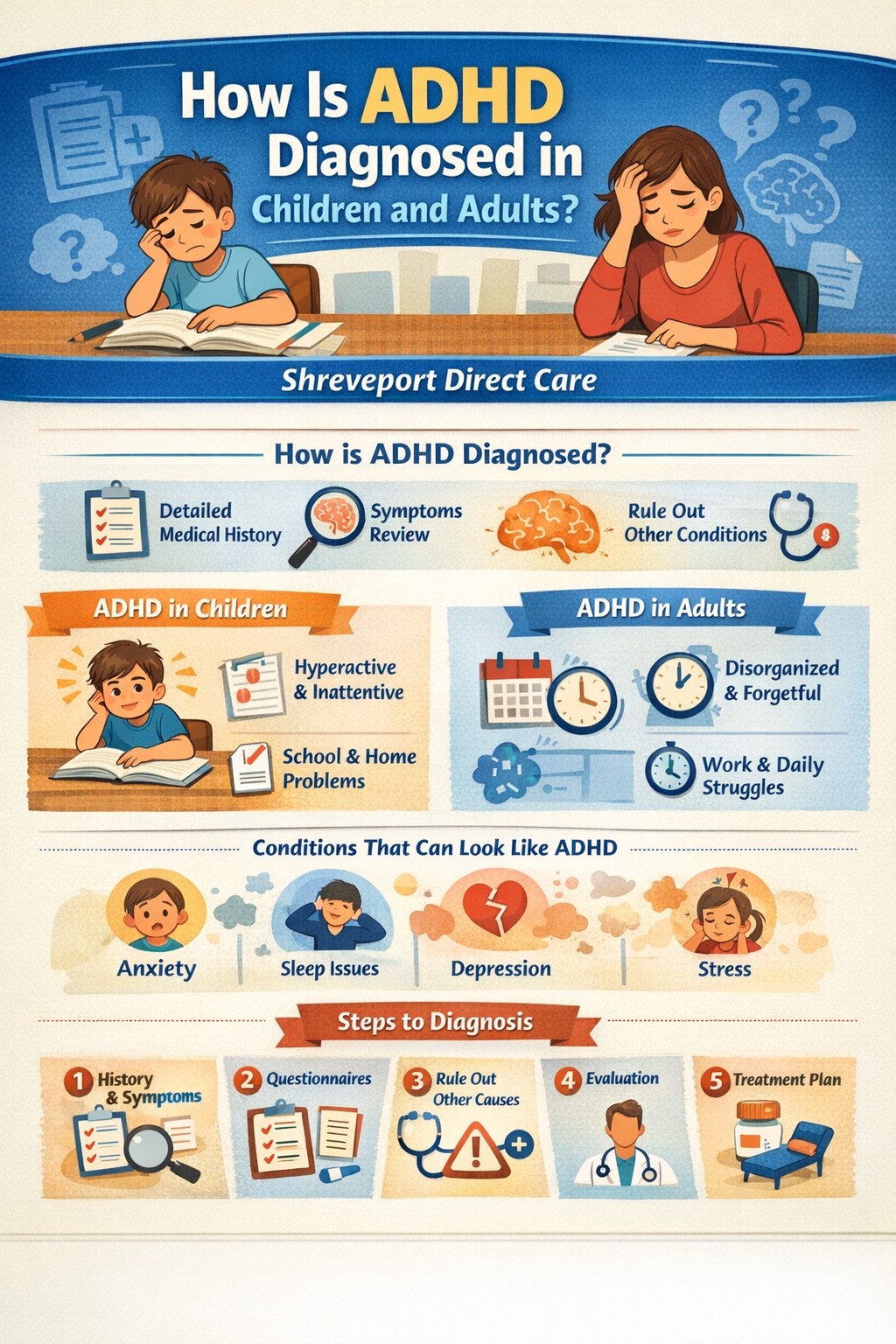
ADHD does not look the same in every person. Some people struggle mostly with inattention. Others have more hyperactivity and impulsivity. Many have a mix of both.
In children, ADHD may look like trouble sitting still, blurting out answers, not following through on directions, struggling to stay focused in class, or losing school items again and again. Parents may notice homework battles, messy routines, and frustration that seems bigger than expected for the child’s age.
In adults, the signs are often less obvious. A person may not be running around the room, but they may feel mentally restless, chronically disorganized, late on deadlines, forgetful, overwhelmed by simple routines, or unable to finish tasks without last-minute panic. Adults often say things like, “I’ve always felt smart, but I can never seem to stay on top of things.” NIMH notes that adults and adolescents over age 16 need fewer symptoms than younger children for diagnosis, but the symptoms still need to cause real problems in daily life.
Here is a simple example. A child may seem distracted at school and at home for years. An adult may look successful on the outside but constantly miss details, run late, and feel exhausted from trying to keep everything together. Both situations can fit ADHD, but both need a careful evaluation.
Conditions That Can Look Like ADHD
This is one of the most important parts of the whole process.
Not every person with trouble focusing has ADHD. Problems with attention and follow-through can also happen with anxiety, depression, poor sleep, high stress, trauma, substance use, or other medical problems. That is why a thoughtful evaluation matters so much.
For example, a teen who cannot focus in class may actually be sleeping very poorly and feeling anxious all the time. An adult who forgets everything and cannot stay organized may have ADHD, depression, or both. Someone under heavy stress may look distracted simply because their brain is overloaded. The right diagnosis comes from looking at the whole story, not just one symptom.
The AAP’s guideline specifically highlights the importance of evaluating coexisting and comorbid conditions in children and adolescents with ADHD. In everyday language, that means doctors should look for other issues that may be present at the same time or may be causing similar symptoms.
This is where longer visits can really help. At Shreveport Direct Care, a longer appointment allows time to ask deeper questions, review patterns over time, and decide whether the problem is ADHD, something else, or more than one thing at once. That kind of careful approach is especially valuable for families and adults looking for family medicine in Shreveport that feels personal and thorough.
What to Expect During an ADHD Evaluation in Shreveport
A helpful ADHD evaluation usually happens in steps.
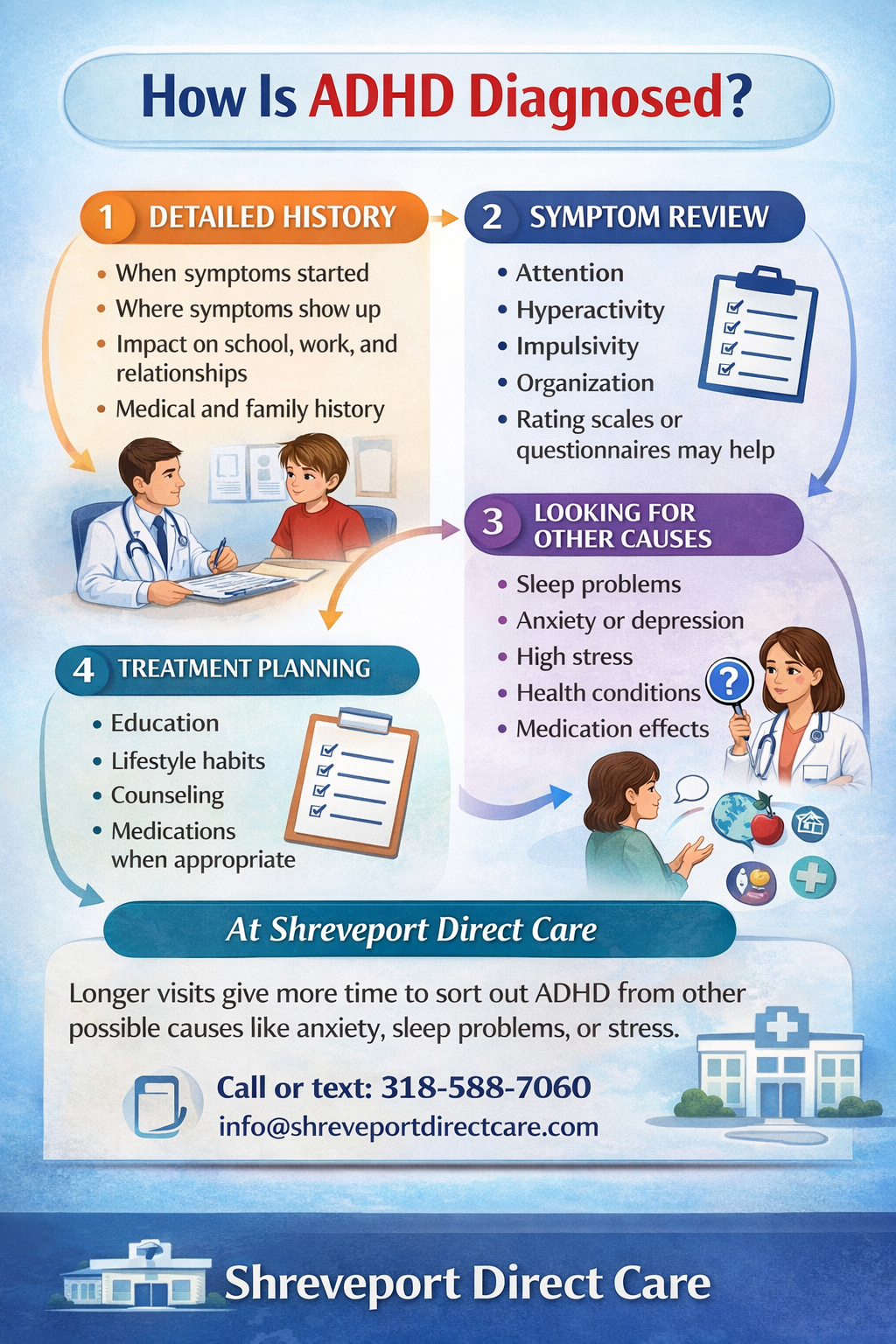
First, the doctor takes a detailed history. That includes symptoms, when they started, where they show up, and how they affect school, work, home life, and relationships. In children, parents and teachers may help describe what they are seeing. In adults, the doctor may ask about childhood patterns, school struggles, and long-term habits with focus, organization, or impulsivity.
Second, the doctor reviews the core symptom areas, including attention, impulsivity, hyperactivity, and executive function problems such as planning, organizing, time management, and finishing tasks. Standardized rating scales or questionnaires may also be used. These tools can be helpful, but they support the evaluation rather than replace clinical judgment.
Third, the clinician looks for other possible causes or overlapping conditions. Sleep quality, mood symptoms, stress, anxiety, depression, substance use, and relevant medical history all matter. This step is one reason that a quick online quiz is not enough to make a reliable diagnosis.
Finally, if ADHD is diagnosed, the conversation moves to treatment. Treatment may include education, school or work supports, behavior strategies, counseling, medication when appropriate, or a combination of these. The CDC notes that treatment for adults can include medication, psychotherapy, education or training, or combined approaches.
If you are looking for ADHD testing in Shreveport or an ADHD evaluation in Shreveport, the best place to start is often a clinic that can slow down, listen well, and help you understand not just whether you have ADHD, but what to do next.
Why Getting the Right Diagnosis Matters
A missed ADHD diagnosis can leave children and adults feeling frustrated, ashamed, or misunderstood. A wrong diagnosis can also be a problem, because it may delay treatment for the real cause of the symptoms.
When the diagnosis is right, people often feel relief. They finally have an explanation for patterns that never made sense before. More importantly, they can move toward a plan that actually helps. That may mean school support for a child, better routines for a teen, counseling for stress, treatment for sleep problems, or ADHD treatment itself.
In primary care, this kind of evaluation fits naturally with whole-person care. ADHD is not just about attention. It affects sleep, mood, work, family life, self-esteem, and daily routines. That is why a membership-based clinic like Shreveport Direct Care can be a good fit for patients who want a doctor in Shreveport who takes time to connect the dots.
Frequently Asked Questions
1. Is there a test for ADHD?
There is no single blood test, brain scan, or lab test that diagnoses ADHD. Diagnosis is based on symptoms, history, and how those symptoms affect daily life.
2. Can adults be diagnosed with ADHD?
Yes. Many adults are diagnosed later in life. Symptoms still need to fit ADHD criteria, and there should be evidence that symptoms began earlier, even if no one recognized them at the time.
3. How do doctors tell the difference between ADHD and anxiety?
Doctors look at the full picture. Anxiety can cause poor focus, and ADHD can also make people feel anxious. Some people have both, which is why a careful evaluation is so important.
4. Can sleep problems look like ADHD?
Yes. Poor sleep can affect focus, mood, memory, and daily functioning, which can sometimes look a lot like ADHD. That is one reason sleep history matters during the evaluation.
5. Do children and adults have the same ADHD symptoms?
Some symptoms overlap, but ADHD can look different at different ages. Children may appear more visibly hyperactive, while adults may struggle more with organization, forgetfulness, and internal restlessness.
6. Where can I get an ADHD evaluation in Shreveport?
A strong place to start is a primary care clinic that offers enough time for a full history, symptom review, and discussion of overlapping issues. Shreveport Direct Care provides longer visits designed to help sort out ADHD from anxiety, depression, sleep problems, or stress.
Take the Next Step
If you or your child are struggling with focus, attention, organization, or follow-through, do not try to figure it out alone. At Shreveport Direct Care, we offer longer, thoughtful visits to help evaluate ADHD and related concerns in both children and adults. To schedule a visit, call or text 318-588-7060 or email info@shreveportdirectcare.com.
References
National Institute of Mental Health. Attention-Deficit/Hyperactivity Disorder: What You Need to Know. National Institute of Mental Health. Accessed March 19, 2026. https://www.nimh.nih.gov/health/publications/attention-deficit-hyperactivity-disorder-what-you-need-to-know
American Academy of Pediatrics. Attention Deficit Hyperactivity Disorder (ADHD). American Academy of Pediatrics. Accessed March 19, 2026. https://www.aap.org/en/patient-care/attention-deficit-hyperactivity-disorder-adhd/
Wolraich ML, Hagan JF Jr, Allan C, et al. Clinical Practice Guideline for the Diagnosis, Evaluation, and Treatment of Attention-Deficit/Hyperactivity Disorder in Children and Adolescents. Pediatrics. 2019;144(4):e20192528. Accessed March 19, 2026. https://publications.aap.org/pediatrics/article/144/4/e20192528/81590/Clinical-Practice-Guideline-for-the-Diagnosis
Centers for Disease Control and Prevention. About ADHD. Centers for Disease Control and Prevention. Accessed March 19, 2026. https://www.cdc.gov/adhd/about/index.html
Centers for Disease Control and Prevention. Treatment of ADHD. Centers for Disease Control and Prevention. Accessed March 19, 2026. https://www.cdc.gov/adhd/treatment/index.html
Staley BS, Frieden TR, et al. Attention-Deficit/Hyperactivity Disorder Diagnosis, Treatment, and Telehealth Use in Adults — National Center for Health Statistics Rapid Surveys System, United States, October–November 2023. MMWR Morb Mortal Wkly Rep. 2024. Accessed March 19, 2026. https://www.cdc.gov/mmwr/volumes/73/wr/mm7340a1.htm
Centers for Disease Control and Prevention. Facts About ADHD in Adults. Centers for Disease Control and Prevention. Updated October 11, 2024. Accessed March 19, 2026. https://www.cdc.gov/adhd/php/adults/index.html