
Vitamin D supplements and brain health
Vitamin D deficiency is genuinely common, and low levels are consistently linked to worse memory and higher dementia risk in observational research. So it’s a reasonable assumption that correcting a deficiency with a supplement should help protect your memory. However, two rigorous trials to test that question directly found, surprisingly, thay it does not- at least not in the way most people expect. Vitamin D still matters for your health. The memory story is more complicated than the supplement aisle suggests.
Vitamin D Deficiency Is Extremely Common
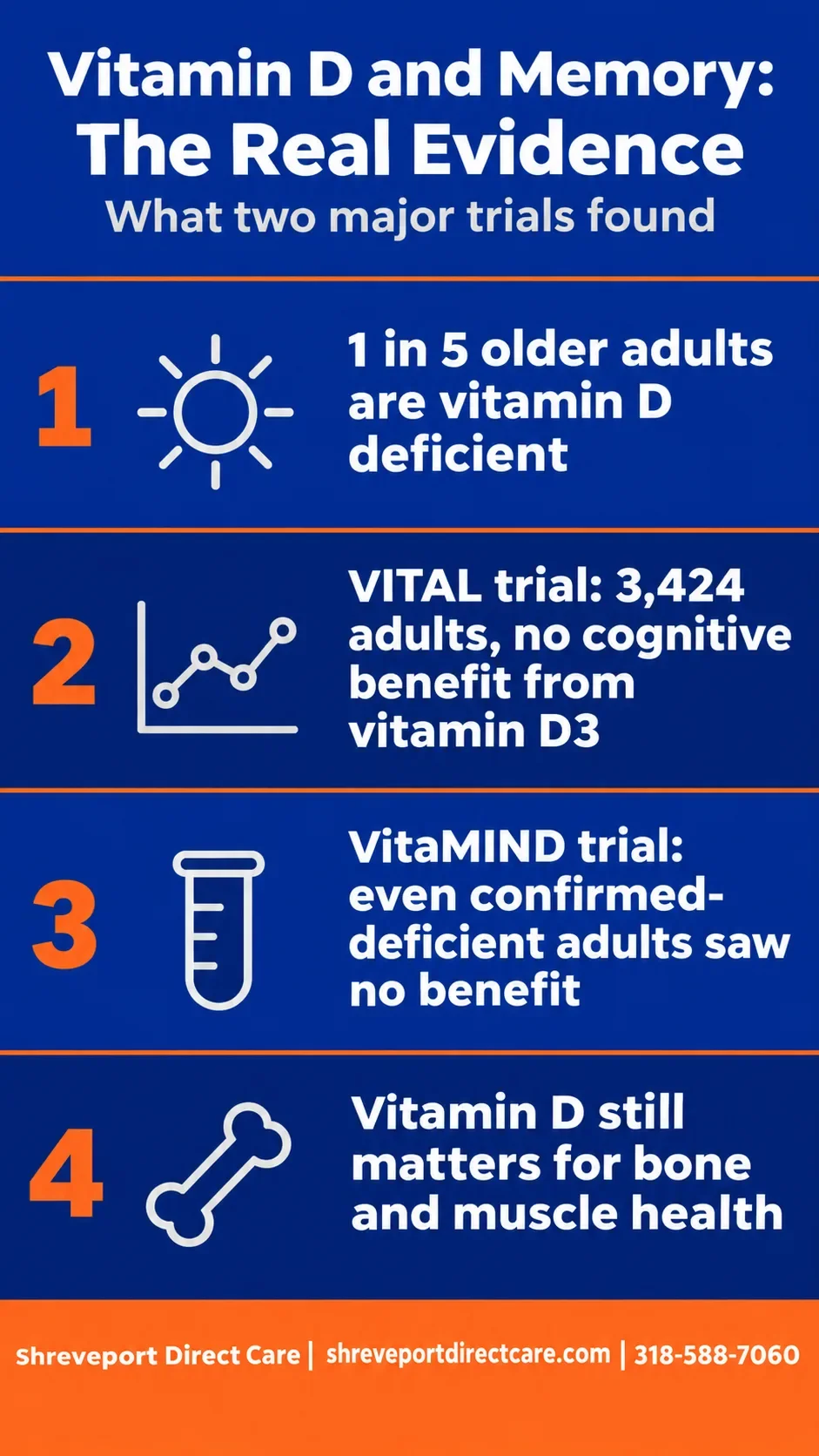
This part of the story checks out. National health survey data on U.S. adults 50 and older found roughly 1 in 5 were vitamin D deficient, with another third falling into the “insufficient” range, meaning a majority of older adults have less-than-optimal vitamin D levels.[1] Risk factors include older age, obesity, darker skin pigmentation, limited sun exposure, and living in northern latitudes, all of which describe a substantial share of primary care patients.
Given that deficiency is common and observational studies consistently associate low vitamin D with worse cognitive outcomes, it made sense to test whether correcting it directly improves memory. Two well-designed trials have now done exactly that.
Two Rigorous Trials Asked: Does Correcting It Help Memory?
Vitamin D deficiency and cognitive decline
The first is VITAL-Cog, an ancillary study of the large NIH-funded VITAL trial. Researchers followed 3,424 adults ages 60 to 91 for two to three years, randomly assigning them to 2,000 IU of daily vitamin D3 or a placebo. The result: no meaningful difference in the rate of cognitive decline between groups overall.[2] Notably, the benefit didn’t depend on participants’ starting vitamin D levels, a modest signal turned up specifically in Black participants, a finding the researchers said needs confirmation before it can be relied on.
The second trial, VitaMIND, targeted the population most likely to benefit: 620 adults over 50 with confirmed mild to moderate vitamin D deficiency and early cognitive changes. Over two years, participants received either vitamin D or a placebo. The result was the same. No significant improvement in executive function, working memory, or overall cognitive performance in the vitamin D group compared to placebo.[3]
Two trials, two different populations, one consistent answer: correcting vitamin D deficiency, even in people who were actually deficient, didn’t measurably improve memory or thinking in either study.
So Why Do Low Vitamin D Levels Keep Showing Up in Memory Research?
This is the same pattern we found when we looked at omega-3 supplements and brain health. Observational studies repeatedly link a nutrient to better cognitive outcomes, but when researchers run a randomized trial that actually tests cause and effect, the benefit doesn’t show up. People with low vitamin D often also spend less time outdoors, have less mobility, eat less varied diets, and have more chronic illness, any of which could independently explain worse cognitive outcomes. The vitamin D level may be a marker of overall health rather than a cause of cognitive decline in its own right.
Vitamin D Still Matters, Just Maybe Not for This Reason
None of this means vitamin D is unimportant. It plays a well-established role in bone health, muscle function, and immune health, and correcting a real deficiency remains worthwhile for those reasons. What the current evidence doesn’t support is taking vitamin D specifically as a memory-protection strategy, whether or not you’re deficient.
The practical takeaway is the same one we’ve covered in how to know if you have a vitamin deficiency: get tested, correct a real deficiency for the health reasons it actually supports, and don’t expect it to be your memory fix.
What This Looks Like at Shreveport Direct Care
For patients in Shreveport, Bossier City, and across Northwest Louisiana, this is exactly the kind of nuance that’s easy to miss in a rushed visit or a supplement aisle display. As a direct primary care practice, we have the time to check your actual vitamin D level, talk through what it does and doesn’t affect, and build your care plan around what the evidence actually supports. Dr. Bass’s approach to preventive care means you get the real picture, not just the marketing version.
For the broader set of habits with stronger memory evidence behind them, see 8 evidence-based ways to protect your memory.
Schedule a free meet-and-greet with Dr. Bass, no commitment, no pressure. Just a conversation about your health and how we can help.
Schedule your free visit at Shreveport Direct Care →
Phone/Text: 318-588-7060
Vitamin D and memory
FAQs:
1. Does vitamin D help with memory?
Two rigorous randomized trials, including one specifically in people with confirmed vitamin D deficiency, found no meaningful improvement in memory or cognitive function from vitamin D supplementation.
2. How common is vitamin D deficiency?
Very common. National survey data found roughly 1 in 5 U.S. adults 50 and older are vitamin D deficient, with another third in the insufficient range.
3. Should I still take vitamin D if I’m deficient?
Yes, for reasons unrelated to memory. Vitamin D supports bone health, muscle function, and immune health. Current trial evidence just doesn’t support it as a memory-protection strategy specifically.
4. What did the VITAL trial find about vitamin D and cognition?
The VITAL-Cog ancillary study followed 3,424 older adults for two to three years and found no overall difference in cognitive decline between those taking vitamin D3 and those taking a placebo.
5. Why do studies link low vitamin D to dementia risk if supplements don’t help?
Observational studies can’t rule out confounding factors. People with low vitamin D often have less mobility, less time outdoors, and more chronic illness, any of which could independently affect cognitive outcomes. Randomized trials are designed to isolate cause and effect, and they haven’t shown a cognitive benefit from supplementation.
6. Can a primary care doctor test my vitamin D level?
Yes. A simple blood test (25-OH vitamin D) can confirm whether you’re actually deficient, which matters for bone and muscle health even though current evidence doesn’t support it as a memory intervention.
References
PMC. The Prevalence and Determinants of Vitamin D Inadequacy among U.S. Older Adults: National Health and Nutrition Examination Survey 2007-2014. (Source for vitamin D deficiency and insufficiency prevalence among U.S. adults 50+.)
PMC / Scientific Reports. Effect of vitamin D on cognitive decline: results from two ancillary studies of the VITAL randomized trial. (Source for the VITAL-Cog trial finding no overall cognitive benefit from vitamin D3 supplementation.)
Journal of the American Medical Directors Association. Impact of Vitamin D Supplementation on Cognition in Adults With Mild to Moderate Vitamin D Deficiency: Outcomes From the VitaMIND Randomized Controlled Trial.2025. (Source for the VitaMIND trial finding no cognitive benefit even in confirmed deficient adults.)
*Shreveport Direct Care is a direct primary care practice serving adults and children in Shreveport, Bossier City, and surrounding communities in Northwest Louisiana.
Dr. Pat “Ricky” Bass III is board-certified in Internal Medicine and Pediatrics.*