
Can Weight Loss Lower Blood Pressure?
Can weight loss lower blood pressure?
Yes, and often more dramatically than patients expect.
High blood pressure, or hypertension, is one of the most common conditions we treat at Shreveport Direct Care. It is also one of the conditions most directly tied to body weight, a connection that surprises a lot of patients when we talk about it. Many people assume that blood pressure is simply a genetic hand they have been dealt, or that once they are on medication, they will be on it for the rest of their lives. Neither of those things is always true.
Nearly half of all American adults (47.7%) have high blood pressure.[1] Only about 1 in 4 of them has it under control.[1] In Louisiana, where obesity rates are among the highest in the country, that number is even more concerning. Excess weight and high blood pressure are deeply intertwined, and addressing one almost always improves the other.
This post explains exactly how weight loss affects blood pressure, how quickly that change can happen, and what patients on blood pressure medication need to watch for as they start losing weight.
Why Blood Pressure and Weight Are So Closely Connected
When a patient comes to us carrying extra weight and also dealing with high blood pressure, those two problems are rarely coincidental. They share a root. Excess body fat, particularly around the abdomen, increases the workload on the heart, raises inflammation throughout the body, disrupts insulin sensitivity, triggers hormonal changes that affect the kidneys, and activates the sympathetic nervous system in ways that drive blood pressure up.
That last point matters: the nervous system connection is one reason blood pressure can improve so quickly when someone starts losing weight, sometimes before the scale shows a meaningful change at all.
"Many people don't make the connection," says Dr. Bass. "They're also very surprised when I tell them that if they lose weight, they may not have to take blood pressure medicines anymore."
That possibility, getting off medication, is real for many patients. It is not guaranteed, and it depends on how long someone has had hypertension, what other risk factors are present, and how much weight they are able to lose and sustain. But for patients whose hypertension developed alongside weight gain, meaningful weight loss is often the most powerful intervention available. More powerful, in many cases, than adding another medication.
How Much Weight Loss Does It Take to See a Difference?
The relationship between weight and blood pressure is remarkably consistent in the research. According to the American Heart Association and American College of Cardiology 2025 guidelines, each kilogram (about 2.2 pounds) of weight lost produces approximately a 1 mmHg reduction in systolic blood pressure.[2]
That may not sound like much, but consider the math. A patient who loses 20 pounds, about 9 kilograms, can expect a systolic blood pressure reduction in the range of 7 to 10 mmHg. For someone with stage 1 hypertension (systolic between 130 and 139), that kind of reduction can bring their blood pressure into a normal range entirely, without changing their medication at all.
Clinical research backs this up. One systematic review found that weight loss interventions reduced clinic systolic blood pressure by an average of 5.79 mmHg and diastolic blood pressure by 3.36 mmHg.[3] In patients using GLP-1 medications alongside lifestyle changes, reductions have been even larger. Tirzepatide has produced mean systolic reductions of 7 to 10 mmHg at therapeutic doses.[4] For a closer look at how these medications work and what Shreveport patients should know before starting one, see our guide to GLP-1 weight loss in Shreveport.
Even modest weight loss, as little as 2 to 3% of body weight, has been shown to begin improving cardiovascular risk factors.[2] You do not have to wait until you have lost 50 pounds to start seeing your blood pressure move.
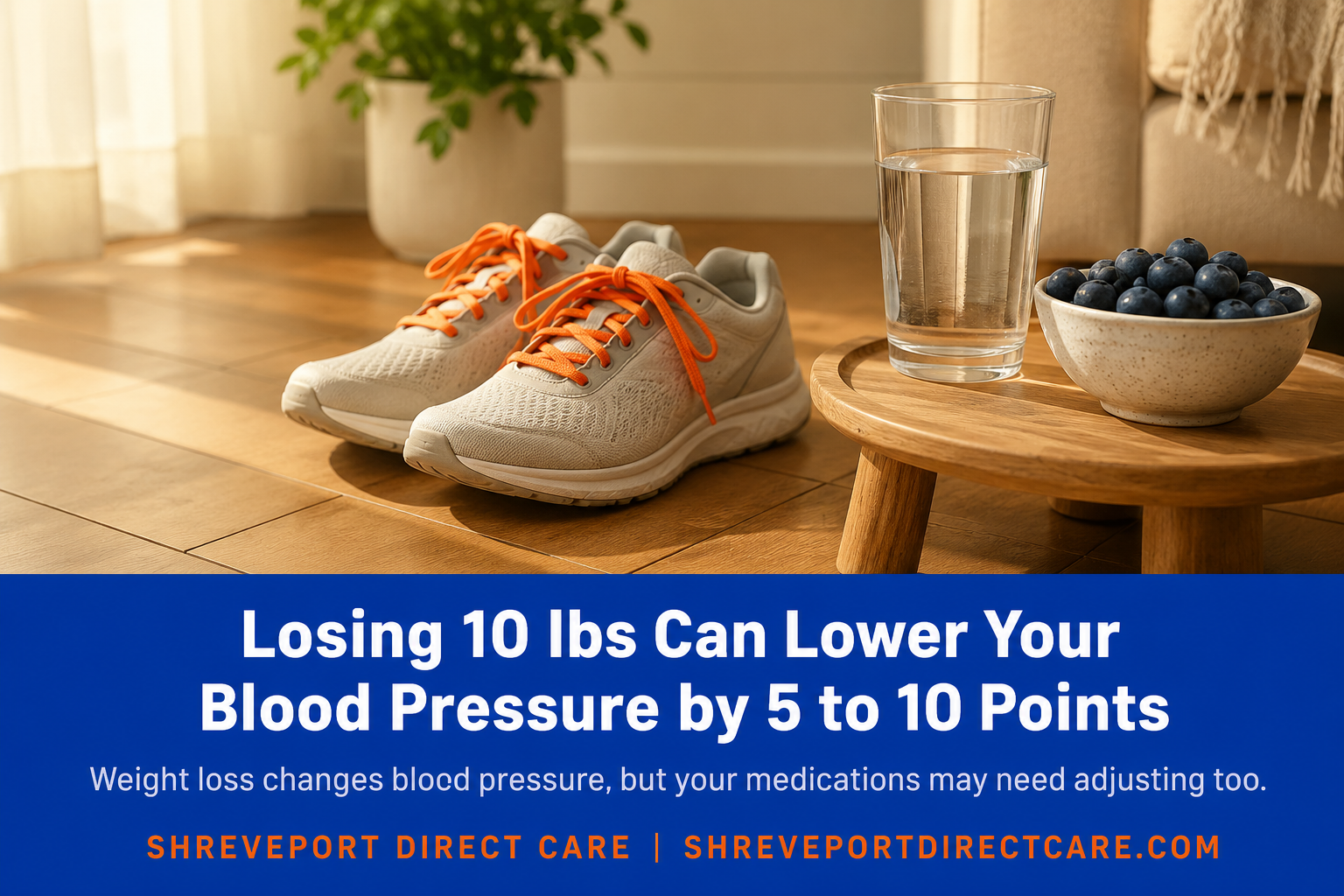
How much weight can you lose lowering blood pressure?
The Surprising Truth: Your Blood Pressure May Improve Before You Notice the Weight Loss
This is one of the clinical pearls Dr. Bass shares with patients that tends to catch them off guard.
"Blood pressure begins to correct even before patients will have noticeable weight loss," he says.
The research supports this. Studies on patients who have undergone metabolic interventions, including dietary changes and weight loss surgery, have documented measurable blood pressure improvements within days to weeks, well before the scale reflects significant change.[5] The mechanism involves multiple pathways: reductions in circulating insulin, changes in sympathetic nervous system tone, and improvements in how the kidneys handle sodium all begin quickly when someone starts eating differently and moving more.
What this means practically: if you start a physician-supervised weight loss program and your doctor is monitoring your blood pressure, do not be surprised if your numbers start to improve faster than your pants size does. That is not a fluke. That is your body responding to a meaningful change.
It also means your doctor needs to be watching. Which brings us to the part of this conversation that most online articles completely skip.
The Hidden Risk: What Happens to Your Blood Pressure Medications When You Start Losing Weight
This is the clinical detail that matters most, and it is one Dr. Bass makes sure every weight loss patient at Shreveport Direct Care understands before they begin.
When someone is on blood pressure medication and starts losing weight, their blood pressure may drop faster than expected. If their medication dose is not adjusted to account for that drop, their pressure can fall too low. The result is a condition called orthostatic hypotension, a sudden drop in blood pressure when standing up, along with persistent fatigue, lightheadedness, and general malaise that can make patients feel like something is wrong when actually something is going right.
"When patients are actively losing weight, we need to keep a close eye on their blood pressure," says Dr. Bass. "When they are on blood pressure medications, it can make it drop significantly. Patients may feel bad, experiencing things like orthostasis or fatigue."
Consider David, a 58-year-old patient from the Bossier City area who came to Shreveport Direct Care after starting a GLP-1 medication through an online service. He was already on two blood pressure medications when he began losing weight. Within eight weeks, he had lost 14 pounds, a great result. But he was also feeling persistently dizzy when he stood up and exhausted by mid-afternoon. He had assumed it was a side effect of the GLP-1. It was not. His blood pressure had dropped into a range where his existing medications were now too strong for his new physiology. A simple dose adjustment resolved the symptoms entirely. But nobody in his previous program had been monitoring his blood pressure as his weight changed, and nobody had warned him it might happen.
This is exactly why weight loss care is medical care, not just a wellness program. The body changes as the weight comes off. Someone needs to be watching and adjusting as that happens. For a full picture of what physician-supervised weight loss looks like in practice, see our complete guide to weight loss care in Shreveport.
At Shreveport Direct Care, blood pressure is monitored at every visit during active weight loss. If a patient is on antihypertensive medications, we track trends carefully and adjust proactively. The goal is not just to lose weight. It is to do it safely, with the full picture in view.
The Unintended Benefits Nobody Talks About
Here is the thing about weight loss that Dr. Bass wants every patient to understand. It rarely makes it into a typical doctor's conversation with a patient.
"In addition to feeling better physically and better about yourself when you see the scales drop, there are a number of unintended consequences of weight loss that can help overall improve your health."
Blood pressure is one. But it is far from the only one.
Patients who lose meaningful weight often see their blood sugar levels improve, sometimes enough to reduce or eliminate diabetes medications. Their cholesterol panels shift in the right direction. Their sleep improves, often dramatically, as excess weight around the airway decreases. Their joints hurt less. Their energy increases. Inflammatory markers fall. The risk of heart disease, stroke, and certain cancers decreases.
None of these benefits come separately. They come together, because excess body weight affects the body as a system, and addressing it improves the system as a whole.
This is part of why we talk about weight the same way we talk about blood pressure or diabetes: as a medical condition with biological roots, real health consequences, and treatments that work when applied correctly. There is no shame in carrying extra weight, and there is no shame in needing medical support to address it. What matters is having access to care that takes it seriously, with a doctor who sees the full picture.
What Physician-Led Weight Loss Care in Shreveport Looks Like
For patients in Shreveport, Bossier City, and the Ark-La-Tex who are dealing with high blood pressure alongside excess weight, Shreveport Direct Care offers the kind of integrated care that addresses both at the same time.
Our weight loss program begins with a complete laboratory workup, including blood pressure evaluation, metabolic panels, thyroid function, and fasting glucose, so we know exactly where you are starting. From there, we work with you on a specific plan: what you are eating, how you are moving, what medications may be appropriate, and how often we check in as things change. For a deeper look at the structure and philosophy behind the approach, see our post on physician-led weight management.
If you are already on blood pressure medication, we monitor your numbers closely and adjust your doses as your weight comes down. You will not be flying blind. You will not find out you were over-medicated by fainting in the kitchen.
Shreveport Direct Care operates on a flat monthly membership starting at $109 per month, which includes unlimited visits, direct text and email access to Dr. Bass, and over 1,000 generic medications at no additional cost. That model is particularly well-suited for weight loss care, because weight loss requires ongoing contact. You need someone tracking your progress, adjusting your plan, and monitoring everything that changes as the weight comes off.
Dr. Bass's background and training include board certification in both Internal Medicine and Pediatrics, which means he can evaluate the full range of conditions that interact with weight, from cardiovascular risk to metabolic syndrome to hormonal factors. Weight does not exist in isolation. It touches everything. Treating it well requires seeing everything.
If you have been told you have high blood pressure, or if you have been on blood pressure medication for years and wondering whether weight loss might change that, we would like to have that conversation with you.
Schedule a free meet-and-greet with Dr. Bass. No commitment, no pressure. Just a conversation about your health and how we can help. Schedule your free visit at Shreveport Direct Care →
Phone/Text: 318-588-7060 Email: info@shreveportdirectcare.com
FAQs
1. Can losing weight really lower blood pressure enough to stop medication? For many patients, yes, especially those whose hypertension developed alongside weight gain. Research shows approximately 1 mmHg of systolic blood pressure reduction per kilogram of weight lost. A 20-pound weight loss can produce enough reduction to bring some patients into a normal range. Whether you can reduce or stop medication depends on your individual history and should always be evaluated by your doctor.
2. How quickly does blood pressure respond to weight loss? Faster than most patients expect. Blood pressure can begin to improve within days to weeks of starting a weight loss program, sometimes before noticeable weight loss appears on the scale. The early improvements are driven by changes in nervous system activity, insulin levels, and how the kidneys handle sodium.
3. Is it dangerous to lose weight while on blood pressure medication? Not if you are being monitored properly. As weight comes off, blood pressure drops, and if your medication dose is not adjusted to account for that, your pressure can fall too low. Symptoms include dizziness when standing (orthostasis), persistent fatigue, and lightheadedness. This is why weight loss care at Shreveport Direct Care includes regular blood pressure monitoring and proactive medication adjustments.
4. What kind of weight loss is most effective for lowering blood pressure? Sustained weight loss through a combination of dietary changes, physical activity, and when appropriate, medical treatment. Even modest losses of 5 to 10% of body weight produce clinically meaningful blood pressure improvements. The approach that works best is medically supervised, personalized, and supported with regular follow-up.
5. Is high blood pressure common in Northwest Louisiana? Yes. Louisiana's hypertension rates are estimated to be around 8% higher than the national average, which itself sits near 48% of all adults.[1] Obesity rates in the Shreveport area are among the highest in the state, and the two conditions frequently occur together.
6. Does Shreveport Direct Care treat both weight and blood pressure together? Yes. Our weight loss program includes baseline and ongoing blood pressure monitoring, lab work, medication management, and a personalized plan for nutrition and physical activity. Membership starts at $109/month and includes unlimited visits and direct access to Dr. Bass. Schedule a free meet-and-greet →
References
High Blood Pressure Facts. Centers for Disease Control and Prevention. October 2024. (Supports 47.7% hypertension prevalence and 1-in-4 control rate among U.S. adults.)
Weight Loss Therapies and Hypertension Benefits. Biomedicines. 2024. (Supports ~1 mmHg systolic reduction per kg of weight lost; 2-3% weight loss improving CVD risk factors.)
Effect of weight loss on blood pressure changes in overweight patients: A systematic review and meta-analysis. PMC / NCBI. 2023. (Supports mean systolic reduction of 5.79 mmHg and diastolic reduction of 3.36 mmHg from weight loss interventions.)
New weight loss medication may help lower blood pressure in adults with obesity. American Heart Association. 2024. (Supports tirzepatide-associated systolic blood pressure reductions of 7-10 mmHg.)
Weight loss and blood pressure normalization: the relevance of early interventions in hypertension. Hypertension Research / Nature. 2009. (Supports early blood pressure improvements before significant weight loss; neuroendocrine and sympathetic nervous system mechanisms. Note: older study; most current data is consistent with these findings.)
Shreveport Direct Care is a direct primary care practice serving adults and children in Shreveport, Bossier City, and surrounding communities in Northwest Louisiana. Dr. Pat "Ricky" Bass III is board-certified in Internal Medicine and Pediatrics.