
Is Dementia Preventable? What the Research Recommends
Is dementia preventable?
Nearly half of all dementia cases worldwide could potentially be prevented or delayed by addressing a defined list of modifiable risk factors, according to a major 2024 update from the Lancet Commission on dementia that still drives public health strategy in 2026.[1] That's not a small claim, and it's backed by some of the most rigorous evidence synthesis in the field. Dementia is often talked about as something that either happens to you or doesn't, a matter of genetics and bad luck. The research doesn't support that framing anymore.
Here's what the research actually says, and what a real prevention plan looks like for patients in Shreveport and Bossier City.
The Headline Number: 45%
The Lancet Commission's 2024 report identified 14 modifiable risk factors across the life course, early life, midlife, and later life, that collectively account for an estimated 45% of dementia risk.[2] That figure grew from earlier estimates as researchers identified more contributing factors, and it reflects population-level risk, not a guarantee for any one individual. Still, the implication is significant: for a large share of dementia cases, the disease is not simply an unavoidable consequence of aging or genetics.
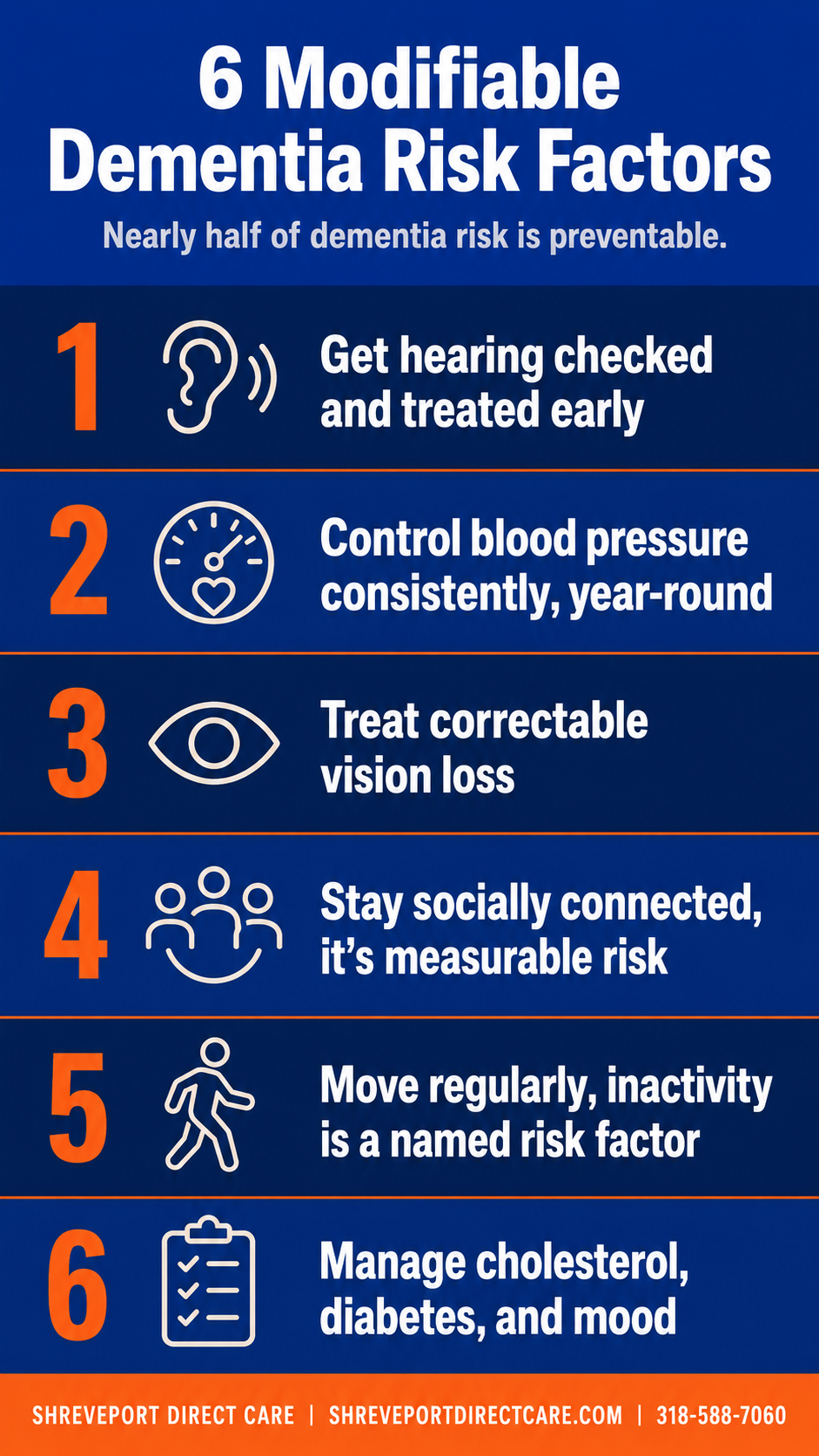
The risk factors identified by the Commission span three life stages. In early life, less education carries risk. In midlife, hearing loss, high LDL cholesterol, depression, traumatic brain injury, physical inactivity, diabetes, smoking, hypertension, obesity, and excessive alcohol use all play a role. In later life, social isolation, air pollution, and untreated vision loss round out the list.[3] Two factors, untreated vision loss and high LDL cholesterol, were added in the 2024 update, reflecting how quickly this evidence base is still evolving.[3]
Why Hypertension and Vascular Health Keep Showing Up
Vascular risk factors carry an outsized share of the modifiable burden. The 2024 report specifically credits reductions in smoking and improved blood pressure treatment with contributing to a measurable decline in age-specific dementia incidence already observed in high-income countries.[4] This tracks with a growing body of research on vascular contributions to cognitive decline. Reducing vascular damage protects not just the heart, but appears to directly protect brain tissue and cognitive reserve over time.[4] For patients already being treated for hypertension, this is one more reason consistent blood pressure control matters well beyond cardiovascular risk.
The Social Connection Finding: Isolation Isn't Just Lonely, It's Measurable Risk
One of the more underappreciated findings in this space comes from a global collaborative analysis published in The Lancet Healthy Longevity, which pooled data from over 40,000 people across 13 countries and cohorts spanning North America, South America, Europe, Africa, Asia, and Australia.[5] After excluding participants who already had dementia at baseline, researchers examined how social connection markers related to the rate of cognitive change over time.[5] Social isolation is now formally recognized as one of the Lancet Commission's 14 modifiable risk factors, alongside more commonly discussed factors like diet and exercise.[3]
This matters clinically because social connection is rarely treated as a medical variable. It doesn't show up on a lab panel, and it's easy for a rushed primary care visit to skip past it entirely. But the evidence increasingly places it in the same category as blood pressure or cholesterol, a modifiable factor worth actively addressing, not just a quality-of-life nicety.
Isolation increases dementia risk
Building the Evidence Into an Actual Plan
The research is encouraging, but a list of risk factors isn't the same as a plan. Recent work has focused specifically on how to translate this evidence into action, with mixed but informative results. A 2026 systematic review of population-level dementia-prevention interventions across eight countries found that broad mass-media awareness campaigns produced only marginal gains in public knowledge, while more personalized approaches, individualized risk profiling, structured online courses, and community-based programs, produced more consistent improvements in both knowledge and actual risk-reducing behavior.[6]
That finding lines up with what's worked in the largest clinical trials of dementia prevention. The Alzheimer's Association's U.S. POINTER trial, the largest randomized trial of its kind, found that a structured, higher-accountability lifestyle intervention combining exercise, a MIND-diet nutrition plan, cognitive and social engagement, and regular health monitoring produced greater cognitive benefit than a lower-structure, self-guided version of the same components.[7] In other words, generic advice to eat better and exercise more is real, evidence-based guidance, but it works better with structure, accountability, and someone tracking progress with you, not as a pamphlet handed over once a year.
A Practical Checklist
Based on the current evidence, a reasonable, evidence-aligned prevention plan starts with getting hearing checked and treated, since hearing loss is one of the largest single modifiable contributors identified by the Lancet Commission. From there, it means controlling blood pressure consistently, not just during the visit where it's measured, getting an eye exam and treating correctable vision loss, and addressing LDL cholesterol through diet, exercise, or medication as appropriate. Staying socially connected is now formal, quantified risk-factor territory, not just a nice-to-have, and moving regularly matters because physical inactivity is a named, modifiable risk factor in its own right. Treating depression rather than normalizing it as an unavoidable part of aging, limiting alcohol and avoiding smoking, managing diabetes and metabolic health, and protecting against head injury where relevant round out the list.
If any of this sounds like a lot to track on your own, that's the point. It's a lot to track, which is exactly why it needs a doctor who has the time to help you do it, not a list you're handed once a year.
When Memory Changes Deserve a Closer Look
Prevention is one half of the picture. The other half is knowing when a change in memory or thinking deserves a real evaluation rather than a wait-and-see approach. If you or a family member have noticed new or worsening symptoms, our guide on early warning signs of dementia walks through what to watch for. And if the changes are showing up specifically after age 50, memory loss after 50 covers the reversible causes primary care doctors often find and rule out first.
Families navigating a possible Alzheimer's diagnosis in Shreveport or the surrounding Ark-La-Tex area often have the same basic questions about what's next. We put together answers to 15 common questions about Alzheimer's disease to help families feel less overwhelmed at the start of that conversation.
Modifiable dementia risk factors
The Bottom Line
The old narrative, that dementia risk is fixed by genetics and bad luck, doesn't hold up against the current evidence. Nearly half of dementia risk sits in a category that's genuinely modifiable, and the research increasingly shows that structured, monitored intervention outperforms generic advice. The challenge isn't a lack of evidence. It's that most of these risk factors live outside any single specialist's lane, which is exactly why they tend to fall through the cracks in a rushed, fragmented model of care.
If you want a real prevention plan built around your actual risk factors, blood pressure, hearing, vision, metabolic health, and social engagement, schedule a visit with Shreveport Direct Care. Learn more about our memory and cognitive health services and how our membership model works to give you the time this kind of plan actually requires. We have the time to build that plan with you and track it over years, not just one appointment.
Schedule a free meet-and-greet with Dr. Bass, no commitment, no pressure. Just a conversation about your health and how we can help. Schedule your free visit at Shreveport Direct Care →
Phone/Text: 318-588-7060 Email:info@shreveportdirectcare.com
FAQs:
1. Can dementia actually be prevented? Not entirely, but research from the Lancet Commission estimates that nearly half of dementia risk worldwide comes from modifiable factors like blood pressure, hearing loss, and physical inactivity, meaning a meaningful share of cases could potentially be prevented or delayed.
2. What are the 14 modifiable risk factors for dementia? They span early life (less education), midlife (hearing loss, high LDL cholesterol, depression, traumatic brain injury, physical inactivity, diabetes, smoking, hypertension, obesity, excessive alcohol use), and later life (social isolation, air pollution, untreated vision loss).
3. Is social isolation really a dementia risk factor? Yes. Large international studies have found that social connection markers relate to the rate of cognitive change over time, and social isolation is now formally included among the Lancet Commission's 14 modifiable risk factors.
4. Does treating high blood pressure lower dementia risk? Growing evidence suggests it does. Improved blood pressure treatment has been credited with contributing to measurable declines in dementia incidence in high-income countries, likely by protecting vascular health and blood flow to the brain.
5. What's the most effective way to act on dementia prevention research? Structured, personalized approaches, like individualized risk profiling and monitored lifestyle programs, have outperformed generic public awareness campaigns in recent studies.
6. How can a primary care doctor in Shreveport help with dementia prevention? A Direct Primary Care visit allows time to review each of the modifiable risk factors individually, hearing, vision, blood pressure, cholesterol, mood, and social connection, and build a tracked plan around them, rather than a once-a-year checklist.
References
Livingston G, et al. Dementia prevention, intervention, and care: 2024 report of the Lancet standing Commission. The Lancet. 2024. (Primary source for the 45% modifiable risk estimate and the 14 risk factors.)
Targeting 14 lifestyle factors may prevent up to 45% of dementia cases. Alzheimer's Drug Discovery Foundation, Cognitive Vitality. (Summary of the Lancet Commission findings.)
Population attributable fractions of modifiable risk factors for dementia: a systematic review and meta-analysis. The Lancet Healthy Longevity. 2024. (Details the three life-stage risk factor categories.)
Dementia prevention, intervention, and care: 2024 report of the Lancet standing Commission. The Lancet. (Supports the vascular health and dementia incidence link.)
Associations between social connections and cognition: a global collaborative individual participant data meta-analysis. The Lancet Healthy Longevity. (Source for the 40,000-person social connection analysis.)
Population-level interventions for dementia prevention: a systematic review. The Lancet Healthy Longevity. 2026. (Supports findings on personalized vs. mass-media prevention approaches.)
Alzheimer's Association. U.S. POINTER Study Results. (Supports the structured lifestyle intervention findings.)
Shreveport Direct Care is a direct primary care practice serving adults and children in Shreveport, Bossier City, and surrounding communities in Northwest Louisiana. Dr. Pat "Ricky" Bass III is board-certified in Internal Medicine and Pediatrics.