
Heat-Related Illness in Shreveport: When to Go to the ER vs. Call Your Doctor
Shreveport summers are not subtle. From June through September, average high temperatures push into the mid-90s with humidity that routinely makes it feel like 105°F or hotter. The National Weather Service describes the Shreveport climate as "hot and oppressive" — a subtropical environment where the combination of heat and moisture creates genuine physiological stress for anyone spending time outdoors.
This isn't just uncomfortable. It's dangerous.
In 2023 — Louisiana's hottest summer on record — the state recorded 88 heat-related deaths and more than 6,100 emergency department visits for heat illness.[1] The region that includes Louisiana had the highest rate of heat-related ER visits in the entire country, at 483 visits per 100,000 — nearly ten times the rate seen in the Northeast.[4] In 2024, Louisiana still recorded 51 heat-related deaths and 4,463 ER visits.[3]
What makes Shreveport particularly high-risk is not just the temperature — it's the combination of extreme heat, high humidity, a large outdoor workforce, and a population with elevated rates of diabetes, hypertension, and cardiovascular disease. All of those conditions make the body far more vulnerable to heat stress.
Knowing the difference between heat illness that can be managed at home, heat illness that needs same-day physician attention, and heat illness that is a life-threatening emergency requiring 911 could save your life — or someone else's — this summer.
The Spectrum: From Uncomfortable to Life-Threatening
Heat illness isn't one thing. It's a progression — a continuum of conditions that range from minor to fatal, often moving from one stage to the next faster than people expect. Understanding where someone is on that spectrum is what determines whether you need water and shade, a phone call to your doctor, or an ambulance.
Here's the full progression, from mildest to most severe:
Heat Stroke Heat Exhaustion Shreveport Louisiana
Heat Rash (Prickly Heat)
What it looks like: Red, bumpy rash on the skin, usually where clothing traps sweat — neck, chest, groin, armpits. Itchy or stinging. More common in children.
What it means: Sweat ducts are blocked. The body is struggling to cool itself through the skin.
What to do: Move to a cool, dry area. Keep the skin dry. Wear loose, breathable clothing. Heat rash usually clears on its own in a few hours to days. If it persists, becomes infected, or involves fever, call your doctor.
Heat Cramps
What it looks like: Painful muscle spasms, usually in the legs, abdomen, or arms. Often the first sign that the body is under heat stress. The muscles are depleted of sodium and other electrolytes lost through heavy sweating.
What it means: The body is significantly dehydrated and low on electrolytes. This is a warning sign — heat cramps can progress to heat exhaustion if not addressed.
What to do: Stop activity immediately. Move to a cool place. Drink a sports drink or water with electrolytes. Stretch and gently massage the cramping muscle. Rest and avoid strenuous activity for several hours.
When to call your doctor: If cramps don't resolve within an hour, if the person has a heart condition or is on a low-sodium diet, or if the cramps keep coming back.
Heat Syncope
What it looks like: Fainting or near-fainting after prolonged standing or exercise in the heat. The person may feel dizzy, lightheaded, or nauseous just before losing consciousness briefly.
What it means: Blood has pooled in the legs and away from the brain. The body's cooling mechanisms are working hard and the cardiovascular system is strained.
What to do: Help the person lie down flat in a cool area with their legs elevated. Give them cool fluids if they're conscious and can swallow. Monitor closely.
When to go to the ER: If the person doesn't recover quickly, if they're confused or don't return to normal, or if they have a history of heart disease.
Heat Exhaustion
What it looks like: This is the most common serious heat illness, and it's what most people think of when they imagine someone "overheating." Symptoms include:
- Heavy sweating
- Cold, pale, clammy skin
- Fast, weak pulse
- Nausea or vomiting
- Headache
- Dizziness or lightheadedness
- Weakness or fatigue
- Muscle cramps
- Fainting
Core body temperature is elevated but typically below 104°F. The person is usually still conscious and coherent.
What to do immediately: Move the person to a cool, air-conditioned space. Remove excess or tight clothing. Apply cool, wet cloths to the skin — especially the neck, armpits, and groin. Have them sip cool water or a sports drink if they can keep it down. Fan them while misting with cool water.
When to call your doctor (don't go straight to ER): Mild heat exhaustion — the person is sweating, weak, and dizzy but conscious, coherent, able to drink fluids, and improving within 30 minutes of cooling and rehydration.
When to go to the ER: Heat exhaustion becomes an ER situation when:
- Symptoms don't improve within 30 minutes of cooling measures
- The person is vomiting and can't keep fluids down
- They faint or lose consciousness
- They become confused or disoriented
- They have chest pain, shortness of breath, or signs of a heart problem
- The person has diabetes, heart disease, or kidney disease, and you're uncertain
- A child or elderly person is showing these symptoms
Heat Stroke — Always Call 911
Heat stroke is a medical emergency. It can cause permanent brain damage or death within minutes if not treated immediately.
Heat stroke occurs when the body's core temperature rises above 104°F and the cooling system fails. There are two types:
Classic heat stroke: Happens to people who are passively exposed to extreme heat over hours or days — the elderly person without air conditioning during a heat wave, the child left in a hot car. Sweating may or may not be present.
Exertional heat stroke: Happens to active people — outdoor workers, athletes, military recruits — during intense physical activity in the heat. The body generates more heat than it can expel. The person is often still sweating.
Signs of heat stroke — call 911 immediately if you see any of these:
- Confusion, disorientation, or bizarre behavior
- Slurred speech
- Loss of consciousness or unresponsiveness
- Seizures
- High body temperature — above 104°F
- Hot, red skin (dry or damp — sweating does not rule out heat stroke)
- Rapid, strong pulse
- Throbbing headache
- Nausea or vomiting along with any of the above
What to do while waiting for 911:
Do not wait to see if they improve. Call 911 first, then act.
- Move the person to a cool or shaded area immediately.
- Remove outer clothing.
- Cool the person as rapidly as possible — this is the most important intervention. The 2025 Society of Critical Care Medicine guidelines confirm that cold or ice water immersion achieves the fastest cooling rate and should be prioritized when available.6 If you have a tub, fill it with cool or ice water. If not, apply ice packs or bags of ice directly to the neck, armpits, and groin. Pour cool water over them. Fan aggressively.
- Do NOT give fluids to someone who is unconscious or confused.
- Stay with them until emergency services arrive.
Every minute counts. Heat stroke can cause body temperature to rise to 106°F or higher within 10 to 15 minutes. Rapid cooling before hospital arrival improves outcomes dramatically.
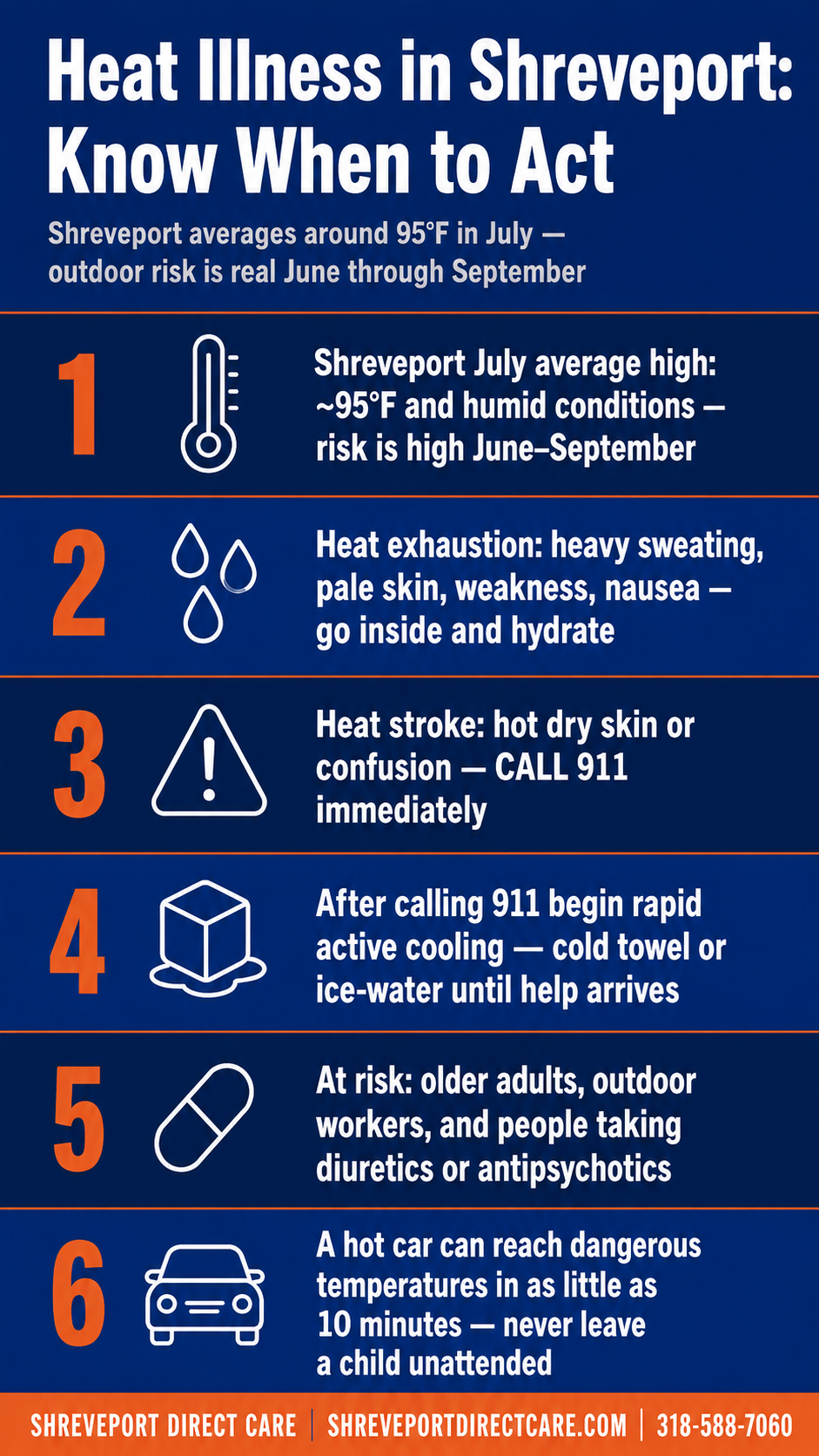
When to Go to ER Heat Illness
Who Is Most at Risk in Shreveport
Not everyone faces the same heat risk. The Louisiana Department of Health identifies these groups as highest risk for heat illness in our state:
Outdoor workers. In 2023, nearly one-quarter of all heat-related ER visits in Louisiana involved workers. Males made up 76% of all heat-related ER visits statewide, and for adults ages 20 to 59, 8 out of 10 visits were male — directly reflecting the prevalence of male-dominated outdoor occupations in construction, landscaping, utility maintenance, and agriculture in the Shreveport area.2
Elderly adults. The ability to regulate body temperature declines with age. Older adults also sweat less efficiently, may not feel thirst until they're already dehydrated, and are more likely to be living alone without someone to notice they're struggling.
People with chronic health conditions. Diabetes impairs the body's ability to regulate temperature and increases dehydration risk. Hypertension and cardiovascular disease mean the heart and blood vessels are already under strain. Obesity reduces the body's cooling efficiency. People with these conditions — prevalent throughout Shreveport — face elevated risk in any heat event.
People without air conditioning. In Louisiana's heat, even a few hours without AC can become dangerous. This is particularly true during heat waves, when nighttime temperatures stay elevated and the home never fully cools down.
Children. Children's bodies produce more heat relative to their size and cannot regulate temperature as effectively as adults. They also depend entirely on adults to keep them out of dangerous heat. Never leave a child in a parked car — even for a few minutes, even with windows cracked. Car temperatures can reach life-threatening levels within ten minutes.
People who drink alcohol or use substances. In 2023, drugs or alcohol were involved in 31% of all heat-related deaths in Louisiana.1 Alcohol causes blood vessels to dilate, which can falsely make a person feel cool while core temperature actually rises. It also impairs judgment and masks the warning signs of heat illness.
Your Medications May Be Affecting Your Heat Tolerance — Without You Knowing
This is one of the most underappreciated risks in heat illness prevention, and it's especially relevant in Shreveport where many residents manage chronic conditions with multiple medications.
Several common drug classes directly impair the body's ability to cool itself:
Diuretics ("water pills") — commonly prescribed for high blood pressure and heart failure — increase fluid loss through urination, raising dehydration risk in the heat.
Beta-blockers — used for heart disease and hypertension — reduce the heart rate response to exercise and heat, which means the body is less able to pump blood efficiently to the skin for cooling.
Antihistamines — including many over-the-counter allergy medications like diphenhydramine (Benadryl) — reduce sweating, one of the primary mechanisms of heat dissipation.
Antipsychotics and certain antidepressants — impair the hypothalamus's ability to regulate body temperature and also reduce sweating.9
ACE inhibitors and ARBs — can affect kidney function and electrolyte balance in extreme heat.
If you're taking any of these medications and you plan to be outdoors in Shreveport's summer heat, this is a conversation worth having with your doctor before the season gets fully underway — not after you're already symptomatic. Your physician can help you understand your specific risk, adjust how you hydrate, and identify warning signs you should watch for given your medication regimen.
Prevention: Practical Rules for Shreveport Summer
Most heat illness is preventable. These guidelines from the CDC and Louisiana Department of Health apply directly to life in Northwest Louisiana:
Drink water before you're thirsty. By the time you feel thirst, you're already dehydrated. The LDH recommends 2 to 4 glasses (16–32 ounces) of water per hour when working or exercising outdoors. Sports drinks help replenish electrolytes lost through sweat for people doing intense activity.
Avoid outdoor activity during peak heat. In Shreveport, the most dangerous window is typically 10 a.m. to 4 p.m. in summer. Schedule outdoor work and exercise for early morning or evening when possible.
Dress for the heat. Light-colored, loose-fitting, lightweight clothing reflects sunlight and allows airflow. Dark, tight, or heavy fabrics trap heat.
Take frequent shade breaks. Even 15 minutes in shade or air conditioning helps your body reset. Shade alone doesn't cool the body as effectively as air conditioning or cool water, but it meaningfully reduces heat exposure.
Never leave children or pets in parked cars. This bears repeating every summer because it keeps happening. A car parked in Shreveport's July sun can reach 140°F inside within 20 minutes.
Check on elderly neighbors and family members. Heat illness often progresses slowly in older adults who may not recognize the signs. A welfare check during a heat wave can be lifesaving.
Know the heat index, not just the temperature. Humidity dramatically increases how hot it feels and how hard your body has to work. When the heat index — the "feels like" temperature combining heat and humidity — is above 103°F, outdoor activity carries serious risk. Above 125°F, heat stroke can occur rapidly even in healthy people doing little activity.
How Shreveport Direct Care Fits In
Heat illness exists on a spectrum, and not every case belongs in an emergency room. Mild heat exhaustion, persistent heat cramps, heat rash in a child, or concern about whether your medications are putting you at risk — these are exactly the kinds of things that belong with a primary care physician who knows you and has time to talk.
At Shreveport Direct Care, same-day appointments are the standard, not the exception. If someone in your family is symptomatic but not in heat stroke territory — exhausted, nauseated, weak, not recovering as quickly as you'd expect — you can text Dr. Bass directly and get guidance on whether to head in, manage at home, or go to the ER.
For patients managing chronic conditions like diabetes, hypertension, or heart disease, a brief pre-season conversation about heat safety — including a review of your medications and their effects on heat tolerance — can prevent an ER visit later. That kind of proactive care is built into the SDC membership.
If you've had a heat-related illness and you want to understand why you're more vulnerable, or if you're on multiple medications and heading into the Shreveport summer worried about how to manage, Dr. Bass has the time to work through that with you in an hour-long visit — something a 12-minute traditional appointment simply cannot accommodate.
> Don't wait until you're in crisis.> Schedule a free meet-and-greet with Dr. Bass — especially if you have chronic conditions or take medications that may affect your heat tolerance this summer. > Book your free visit at Shreveport Direct Care →
Shreveport Direct Care is a direct primary care practice serving adults and children in Shreveport, Bossier City, and surrounding communities in Northwest Louisiana. Dr. Pat "Ricky" Bass III is board-certified in Internal Medicine and Pediatrics.
FAQs:
1. What is the difference between heat exhaustion and heat stroke? Heat exhaustion is serious but not immediately life-threatening. Signs include heavy sweating, cold and clammy skin, weakness, nausea, and a fast but weak pulse — with core body temperature typically below 104°F and the person still conscious and coherent. Heat stroke is a medical emergency. It occurs when core temperature rises above 104°F and the body's cooling system fails. Key warning signs include confusion, slurred speech, loss of consciousness, seizures, and hot red skin. If you see any signs of heat stroke, call 911 immediately — do not wait to see if things improve.
2. When should I go to the ER for heat illness versus call my doctor? Call your doctor — or text Dr. Bass at Shreveport Direct Care — when someone is sweaty, weak, and dizzy but conscious, coherent, able to drink fluids, and improving within 30 minutes of cooling and rest. Go to the ER when symptoms don't improve after 30 minutes of cooling, the person is vomiting and can't keep fluids down, they faint or become confused, or they have chest pain or shortness of breath. Call 911 immediately for any sign of heat stroke: confusion, loss of consciousness, seizures, or a body temperature above 104°F.
3. Which medications increase heat illness risk during Shreveport summers? Several common drug classes impair the body's ability to cool itself. Diuretics (water pills) increase dehydration risk. Beta-blockers reduce the heart rate response the body needs to push blood to the skin for cooling. Antihistamines like Benadryl reduce sweating. Antipsychotics and some antidepressants impair the brain's temperature regulation. ACE inhibitors and ARBs can affect kidney function and electrolyte balance in extreme heat. If you take any of these medications and plan to be outdoors during a Shreveport summer, have that conversation with your doctor before the season starts — not after you're already symptomatic.
4. How do I cool someone down during a heat emergency? For heat exhaustion: move the person to a cool, air-conditioned space; remove excess clothing; apply cool, wet cloths to the neck, armpits, and groin; and give cool water or a sports drink if they can swallow. For heat stroke — call 911 first, then act: immerse the person in cool or ice water if possible, since the 2025 Society of Critical Care Medicine guidelines confirm cold water immersion achieves the fastest cooling rate. If immersion isn't available, apply ice packs to the neck, armpits, and groin; pour cool water over the body; and fan aggressively. Never give fluids to someone who is unconscious or confused.
5. Who is most at risk for heat illness in Shreveport, Louisiana? The highest-risk groups in Shreveport include outdoor workers — men ages 20 to 59 account for 8 out of 10 heat-related ER visits in Louisiana — along with elderly adults, people with chronic conditions like diabetes, hypertension, and cardiovascular disease, those without air conditioning, children, and people who drink alcohol or use substances. Drugs or alcohol were involved in 31% of Louisiana's heat-related deaths in 2023. Shreveport's subtropical heat and high humidity amplify the risk for all of these groups compared to most of the country.
6. How much water should I drink to prevent heat illness in Shreveport's summer? The Louisiana Department of Health recommends 2 to 4 glasses — 16 to 32 ounces — of water per hour when working or exercising outdoors. Don't wait until you feel thirsty: by the time thirst kicks in, you're already dehydrated. For intense or prolonged outdoor activity, add a sports drink to replace electrolytes lost through sweat. Avoid alcohol and caffeine in the heat, as both increase fluid loss. During Shreveport's peak heat window (10 a.m. to 4 p.m.), schedule regular breaks in air conditioning or shade and don't push through warning signs like dizziness or muscle cramps.
References
- Louisiana Department of Health. Heat-Related Illness and Deaths. LDH. 2024. (88 deaths and 6,142 ED visits in 2023; drugs/alcohol involved in 31% of deaths; high-risk groups including outdoor workers, elderly, chronic disease patients.)
- Louisiana Department of Health. LDH Launches Expanded Heat-Related Illness Dashboard. LDH. June 2024. (Males 76% of heat-related ED visits; ages 20–59 = 8 out of 10 visits male; Black Louisianans at higher rates; 24% of visits involved workers.)
- Louisiana Department of Health. As Summer Heats Up, LDH Helps Residents Prevent Heat-Related Illness. LDH. June 2025. (51 heat-related deaths and 4,463 ED visits in 2024; updated high-risk populations and prevention guidance.)
- CDC / MMWR. Heat-Related Emergency Department Visits — United States, May–September 2023. CDC MMWR. April 2024. (HHS Region 6 — including Louisiana — had highest heat-related ED visit rate nationally at 483 per 100,000; males ages 18–64 disproportionately affected.)
- CDC. Heat-Related Illnesses. National Institute for Occupational Safety and Health. 2026. (Full spectrum of heat illnesses; heat stroke as medical emergency; cooling and first aid protocols.)
- Society of Critical Care Medicine. Guideline for the Treatment of Heat Stroke. SCCM. February 2025. (Cold or ice water immersion as fastest cooling method; strong recommendation for active cooling.)
- Wilderness Medical Society. Clinical Practice Guidelines for the Prevention and Treatment of Heat Illness: 2024 Update. Wilderness & Environmental Medicine. 2024. (Evidence-based guidelines for heat exhaustion and heat stroke recognition, treatment, and prevention.)
- Weather Atlas. Climate and Monthly Weather Forecast — Shreveport, LA. Weather Atlas. 2024. (Average July/August highs of 95.5°F; relative humidity 77–80%; subtropical humid climate classification.)
- HHS. Extreme Heat. U.S. Dept of Health and Human Services. 2024. (Louisiana/Texas region experienced 30+ days above 95th percentile heat in 2023; diuretics, antihistamines, and antipsychotics identified as medications impairing heat tolerance.)