
Semaglutide Produces Nearly 15% Weight Loss: What the STEP 1 Trial Means for You
Semaglutide Weight Loss Results
If you've heard about Ozempic or Wegovy and wondered whether the results people talk about are real — there's a landmark clinical trial that answers that question with hard numbers. And for patients in Shreveport and Northwest Louisiana, where obesity rates are among the highest in the country, those numbers matter.
The STEP 1 trial — published in the New England Journal of Medicine in February 2021 — was a major turning point in how medicine thinks about weight loss. It wasn't a small study, and it wasn't funded by anecdote. Here's what it found, what it means, and what it doesn't mean.
What the Study Was
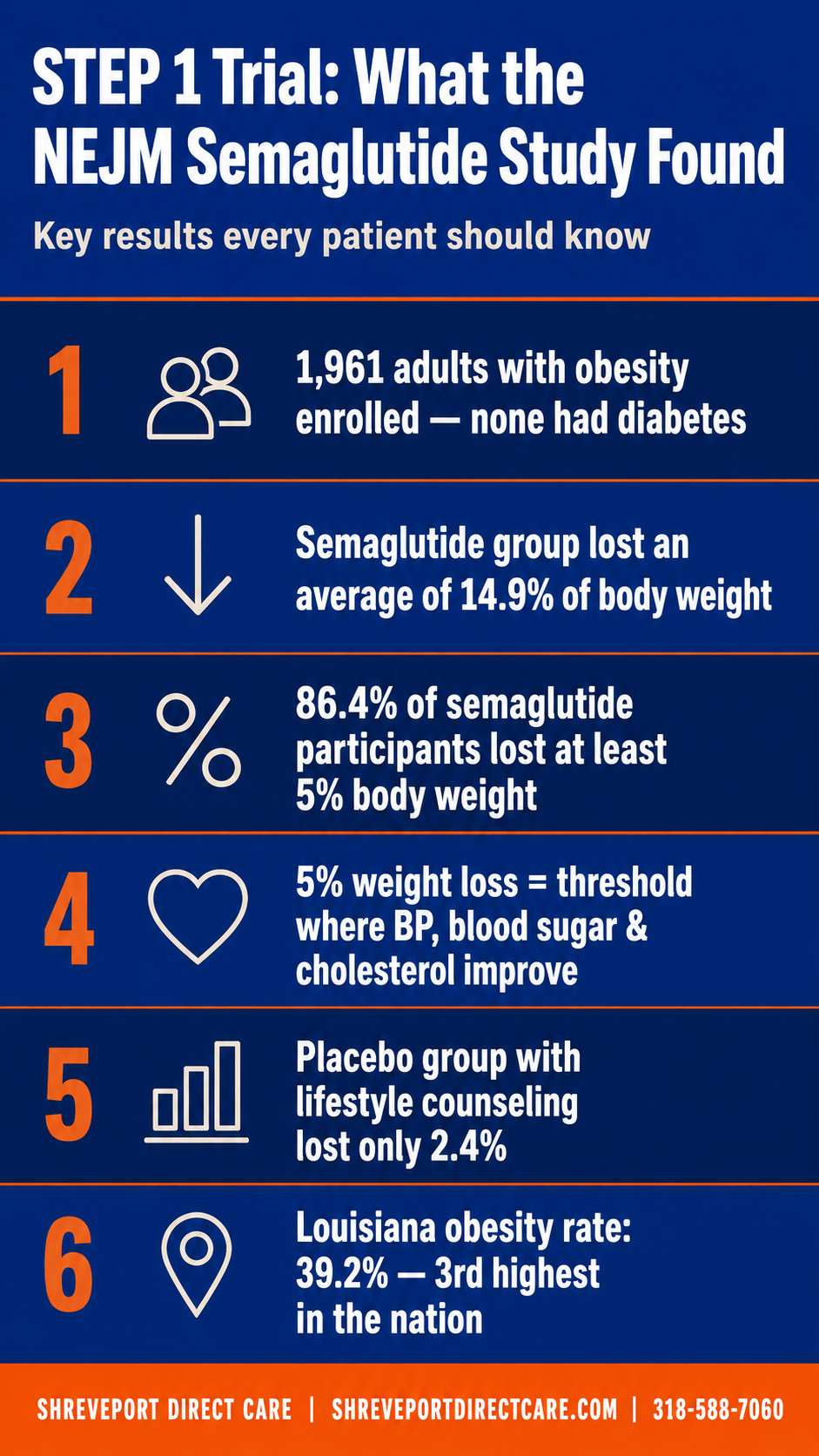
STEP 1 (Semaglutide Treatment Effect in People with Obesity) was a randomized, double-blind, placebo-controlled trial involving 1,961 adults with obesity or overweight with at least one weight-related health condition — none of whom had diabetes.[1]
Participants were randomly assigned to receive once-weekly subcutaneous semaglutide at 2.4 mg or a placebo injection for 68 weeks. Both groups also received lifestyle intervention — counseling on diet and physical activity. The study was sponsored by Novo Nordisk, the manufacturer of semaglutide, and reviewed by an independent data monitoring committee.
The average participant was 46 years old, and nearly three-quarters of participants were women. About 45% had pre-diabetes at the start of the trial — a meaningful detail, given how closely weight and metabolic health are intertwined.
What the Study Found
The results were striking.
Participants taking semaglutide lost a mean of 14.9% of their body weight over 68 weeks. Those taking placebo lost 2.4%.[1] That's an estimated treatment difference of 12.4 percentage points — meaning the medication, on top of lifestyle intervention, drove most of the result.
Even more telling: 86.4% of the semaglutide group lost at least 5% of their body weight, compared with 31.5% in the placebo group.[1] A 5% reduction is the threshold most guidelines consider clinically meaningful — the point at which blood pressure, blood sugar, cholesterol, and other metabolic markers typically begin to improve.
For a patient weighing 250 pounds, a 14.9% reduction means losing roughly 37 pounds. For a patient at 200 pounds, it means approximately 30 pounds. These aren't theoretical numbers — they reflect what participants in a rigorous clinical trial actually achieved.
GLP-1 weight loss Shreveport
What About Side Effects?
The overall rates of adverse events were similar between groups — 89.7% in the semaglutide arm versus 86.4% in the placebo arm.[1] Most side effects were gastrointestinal: nausea, vomiting, diarrhea, and constipation. These are well-known with GLP-1 medications and typically most pronounced in the early weeks of treatment.
4.5% of participants taking semaglutide stopped the medication due to gastrointestinal side effects, compared with 0.8% in the placebo group.[1] That's a real number worth knowing — most people tolerate the medication, but some don't, and that's something to discuss with your doctor before starting.
Serious adverse events occurred in 9.8% of the semaglutide group and 6.4% of the placebo group. The trial did not show increased risk of pancreatitis or other severe complications that had been a concern in earlier studies of GLP-1 class medications.
Medically Supervised Weight Loss Northwest Louisiana
What This Means for Patients in Shreveport and the Ark-La-Tex
Louisiana's obesity rate reached 39.2% in 2024 — the third highest in the country.[2] That means a significant portion of the patients Dr. Bass sees at Shreveport Direct Care are dealing with the exact conditions this trial was designed to address: obesity, pre-diabetes, high blood pressure, elevated cholesterol, and the cascade of health consequences that follows.
The STEP 1 trial is important because it established, in a controlled setting, that semaglutide produces real, meaningful weight loss when used appropriately — not a few pounds, but the kind of reduction that changes metabolic health. It's why semaglutide at 2.4 mg (sold as Wegovy) received FDA approval for weight management in adults without diabetes.
What the trial also confirms is something Dr. Bass emphasizes with every weight loss patient: medication works best alongside lifestyle changes, not instead of them. Both groups in STEP 1 received lifestyle counseling. The combination of medication and lifestyle intervention is what produced those numbers.
At Shreveport Direct Care, weight loss care means exactly that — a full evaluation, labs, a personalized plan, and regular follow-up to monitor how your body responds and adjust as needed. A prescription without that foundation produces different results than what the trial showed.
The Bottom Line
The STEP 1 trial established semaglutide as a genuinely effective medical tool for weight loss in adults with obesity who don't have diabetes. A mean weight loss of nearly 15% over 68 weeks, with 86% of participants losing at least 5%, represents a meaningful shift in what's possible with physician-guided obesity treatment.
If you've been wondering whether these medications are worth considering — or whether physician-supervised weight loss is right for you — we'd like to have that conversation.
Schedule a free meet-and-greet with Dr. Bass — no commitment, no pressure. Book your free consultation →
Phone/Text: 318-588-7060 Email: info@shreveportdirectcare.com
Keywords: semaglutide weight loss results, STEP 1 trial semaglutide, Wegovy weight loss study, GLP-1 weight loss Shreveport, medically supervised weight loss Northwest Louisiana
References
Wilding JPH, Batterham RL, Calanna S, et al. Once-Weekly Semaglutide in Adults with Overweight or Obesity. N Engl J Med. 2021;384(11):989–1002. (Primary source — all STEP 1 trial data cited in this post.)
Louisiana's obesity rate hit 39.2% in 2024. Axios New Orleans / Trust for America's Health. October 2025. (Supports Louisiana obesity prevalence statistic.)
Shreveport Direct Care is a direct primary care practice serving adults and children in Shreveport, Bossier City, and surrounding communities in Northwest Louisiana. Dr. Pat "Ricky" Bass III is board-certified in Internal Medicine and Pediatrics.