
What Is Comprehensive Primary Care?

What Is Comprehensive Primary Care?
If you've searched this question, you already sense that something is missing from the way most people receive medical care. Maybe you've had a string of specialist appointments that never quite answered the underlying question. Maybe you've left an annual physical feeling like you went through a checklist rather than a conversation. Maybe you've wondered whether there's a version of healthcare that actually accounts for you as a whole person, your history, your goals, your family, your life.
There is. It's called comprehensive primary care, and it's rarer than it should be.
Comprehensive primary care is not a new concept. But in a system that rewards volume over depth, it has become increasingly difficult to find in practice. Understanding what it actually means, and what to look for in a doctor who provides it, can change the way you think about your health and who you trust to help you manage it.
The Definition: More Than a Check-Up
Comprehensive primary care is the integration of prevention, treatment, and ongoing health management, delivered through a continuous relationship between a patient and a physician who knows them well.
That last part matters as much as the first. Comprehensive care isn't just a longer checklist at your annual physical. It's what becomes possible when a doctor has taken the time to understand who you are, what you value, what your family history looks like, what your stress level is, and where you want to be in five years. It's what happens when the relationship is the foundation of care, not an afterthought.
The Institute of Medicine has identified continuity of care as a defining characteristic of true primary care, and research consistently backs that up. Patients who have a continuous relationship with a personal physician have lower rates of emergency department visits and hospitalizations, better chronic disease management, higher satisfaction with care, and better quality of life.1 The relationship itself is clinically meaningful.
Comprehensive primary care also has a broader scope than most people realize. It extends beyond physical illness to include mental health, screening for depression, anxiety, and behavioral health concerns that often drive physical symptoms. It includes social and behavioral factors: sleep, stress, relationships, work environment, food access, and the dozen other things outside the exam room that shape health outcomes. A comprehensive primary care physician doesn't just treat the condition. They see the person the condition is happening to.
What Most People Get Wrong About Primary Care
Here's a pattern Dr. Bass sees regularly: a patient arrives having seen three or four specialists over the past year. Each specialist addressed their piece of the problem, a cardiologist for the irregular heartbeat, a GI doctor for the reflux, an endocrinologist for the thyroid, but nobody looked at the full picture. Nobody asked whether the sleep problems were driving the cardiac symptoms, whether the reflux was connected to the weight, whether the thyroid issue had been addressed in the context of everything else going on. Nobody had the time, or the relationship, to make those connections.
"Many people think that they don't need a primary care doctor," says Dr. Bass, "or that many primary care doctors just refer out for complaints, so they consistently seek specialty care. But a good primary doctor can manage your concerns, expectations, and desires for health and work within your value system to make sure your health is optimized."
That phrase, work within your value system, is one of the most important things a primary care doctor can do, and one of the things that gets lost most easily in a system built around brief appointments and billing codes. Our post on finding the right primary care doctor in Shreveport covers what that actually looks like when the relationship is built correctly.
Here's an example Dr. Bass uses with patients: prostate cancer screening. A man comes in for an annual physical. In many traditional practices, a PSA blood test gets ordered almost automatically, it's on the checklist. But a good comprehensive primary care physician stops and has a conversation first. What are the real benefits of this test for you, at your age, with your history? What are the limitations? What would you do if the result were abnormal? Would you want to pursue further workup, biopsy, treatment, or would the uncertainty itself cause more harm than good?
"Many people just get blood drawn during an annual physical," says Dr. Bass. "For a male, a good primary care doctor is going to talk about the risk, benefits, and limitations of screening for something like prostate cancer, rather than have you get screened, have an abnormal value, and then maybe not really have wanted to have gotten screened."
That conversation takes time. It requires a doctor who knows the patient well enough to have it meaningfully. It is exactly what comprehensive primary care looks like in practice, and exactly what gets squeezed out when visits are capped at 15 minutes and productivity is measured in patient volume.
What Comprehensive Primary Care Actually Covers
When done well, comprehensive primary care addresses the full range of a person's health needs, not just the acute problem that prompted the visit.
Prevention. This means age-appropriate screenings, but it also means the conversation that happens before the test. It means understanding your cardiovascular risk before your first cardiac event, not after. It means vaccinations, lifestyle counseling, and the kind of anticipatory guidance that helps you avoid problems rather than just respond to them.
Chronic disease management. Diabetes, high blood pressure, high cholesterol, thyroid conditions, ADHD, anxiety, obesity — a comprehensive primary care physician manages these ongoing conditions over time. Not just writing refills, but tracking trends, adjusting treatment, and responding when something changes. Treating obesity well, for example, often improves multiple other conditions simultaneously, as we explore in our post on whether weight loss can lower blood pressure.
Acute illness. When you're sick, you should be able to reach your doctor, not urgent care, not the ER, not a nurse practitioner you've never met. A comprehensive primary care physician can evaluate, treat, and follow up on the full range of common acute illnesses.
Mental health. Depression and anxiety are among the most common conditions in primary care. A comprehensive primary care physician screens for them, treats them when appropriate, and knows when a referral to a specialist adds value versus when it fragments care unnecessarily.
Social and behavioral health. Sleep, stress, nutrition, physical activity, substance use, relationships, housing stability. These factors shape health outcomes as powerfully as any medication. Comprehensive primary care addresses them, not in a judgmental way, but as part of the clinical picture.
Family continuity. Ideally, comprehensive primary care extends across a family. When a physician knows not just you, but your spouse, your children, and your aging parents, the context of your care deepens. Patterns emerge. Connections get made that would never appear in an isolated specialist visit. A family doctor in Shreveport who truly provides comprehensive care can manage a remarkably broad range of conditions across every stage of life.
Comprehensive Primary Care Sees the Whole Picture.
Why Most Patients End Up With Fragments Instead of Care
The U.S. healthcare system generates an estimated 19.7 million clinically inappropriate specialist referrals every year.[2] A significant portion of those happen not because primary care couldn't handle the problem, but because the appointment was too short, the relationship too thin, or the incentive structure pointed toward referral rather than management.
Patients often seek out specialist care directly, bypassing primary care entirely, because they've been conditioned to believe that specialists are always better. Sometimes they are, when the problem genuinely requires subspecialty expertise. But more often, a skilled comprehensive primary care physician can manage the concern, order the right workup, interpret the results in context, and spare the patient the cascade of appointments, bills, and conflicting opinions that specialist-seeking tends to generate.
Consider Teresa, a 44-year-old patient from the Northwest Louisiana area who came to Shreveport Direct Care after two years of bouncing between a cardiologist, a neurologist, and a rheumatologist for a constellation of symptoms that none of them had been able to explain. She was exhausted, increasingly anxious, and felt like no one had ever looked at her as a whole person. At her first visit, Dr. Bass spent an hour reviewing her complete history. By the end, he had identified a combination of undertreated hypothyroidism, sleep apnea that had never been formally evaluated, and significant work-related stress that was amplifying every other symptom. Within four months of addressing all three together, not in isolation, she felt better than she had in years. No new specialists required.
That's not a miracle. That's what comprehensive primary care looks like when there's enough time and relationship to do it right.
Why Time and Access Change Everything
At Shreveport Direct Care, the model is built specifically to make comprehensive primary care possible.
"Shreveport Direct Care has the time and access to learn about your goals of care," says Dr. Bass. That sentence may sound simple, but it describes something that the traditional fee-for-service system has made structurally difficult to achieve.
In a typical insurance-based practice, physicians are reimbursed per visit, which means income depends on volume. That creates pressure to see more patients, move faster, and refer out anything complex. The 15-minute appointment, already the average in most traditional practices, isn't long enough to have the kind of conversation that comprehensive care requires.
Shreveport Direct Care operates on a Direct Primary Care (DPC) model: a flat monthly membership starting at $109 per month, with no per-visit fees, no co-pays, and no insurance billing for routine care. Membership includes unlimited visits, direct text and email access to Dr. Bass, and over 1,000 generic medications at no additional cost. Because the model isn't driven by visit volume, appointments run as long as they need to. An hour is standard, not exceptional.
That structure is what makes comprehensive care achievable. The relationship has room to develop. The conversation has room to happen. For a full look at our services and the range of conditions we manage, visit our services page. Dr. Bass's background and training include dual board certification in both Internal Medicine and Pediatrics, one of a small number of physicians in the country with that combination, which means he can provide comprehensive care to every member of a family, from newborns to grandparents, under one roof and within one continuous relationship.
For patients in Shreveport, Bossier City, and the broader Ark-La-Tex who have grown frustrated with fragmented care, specialist-seeking that leads nowhere, or annual physicals that feel like paperwork, comprehensive primary care through a DPC model is a genuinely different experience.
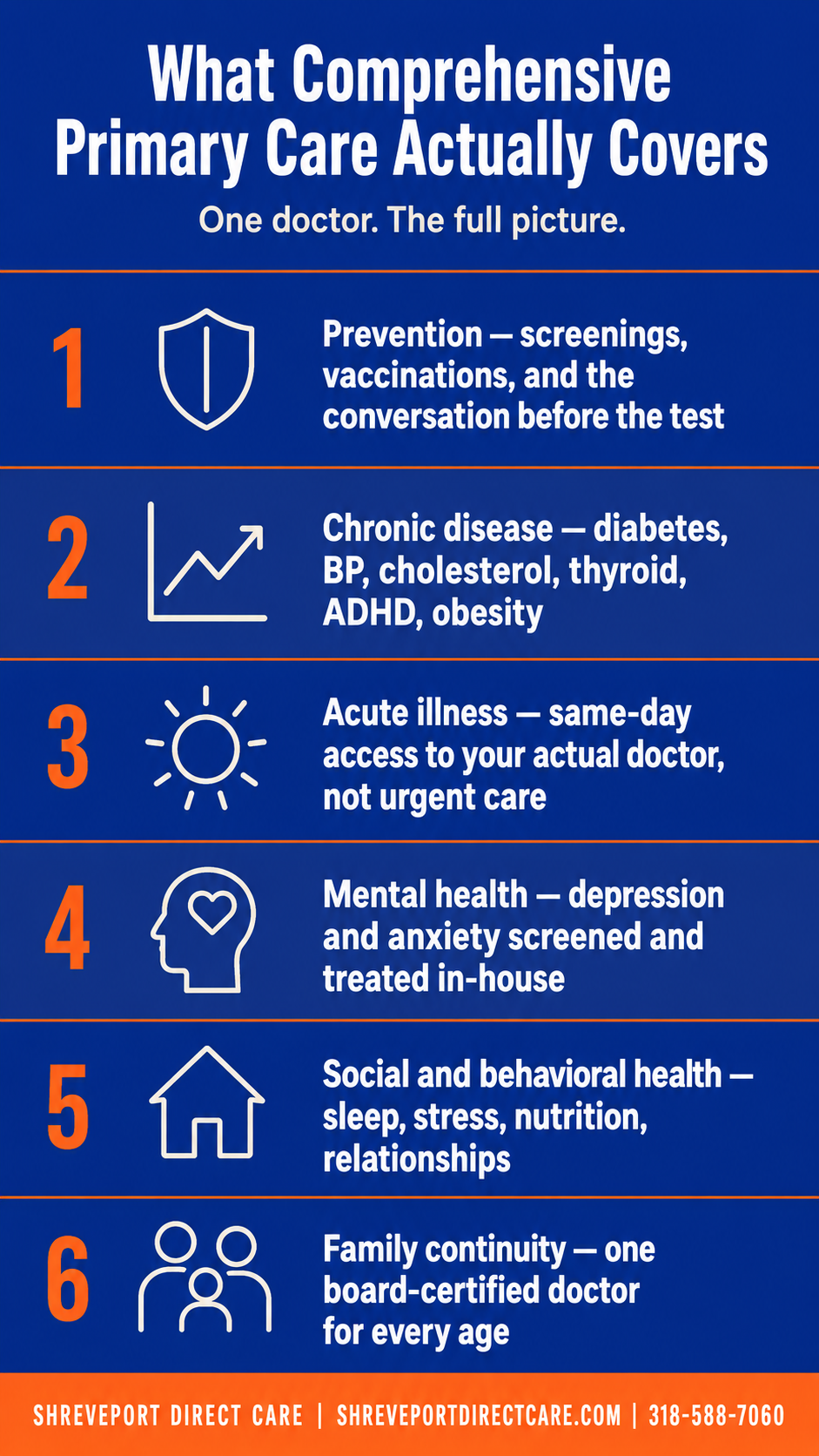
Comprehensive Primary Care.
The Core Message: You Don't Have to Chase It
"Comprehensive primary care is achievable," says Dr. Bass, "and can help you get to your healthcare goals often faster than seeking out specialist after specialist."
That is the thing most people searching this question haven't been told yet. They've been operating in a system that fragments care by design, not because fragmented care is better, but because that's how the reimbursement works. Comprehensive primary care exists. It is being practiced. And in a Direct Primary Care model, it is accessible for a predictable monthly cost without the friction of co-pays, referral approvals, and insurance paperwork.
If you're ready for primary care that actually works the way it was always supposed to, get in touch.
Schedule a free meet-and-greet with Dr. Bass. No commitment, no pressure. Just a conversation about your health and how we can help. Schedule your free visit at Shreveport Direct Care →
Phone/Text: 318-588-7060 Email: info@shreveportdirectcare.com
FAQs
1. What is comprehensive primary care? Comprehensive primary care is the integration of prevention, treatment, and ongoing health management through a continuous relationship with a physician who knows you well. It covers physical health, chronic disease, mental health, and the social and behavioral factors that affect your health, all coordinated by one doctor who sees the full picture.
2. How is comprehensive primary care different from a regular doctor visit? A regular doctor visit addresses the problem you came in with. Comprehensive primary care addresses that problem in the context of your full health history, your goals, your family, and everything else that shapes your wellbeing. The relationship, continuity, and time to have that broader conversation are what make it different.
3. Do I really need a primary care doctor if I have specialists? Yes. Specialists are experts in their area, but they don't see the connections between areas. A comprehensive primary care physician coordinates your care, manages most conditions directly, and ensures that the whole picture is visible to someone who knows you. Research shows patients with a continuous primary care relationship have better outcomes and lower hospitalization rates than those relying on specialist care alone.
4. Does comprehensive primary care include mental health? Yes. A comprehensive primary care physician screens for depression, anxiety, and behavioral health concerns and treats many of them directly. Mental health doesn't exist separately from physical health, and a good primary care doctor treats both as part of the same picture.
5. Is Shreveport Direct Care a comprehensive primary care practice? Yes. Dr. Bass provides comprehensive primary care through a Direct Primary Care membership model, covering prevention, chronic disease, acute illness, mental health, and family care for patients from infancy through adulthood. Membership starts at $109/month and includes unlimited visits and direct access to Dr. Bass.
6. How do I find a comprehensive primary care doctor in Shreveport? Look for a physician who offers long appointments, direct access between visits, and a practice model that allows time for real conversation. Shreveport Direct Care offers a free meet-and-greet so you can evaluate the fit before committing. Schedule yours here →
References
Personal GP continuity improves healthcare outcomes in primary care populations: a systematic review. PMC / NCBI. 2025.
Dropping the Baton: Specialty Referrals in the United States. PMC / NCBI.
Shreveport Direct Care is a direct primary care practice serving adults and children in Shreveport, Bossier City, and surrounding communities in Northwest Louisiana. Dr. Pat "Ricky" Bass III is board-certified in Internal Medicine and Pediatrics.