
Weight Loss Clinic in Shreveport: What GLP-1 Medications Can — and Can't — Do For You

Finding a Weight Loss Clinic in Shreveport
If you've been researching weight loss options in Shreveport, you've almost certainly come across the names Ozempic, Wegovy, Mounjaro, or Zepbound. These medications — collectively known as GLP-1 receptor agonists — have transformed the conversation around weight loss over the last several years, and for good reason. The clinical results are real. For the right patient with the right medical supervision, these medications can produce significant, sustained weight loss that wasn't achievable with diet and exercise alone.
But there's a gap between what these medications can do and how they're often being used. Across Northwest Louisiana and the broader Ark-La-Tex, patients are showing up to new practices having already been placed on a GLP-1 medication — sometimes online, sometimes at a med spa, sometimes at a clinic that ran a single basic lab panel. Often these patients receive little evaluation, limited guidance on what to expect, and no regular follow up checking in as things progress.
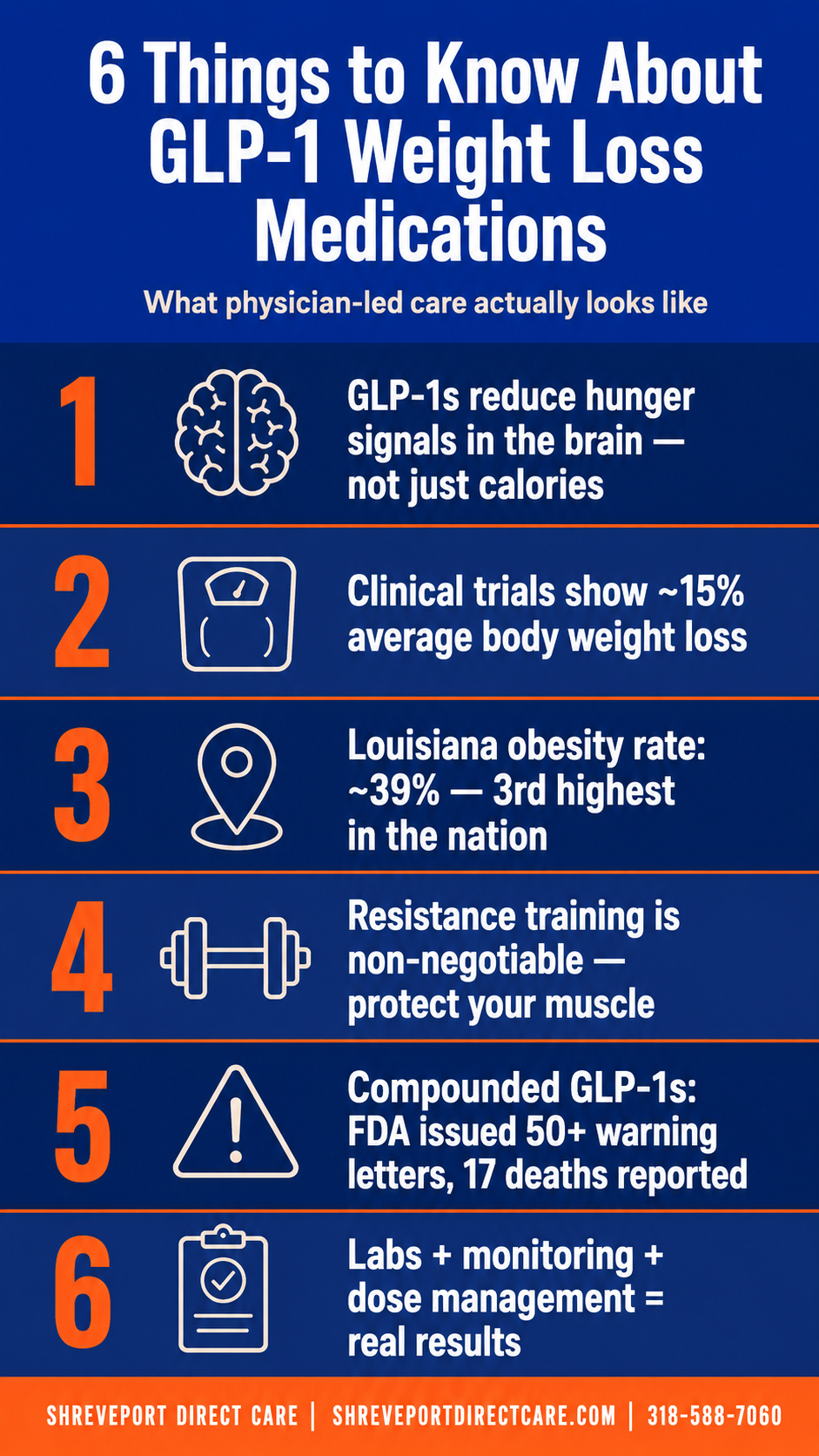
Louisiana's obesity rate hit 39.2% in 2024 — the third-highest in the country.[1] That means demand for weight loss solutions here is real and urgent. What Shreveport patients deserve, though, isn't just access to a medication. It's the medical care behind it.
This post explains how GLP-1 medications work, how semaglutide and tirzepatide actually differ, what a real physician-led weight loss program includes, and why — if you're considering this path — who is guiding you matters as much as what you're taking.
Why So Many Shreveport Patients Are Asking About GLP-1 Medications
The surge in interest in GLP-1 medications is not hype — it's driven by results. In clinical trials, semaglutide at its full weight-loss dose produced a mean reduction of 15.2% of body weight over two years in patients with obesity who did not have diabetes.[2] Tirzepatide, a newer dual-action medication, showed up to 22.5% body weight reduction in its landmark SURMOUNT-1 trial.[3] For someone who has struggled with weight for decades and never gotten traction through diet and exercise alone, those numbers are genuinely significant.
For patients in the Shreveport area, where metabolic conditions like obesity, high blood pressure, and pre-diabetes are more prevalent than the national average, these medications offer something meaningful: a medical tool that addresses the biology of weight — not just the behavior.
But the numbers in clinical trials come with context. Participants in those trials were carefully selected, closely monitored, and combining medication with structured lifestyle support. The results people see outside of that framework — in unmonitored programs, online prescribers, or weight loss clinics with minimal follow-up — are often much more variable.
That gap is where problems start.
What GLP-1 Medications Actually Are — And How They Work
GLP-1 stands for glucagon-like peptide-1, a hormone your body naturally produces in the gut after eating. It does several things. It:
Tells the pancreas to release insulin.
Signals the brain that you're full.
Slows the rate at which your stomach empties, and it reduces appetite.
GLP-1 receptor agonists mimic this hormone and mplifies its effects significantly.
The result is that most people taking GLP-1 medications experience a meaningful reduction in appetite and food cravings. Portions that used to feel small begin to feel sufficient. The constant pull toward food, what some patients describe as "food noise,"quiets down. For people whose relationship with hunger has always felt like a battle they were losing, this shift can be profound.
It's also important to understand what GLP-1 medications are not. GLP-1 medications are not a:
Fast fix.
Replacement for sleep, stress management, or physical activity.
Permanent solution if used temporarily with no changes to underlying habits.
GLP-1 medications are Also not without potential side effects. Nausea, vomiting, constipation, and fatigue are common in the early weeks. There are also some patients for whom they are not appropriate at all.
Used correctly, under medical supervision, with proper evaluation, regular follow-up, and a genuine commitment to lifestyle changes, GLP-1 medications are one of the most effective tools available for treating obesity. For a closer look at how these medications are being used locally and what to expect in the first weeks, see our guide to GLP-1 weight loss in Shreveport. That word, treating, is important. Obesity is a chronic medical condition. Like high blood pressure or type 2 diabetes, it has a biological basis, it carries real health risks, and it often requires medication to manage. There is no shame in that. It is medicine. At Shreveport Direct Care, we treat weight the same way we treat every other chronic condition — with honesty, without judgment, and with a real plan.

GLP-1 Shreveport
Not All GLP-1s Are the Same: Semaglutide vs. Tirzepatide
One of the most common misconceptions Dr. Bass hears from new patients is that all GLP-1 medications work the same way. They don't — and the difference matters.
Semaglutide (the active ingredient in Wegovy and Ozempic) acts on one receptor: the GLP-1 receptor. It is well-studied, FDA-approved for weight loss, and produces meaningful results for most appropriate candidates.
Tirzepatide (the active ingredient in Zepbound and Mounjaro) acts on two receptors: GLP-1 and GIP (glucose-dependent insulinotropic polypeptide). GIP influences insulin sensitivity, fat metabolism, and energy use in ways that complement the GLP-1 pathway. That dual action is probably why tirzepatide has consistently outperformed semaglutide in head-to-head studies — the SURMOUNT trials showed a mean weight loss of 22.5% versus approximately 15% for semaglutide.[3]
But "more effective on average in trials" does not mean tirzepatide is automatically the right choice for every patient. Individual response varies significantly based on health history, current medications, kidney and liver function, cardiovascular risk, gastrointestinal history, and other factors. A patient who did well on semaglutide and then switched to tirzepatide for the higher average results may not get what they expected. A patient who experienced significant nausea on semaglutide may respond completely differently to tirzepatide — or vice versa.
This is exactly why a comprehensive evaluation before starting any GLP-1 medication matters. The right medication for you is not the one with the best headline results. It's the one that fits your health profile, your history, and your goals — determined by a doctor who has actually reviewed all of those things.
The Misconception That Puts Patients at Risk
There is a version of GLP-1 care that is spreading rapidly across the country — and across Shreveport — that looks like this: fill out an online form, get a brief telehealth call, receive a prescription within 48 hours. No comprehensive labs. No review of your full medication list. No follow-up appointments. No one to call when you lose 18 pounds in 12 weeks and your clothes no longer fit but you also can't eat more than a few bites without feeling ill.
If you're evaluating your options, we've put together a guide on what to look for in a medical weight loss clinic in Shreveport — including the questions that matter most before you start. "Many patients come to me with unrealistic expectations," says Dr. Bass. "They often have not had a comprehensive evaluation. They were just placed on a medication or a shot with little medical evaluation or follow-up."
The misconception driving this isn't just "anyone can take a GLP-1" — although that belief is widespread. It's also the assumption that because a medication is effective, it is inherently safe without oversight. It isn't. Patients on GLP-1 medications need baseline labs to establish where they're starting. They need monitoring of kidney function, liver enzymes, thyroid markers, and blood glucose — especially if they're also managing diabetes, taking medications that interact with GLP-1 receptor agonists, or have a history of pancreatitis or certain thyroid conditions. They need someone to adjust their dose when they're struggling with side effects rather than abandoning the medication entirely. They need follow-up — not just a refill.
When that piece is missing, what often happens is this: a patient loses some weight in the first few months, hits a plateau, increases their dose on their own, develops significant side effects, and either stops the medication abruptly or continues taking it while feeling consistently unwell. Neither outcome is good. And neither would have happened under proper medical care.
Medically Supervised Weight Loss Shreveport With GLP-1
What a Real Medical Weight Loss Program Includes
Consider James, a 47-year-old Shreveport-area patient who came to Shreveport Direct Care after six months on a semaglutide prescription he'd obtained through an online telehealth service. He'd lost 14 pounds initially, then stalled. He was experiencing persistent fatigue and occasional nausea but had no one to consult about it. His previous service offered a check-in form — not a doctor. He didn't know whether the fatigue was from the medication, from the caloric restriction, from something else entirely, or from all three.
At his first visit, Dr. Bass ordered a comprehensive metabolic panel. James's ferritin was low — his iron stores had been depleted over months of reduced caloric intake, a common and often overlooked consequence of GLP-1-mediated appetite suppression. His thyroid function had shifted. Nobody had been watching either. Within eight weeks of addressing those issues and making specific adjustments to his eating habits and supplementation, his energy returned and his weight loss resumed.
That's what comprehensive medical weight loss care looks like. At Shreveport Direct Care, our weight loss program includes:
Complete laboratory workup. Before starting any medication, we run a comprehensive metabolic panel, a lipid panel, thyroid function tests, a complete blood count, fasting insulin and glucose, and any additional labs relevant to your history. We're not guessing at your baseline — we're measuring it.
In-depth lifestyle analysis. We don't hand you a pamphlet about eating less and moving more. We talk specifically about what you're eating, how often you're moving, how you're sleeping, what your stress load looks like, and what realistic changes you can actually sustain. The plan is built around your life — not a template.
Specific recommendations, not vague advice. "Eat better and exercise" is not a plan. At Shreveport Direct Care, we give you specific guidance on nutrition, physical activity, and the types of movement that support your goals — including why resistance training is non-negotiable for anyone on a GLP-1 medication.
Regular follow-up. Weight loss is not a one-appointment event. We schedule follow-ups to monitor your response, adjust your dose if needed, check your labs as your body changes, and address any side effects before they become reasons to quit.
Direct access. As a member of Shreveport Direct Care, you can text or email Dr. Bass directly. If something comes up between appointments — a side effect, a question about your dose, a concern about how you're feeling — you don't leave a voicemail and wait. You reach your doctor.
Why Resistance Training Isn't Optional
One of the most important things Dr. Bass is direct about with every weight loss patient is this: if you are not willing to incorporate resistance training, GLP-1 therapy is going to produce a different result than the one you want.
Here's why. GLP-1 medications work primarily by reducing appetite. When you eat less, your body loses weight — but not all of that weight comes from fat. A significant portion comes from lean mass, including muscle. Studies show that patients on semaglutide and tirzepatide who do not engage in resistance training lose substantially more muscle mass than those who do.[4] That matters for more than aesthetics. Muscle is metabolically active — it burns calories at rest, supports insulin sensitivity, protects joints, and is one of the strongest predictors of long-term health outcomes, particularly as you age.
"GLP-1 medications are just one of the tools that we use in patient care for patients who are overweight or obese," says Dr. Bass. "I will push back if patients seem unwilling to do some of the other things that are required — like resistance training — or make meaningful commitments to lifestyle modification."
That's not a judgment. It's medicine. Prescribing a GLP-1 medication to a patient who has no intention of changing anything else is like prescribing a blood pressure medication and telling someone they can keep eating salt. The medication can help. It helps more — a lot more — with the lifestyle changes alongside it.
This is also why the combined approach consistently outperforms medication or lifestyle change alone. A 2025 systematic review and meta-analysis published in eClinicalMedicine confirmed that combining GLP-1 receptor agonists with lifestyle interventions produces significantly better outcomes for both weight loss and cardiometabolic health than either approach in isolation.[4]
Resistance training two to three times per week. Adequate protein intake. Consistent sleep. Stress management. These aren't add-ons to a GLP-1 program — they're the foundation it sits on.
Who Is — and Isn't — a Good Candidate for GLP-1 Medications
GLP-1 medications are FDA-approved for adults with a BMI of 30 or higher, or a BMI of 27 or higher with at least one weight-related health condition such as high blood pressure, type 2 diabetes, or high cholesterol. But FDA approval isn't the same as clinical fit.
There are patients for whom GLP-1 medications are not appropriate. These include patients with a personal or family history of medullary thyroid carcinoma or multiple endocrine neoplasia type 2, patients with a history of pancreatitis, and patients with severe gastrointestinal motility disorders. There are also interactions with other medications — particularly certain diabetes medications — that require careful review before starting.
Beyond contraindications, Dr. Bass evaluates readiness. "I take the time to explain to patients why I feel they are not a good candidate," he says, "and we discuss other options for their treatment." A patient who expects the medication to do all the work, who has no interest in modifying their diet or incorporating physical activity, or who is not realistic about the timeline and the ongoing nature of treatment — that's a conversation that needs to happen before a prescription is written.
For patients who aren't candidates for GLP-1 medications, or who aren't yet ready for that step, there are other tools: dietary interventions, behavioral strategies, treatment of underlying contributors like sleep apnea or thyroid dysfunction, and other pharmacological options with different mechanisms. Weight is a medical problem. There is almost always something that can be done.
Weight Loss Care at Shreveport Direct Care
Shreveport Direct Care is a Direct Primary Care practice, which means the model itself is designed for the kind of care that weight loss actually requires. Members pay a flat monthly fee — starting at $109 per month — and in return they get unlimited visits, direct access to Dr. Bass, and over 1,000 generic medications at no additional cost. There are no per-visit fees and no insurance billing for routine care. For a full overview of how a DPC membership works at Shreveport Direct Care, visit our membership page. And if you want to understand exactly what a physician-led weight management program looks like in practice — and why the physician relationship is the most important variable — we've covered that in detail as well.
That structure matters for weight loss specifically because weight loss care is ongoing. It requires multiple visits over many months. It requires lab draws and follow-up and dose adjustments. In a traditional fee-for-service practice, each of those touchpoints carries a cost — co-pays, office fees, lab bills — that adds up quickly and becomes a reason to skip appointments. In a DPC membership, those barriers don't exist. You come in when you need to. You check in when something comes up. You don't have to decide whether a question is worth the co-pay.
For more on Dr. Bass's background and training, see his full profile on our team page. He is dual board-certified in both Internal Medicine and Pediatrics, which means he is equipped to address the full range of medical factors that intersect with weight, from thyroid function to cardiovascular risk to metabolic syndrome to the hormonal changes of aging. Weight doesn't exist in isolation. It interacts with everything else happening in your body, and treating it well requires a doctor who can see the whole picture.
If you're in Shreveport, Bossier City, or anywhere in the Ark-La-Tex, and you're looking for a weight loss clinic that offers real medical supervision — not just a prescription and a handshake — we'd like to meet you.
Take the Next Step
Ready to find out whether physician-led weight loss care at Shreveport Direct Care is right for you? Schedule a free meet-and-greet with Dr. Bass and find out if our program is right for you.
Book your free consultation →
Phone/Text: 318-588-7060 Email:info@shreveportdirectcare.com
FAQs
1. What GLP-1 medications are available at a weight loss clinic in Shreveport? At Shreveport Direct Care, we evaluate each patient individually before recommending any medication. GLP-1 options may include semaglutide (Wegovy) or tirzepatide (Zepbound), depending on your health history, current medications, and goals. We don't prescribe a one-size-fits-all medication — we choose the right tool for the right patient.
2. What is the difference between semaglutide and tirzepatide? Semaglutide acts on one receptor (GLP-1), while tirzepatide acts on two (GLP-1 and GIP). Tirzepatide has shown higher average weight loss in clinical trials — up to 22.5% of body weight versus approximately 15% for semaglutide — but individual results vary and the right choice depends on your specific health profile, not the headline numbers.
3. Do I need a comprehensive evaluation before starting a GLP-1 medication? Yes — and this is one of the most important parts of safe, effective weight loss care. Before starting any GLP-1 medication at Shreveport Direct Care, we run a full lab panel, review your complete medication list, evaluate your health history, and discuss your goals and expectations. This step protects your health and improves your outcomes.
4. How much does physician-led weight loss care cost in Shreveport? At Shreveport Direct Care, weight loss care is included in your monthly membership, which starts at $109 per month. That includes unlimited visits, direct access to Dr. Bass, lab follow-ups, and over 1,000 generic medications at no additional cost. Medication costs vary depending on insurance coverage and which medication is prescribed.
5. Is obesity a medical condition or a lifestyle problem? Obesity is a chronic medical condition with well-documented biological causes, including genetics, hormonal regulation, metabolic factors, and environmental contributors. It is not a willpower failure. At Shreveport Direct Care, we treat obesity the same way we treat high blood pressure or type 2 diabetes — with evidence-based medical care, without judgment.
6. Can I get GLP-1 medications without a doctor in Shreveport? Online prescribers and med spas offer GLP-1 prescriptions with minimal evaluation, but this approach carries real risks — including unmonitored side effects, drug interactions, and outcomes that fall well short of what's possible with proper medical oversight. Physician-led care isn't a formality; it's the difference between a prescription and a real treatment plan.
References
Louisiana's obesity rate hit 39.2% in 2024. Axios New Orleans / Trust for America's Health. October 2025. (Supports Louisiana obesity rate statistic — third highest in the U.S.)
Semaglutide and Cardiovascular Outcomes in Obesity without Diabetes. New England Journal of Medicine. 2023. (Supports 15.2% mean body weight reduction with semaglutide 2.4 mg over 104 weeks.)
Tirzepatide Once Weekly for the Treatment of Obesity. New England Journal of Medicine. 2022. (Supports tirzepatide SURMOUNT-1 results — up to 22.5% mean body weight reduction.)
Efficacy of lifestyle modification combined with GLP-1 receptor agonists on body weight and cardiometabolic biomarkers: a systematic review and meta-analysis. eClinicalMedicine / The Lancet. 2025. (Supports combined GLP-1 + lifestyle approach and importance of resistance training for lean mass preservation.)
Shreveport Direct Care is a direct primary care practice serving adults and children in Shreveport, Bossier City, and surrounding communities in Northwest Louisiana. Dr. Pat "Ricky" Bass III is board-certified in Internal Medicine and Pediatrics.