
Tirzepatide vs. Semaglutide for Weight Loss: What the SURMOUNT-5 Results Mean for Northwest Louisiana Patients

Tirzepatide vs. Semaglutide in Shreveport Bossier
For the first time, a major clinical trial put tirzepatide (Mounjaro/Zepbound) and semaglutide (Ozempic/Wegovy) head to head in people with obesity who do not have diabetes, and the results landed in the New England Journal of Medicine in May 2025.[1] The short answer: tirzepatide produced significantly more weight loss. Patients on tirzepatide lost an average of 20.2% of their body weight over 72 weeks, compared to 13.7% with semaglutide.[1] That gap is not small, and for patients in Shreveport asking which medication is the better choice, this study provides the clearest evidence yet.
At Shreveport Direct Care, we have been prescribing and monitoring both medications since they became available, and the question of which one works better comes up in nearly every weight loss visit. This article walks you through what the study found, what the numbers mean in real terms, and how we think about medication selection for the patients we treat in the Ark-La-Tex.
What Is the SURMOUNT-5 Trial?
SURMOUNT-5 was a phase 3b randomized controlled trial conducted at 32 sites across the United States and Puerto Rico.[1] A total of 751 adults with obesity but without type 2 diabetes were randomly assigned to receive either tirzepatide or semaglutide once weekly by subcutaneous injection for 72 weeks, which is just under 17 months.[1]
Both medications were increased to the maximum tolerated dose. For tirzepatide, that meant 10 mg or 15 mg. For semaglutide, that meant 1.7 mg or 2.4 mg.[1] All participants also received guidance on nutrition and physical activity throughout the trial. The average participant was 44 years old, weighed about 249 pounds (113 kg), and had been living with obesity for an average of 16 years.[1]
The study was funded by Eli Lilly, the maker of tirzepatide. That is worth noting. Even so, the trial design was rigorous, and the findings are consistent with what clinicians have observed in practice. To understand why these two medications behave differently, it helps to know that tirzepatide activates two hormone receptors (GIP and GLP-1) while semaglutide targets only the GLP-1 receptor.[1] The added mechanism in tirzepatide is believed to produce stronger appetite suppression and more direct effects on fat tissue.
How Much More Weight Did Tirzepatide Patients Lose?
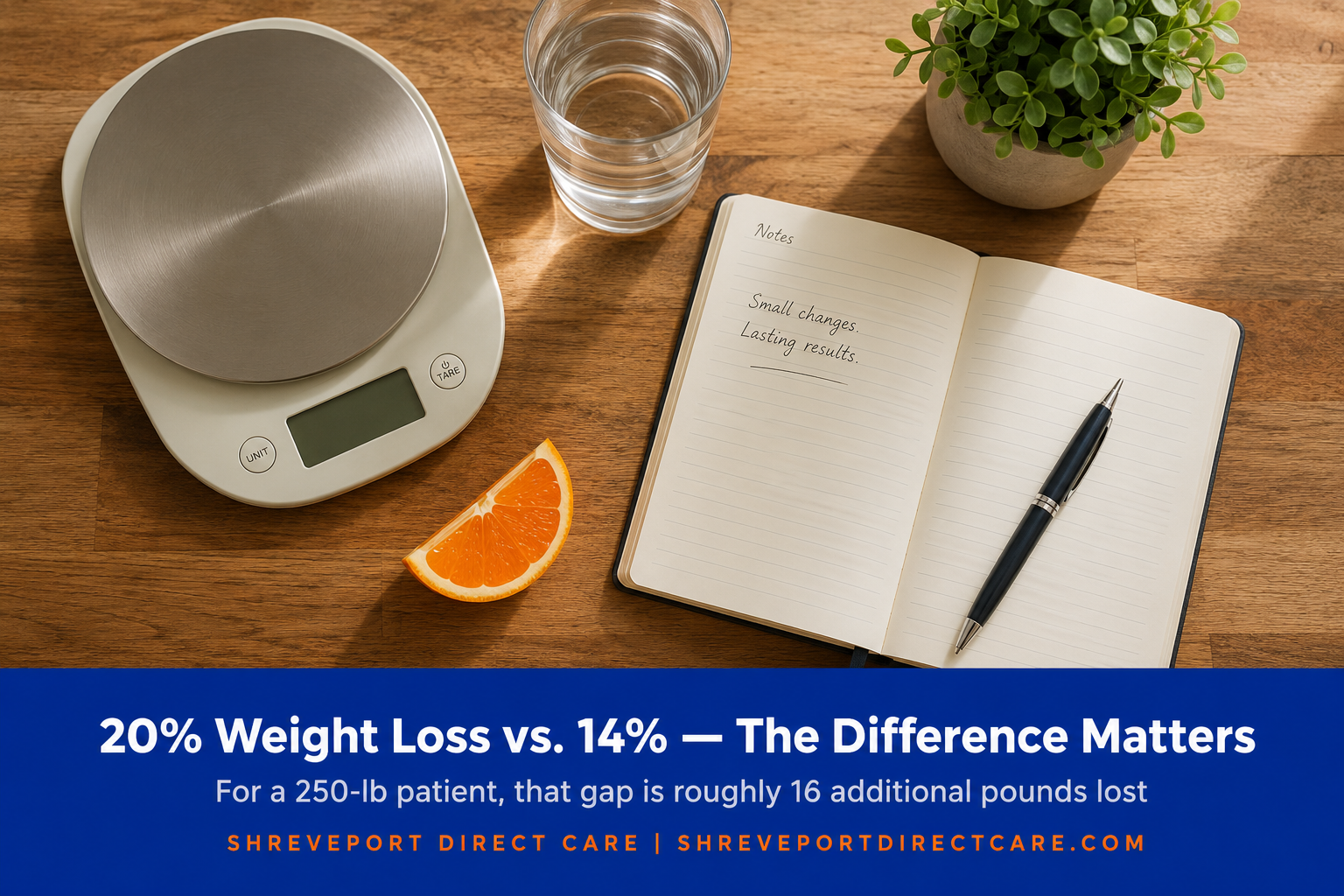
The primary outcome was percent change in body weight at 72 weeks, and the difference was substantial. Tirzepatide patients lost an average of 20.2% of their body weight, while semaglutide patients lost 13.7%, a difference of 6.5 percentage points.[1]
In practical terms, for someone starting at 250 pounds, that means losing roughly 50 pounds (22.8 kg) on tirzepatide versus 33 pounds (15.0 kg) on semaglutide.[1] Waist circumference shrank by an average of 7.2 inches (18.4 cm) with tirzepatide versus 5.1 inches (13.0 cm) with semaglutide, a difference with real implications for heart disease risk.[1]
When researchers looked at more dramatic weight loss thresholds, tirzepatide pulled further ahead. Patients on tirzepatide were twice as likely to lose at least 25% of their body weight, and nearly one in five (19.7%) lost 30% or more, compared to fewer than one in fourteen (6.9%) on semaglutide.[1]
Both medications also improved blood pressure, blood sugar, and cholesterol levels, with greater improvements seen in the tirzepatide group, which tracked with the larger weight reduction.[1] The safety profiles were similar. Gastrointestinal side effects, including nausea, constipation, diarrhea, and vomiting, were the most common complaint in both groups and were generally mild to moderate, occurring mostly during the dose escalation phase.[1] Injection site reactions were more common with tirzepatide (8.6% vs. 0.3%), but none in either group were severe.[1] Injection site reactions are usually manageable, are not true side effects, and do not necessarily lead to having to stop the medication.
Tirzepatide led to more weight loss.
What Do These Results Mean for Patients in Shreveport and Northwest Louisiana?
Louisiana consistently ranks among the states with the highest adult obesity rates in the nation.2 That makes access to effective, physician-monitored weight loss treatment especially important for our patients in Shreveport, Bossier City, and the communities throughout Northwest Louisiana that we serve.
The 6.5 percentage point difference between medications may sound modest on paper, but for someone weighing 250 pounds it is the difference between losing 34 pounds or 50 pounds. Those extra 16 pounds often determine whether a patient crosses the threshold for meaningful improvement in conditions like high blood pressure, obstructive sleep apnea, or prediabetes. The SURMOUNT-5 data on waist circumference is also clinically meaningful: research has shown that each 5-centimeter increase in waist circumference corresponds to a 7 to 9 percent increase in mortality risk, making the 5.4-centimeter additional reduction with tirzepatide a potentially significant benefit.1
That said, semaglutide remains highly effective and is still the right choice for many patients, depending on insurance coverage, cost, tolerance, and individual response. The best medication is the one you can access, afford, tolerate, and stay on consistently. You can read more about what to look for in a medical weight loss program in Shreveport and why physician-supervised programs produce better outcomes than direct-to-consumer prescription services.
Is Tirzepatide Right for You?
Not everyone is a candidate for tirzepatide or semaglutide, and not every patient needs medication to reach their weight loss goals. At Shreveport Direct Care, we evaluate each person individually. We look at your weight history, existing medical conditions, current medications, and what you have already tried before recommending a path forward.
Our weight loss services are built around physician oversight, which means Dr. Bass is reviewing your lab work, monitoring your response, adjusting your dose when needed, and making sure the medication is both safe and working for you. You can learn more about Dr. Bass's training and approach to metabolic and weight management care and how dual board certification in Internal Medicine and Pediatrics shapes his whole-patient approach.
For a detailed look at what tirzepatide treatment involves, its risks and benefits, and who makes the best candidate, see our dedicated tirzepatide post. If you want to explore the broader options, our DPC membership model makes ongoing medication management part of your flat monthly membership, with no per-visit fees and no surprise bills.
Ready to get started with a physician-led weight loss plan? Schedule a free meet-and-greet with Dr. Bass and find out if our program is right for you.
Phone/Text: 318-588-7060 Email: info@shreveportdirectcare.com
FAQs:
1. What is the SURMOUNT-5 trial? SURMOUNT-5 was a 72-week randomized controlled trial published in the New England Journal of Medicine in May 2025. It compared tirzepatide and semaglutide head to head in 751 adults with obesity but without type 2 diabetes. It is the first major trial to directly compare these two medications at their maximum tolerated doses.
2. How much weight can you lose with tirzepatide vs. semaglutide? In SURMOUNT-5, patients on tirzepatide lost an average of 20.2% of their body weight over 72 weeks (about 50 pounds for a 250-pound person), compared to 13.7% (about 33 pounds) with semaglutide. Individual results vary based on starting weight, dose, and lifestyle factors.
3. Is tirzepatide the same as Mounjaro or Zepbound? Yes. Tirzepatide is the generic name. Mounjaro is the brand name approved for type 2 diabetes management, and Zepbound is the brand name approved for chronic weight management. Both are the same medication, given as a once-weekly subcutaneous injection.
4. What are the side effects of tirzepatide compared to semaglutide? Both medications cause similar gastrointestinal side effects, including nausea, constipation, diarrhea, and vomiting. Most are mild to moderate and occur during dose escalation. Tirzepatide had more injection site reactions (8.6% vs. 0.3%), though none were severe in the SURMOUNT-5 trial.
5. Does insurance cover tirzepatide for weight loss in Louisiana? Coverage varies widely. Tirzepatide (Zepbound) and semaglutide (Wegovy) for weight loss are covered by some commercial plans but generally not by Medicare. Shreveport Direct Care can help you navigate your options and manufacturer savings programs during your consultation.
6. Can I get tirzepatide or semaglutide through a DPC practice in Shreveport? Yes. At Shreveport Direct Care, GLP-1 weight loss medications are available as part of a physician-supervised program included in our DPC membership model. Dr. Bass handles prescribing, ongoing monitoring, and dose management so you are never managing a powerful medication on your own.
References
- Aronne LJ, Bade Horn D, le Roux CW, et al. Tirzepatide as Compared with Semaglutide for the Treatment of Obesity. N Engl J Med. 2025;393:26-36. (Source for all SURMOUNT-5 trial data: weight loss percentages, absolute weight change, waist circumference, waist-circumference mortality data, and safety findings.)
- Centers for Disease Control and Prevention. Adult Obesity Prevalence Maps. CDC. 2024. (Source for Louisiana's ranking among states with highest adult obesity rates.)
Shreveport Direct Care is a direct primary care practice serving adults and children in Shreveport, Bossier City, and surrounding communities in Northwest Louisiana. Dr. Pat "Ricky" Bass III is board-certified in Internal Medicine and Pediatrics.