
Can Your Brain Improve at Any Age? New Research Says Yes

Can your brain improve as you get older?
If you've ever caught yourself forgetting a name mid-sentence and thought "well, that's just aging," new research says you might be wrong, and not by a small margin. Two of the largest brain-health studies ever conducted have found that people well into their 80s and 90s can measurably strengthen their brains, with some of the biggest gains showing up in people who started with the lowest scores. The old idea that the brain peaks in your twenties and slides downhill from there simply doesn't hold up against the evidence.
At Shreveport Direct Care, brain health isn't an afterthought tacked onto the end of a physical. It's a core part of how we practice preventive medicine for patients across Shreveport, Bossier City, and Northwest Louisiana. This research reshapes how we talk with patients about memory, focus, and long-term cognitive resilience, and it gives us something concrete to build a plan around.
The Myth of Inevitable Decline
Researchers at the Center for BrainHealth at the University of Texas at Dallas tracked nearly 4,000 adults, ranging in age from 19 to 94, over three years as part of an ongoing research initiative called The BrainHealth Project.[1] Participants engaged in brief daily brain-health practices, often just five to fifteen minutes, and were reassessed every six months.[2] The results, published in the Nature-portfolio journal Scientific Reports, were striking. Measurable cognitive improvement showed up across every age group studied, with no upper ceiling detected. People in their 80s and 90s improved just as much as people in their 20s and 30s.[3]
That point deserves its own sentence, because it contradicts almost everything most people assume about aging brains. Improvement wasn't reserved for the young. It was available to everyone who engaged consistently, at any starting point, including people who began with the lowest scores, who in fact showed some of the largest gains.[3]
So much of the public conversation around brain health treats decline as a one-way street, something to slow down at best but never reverse. This study is direct evidence against that framing. Brain health, at least as measured here, behaves less like an hourglass and more like a muscle, something that responds to consistent use at any age.
How Do You Even Measure "Brain Health"?
Most cognitive tools used in medicine are built to catch decline or disease. They're deficit detectors, designed to flag when something has already gone wrong. The tool used in this study, called the BrainHealth Index, was built to do the opposite: measure upward potential, across the full range of human function, not just the bottom end.[4] It looks at three areas. Clarity covers reasoning, focus, and executive function, the mental skills involved in planning, filtering distraction, and synthesizing information. Connectedness covers social engagement and sense of purpose, which turn out to matter for cognition as much as puzzles or memory drills do. Emotional Balance covers stress regulation and mental resilience, since chronic stress and anxiety measurably degrade cognitive performance over time.
This three-part structure matters clinically because it reflects something we see constantly in practice. Cognitive health isn't just a memory-test score. It's tangled up with sleep, stress, hormone balance, social connection, and daily habits, which is exactly why a whole-person, relationship-based model of care, rather than a rushed 12-minute visit, is positioned to actually move the needle on any of it.
The Lifestyle Evidence Keeps Piling Up
This isn't an isolated finding. In 2025, the Alzheimer's Association released results from the U.S. POINTER trial, the largest randomized controlled trial to date testing whether lifestyle changes can protect cognition in older adults already at elevated risk for decline.[5] Over two years, more than 2,100 adults ages 60 to 79 were assigned to one of two multidomain lifestyle programs combining structured exercise, a MIND-diet nutrition plan, cognitive and social engagement, and regular monitoring of blood pressure and lab values.[6] Both groups improved. The more structured, higher-accountability group improved the most, and the benefit held up regardless of a participant's sex, ethnicity, cardiovascular health, or even genetic risk for Alzheimer's.[7]
The nutrition piece deserves a closer look, because it's one of the most actionable parts of this puzzle. The MIND diet, short for Mediterranean-DASH Intervention for Neurodegenerative Delay, blends features of the Mediterranean and DASH diets specifically to protect brain health.[8] It emphasizes leafy greens and other vegetables, favors berries over other fruits, and calls for regular servings of whole grains, beans, nuts, and fish, while limiting red meat, sweets, cheese, and fried food.[8] A large NIH-supported analysis following roughly 14,000 adults for about a decade found that closer adherence to the MIND diet was linked to a meaningfully lower risk of cognitive decline, with the strongest protective association seen in women.[8] Separate research has found that Mediterranean-style eating patterns are associated with a substantially reduced risk of developing Alzheimer's disease.[9] If you want a fuller rundown of the everyday habits with the strongest evidence behind them, we put together 8 evidence-based ways to protect your memory that walk through each one.
Put simply, two of the largest and most rigorous brain-health studies ever conducted, using very different populations and methods, arrived at a similar conclusion. Cognitive decline is not a fixed sentence. It's substantially modifiable, and much of what modifies it, movement, food choices, social engagement, blood pressure control, is inside a patient's daily control.
The Overnight Repair Job: Sleep and Your Brain's Cleanup Crew
There's a piece of this story that happens while you're not even paying attention to it: sleep. Roughly ninety minutes after you fall asleep, the brain shifts into a distinct mode of operation. Blood flow patterns change, and cerebrospinal fluid begins pulsing through channels that stay largely closed during waking hours, a rinsing process known as the glymphatic system.[10] During this process, the brain clears out metabolic waste products that accumulate over the course of a day, including amyloid-beta and tau, the same proteins implicated in Alzheimer's disease.[10]
This isn't just theoretical. A 2026 randomized crossover trial published in Nature Communications directly compared a night of normal sleep against a night of sleep deprivation in the same participants, and found that glymphatic clearance during normal sleep measurably changed morning plasma levels of Alzheimer's-related biomarkers.[11] Other research has linked reduced slow-wave, or deep, sleep to higher tau burden on brain imaging, independent of a person's age.[12] When sleep is fragmented or cut short, glymphatic efficiency drops, metabolic waste builds up, and the plasticity mechanisms the brain relies on for memory consolidation are disrupted.[13]
The practical implication is simple, even if the biology is intricate. Sleep isn't downtime for the brain. It's when a large share of the day's maintenance work actually happens. Poor sleep quality and undiagnosed conditions like sleep apnea are common, treatable, and frequently overlooked contributors to the brain fog and memory complaints patients bring up almost in passing during a visit.
Sleep is good for the brain.
What This Means for Your Brain Health Plan
None of this means dementia risk is entirely optional, or that lifestyle changes are a guaranteed fix for every diagnosis. Genetics, medical history, and other risk factors still matter, and new or worsening cognitive changes deserve a real clinical workup, not just a wellness pep talk. If you or a family member has noticed early changes, it's worth reading about the early warning signs of dementia so you know what to watch for and when to act.
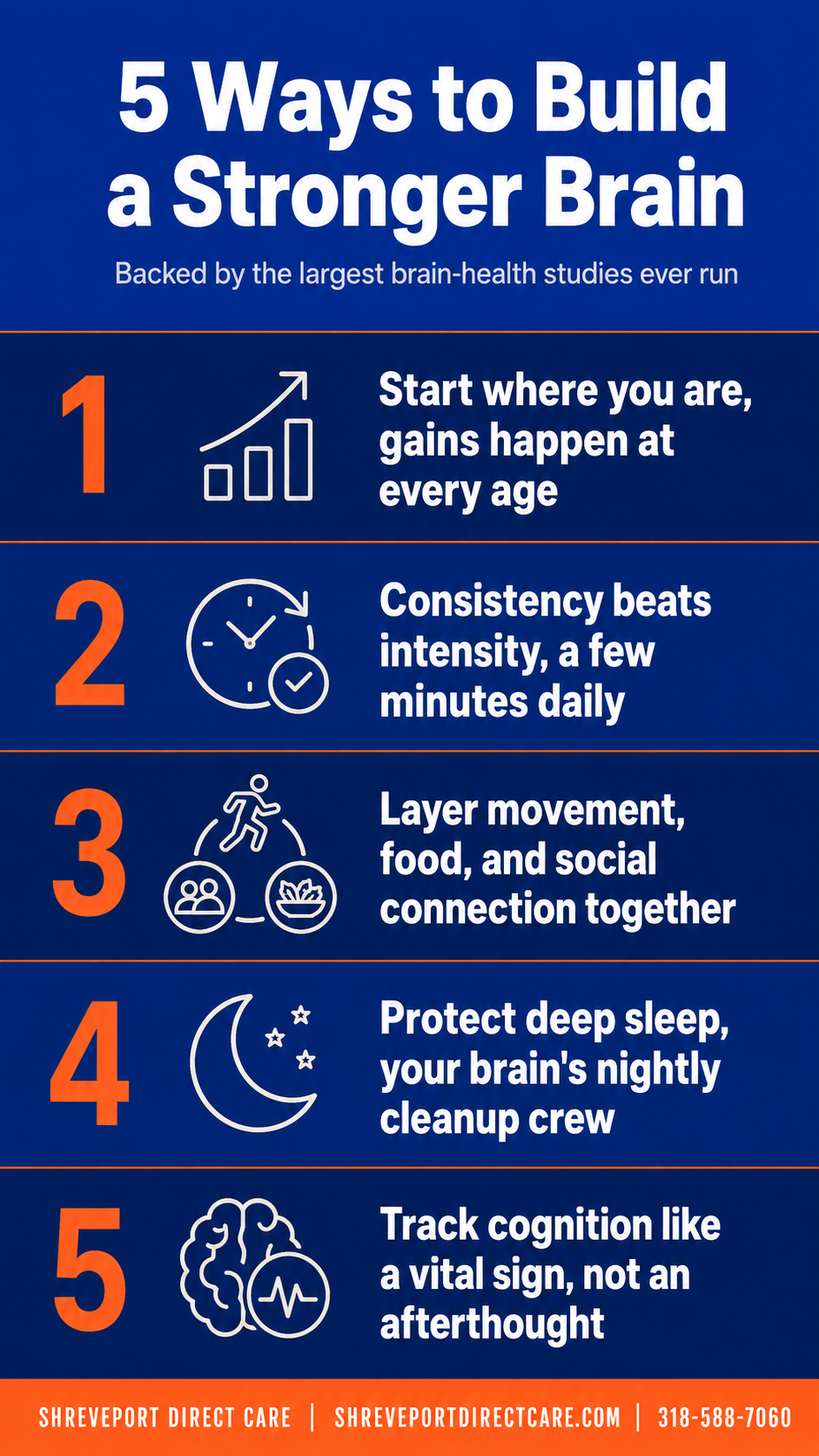
The practical takeaway from this research is genuinely encouraging. Start where you are: both major studies found gains at every starting point, including participants who began with the lowest scores. Consistency beats intensity: short, daily engagement outperformed occasional, sporadic effort in the BrainHealth Project data. Layer your approach: the interventions that worked best combined movement, nutrition, social connection, and health monitoring, not any single brain game or supplement in isolation. Protect your sleep like you would any other treatment, since consistent, adequate deep sleep supports the brain's overnight waste-clearance process. And track it like any other vital sign. Blood pressure gets checked at every visit; cognitive trajectory deserves the same ongoing attention, especially once patients reach their 50s and 60s.
Brain Health Care in Shreveport and Bossier City: Why This Belongs in Primary Care
Here's the gap this research exposes: most of these levers, nutrition counseling, sleep evaluation, blood pressure management, hormone balance, social and cognitive engagement, cross traditional specialty lines. No single 15-minute annual physical has room to cover all of it, and a rushed visit isn't the setting where a real, personalized brain health plan gets built.
This is exactly the gap Direct Primary Care is designed to close. At Shreveport Direct Care, our cognitive and memory evaluation process, part of our memory and cognitive health services, is built around this research: establishing a real baseline, screening for the reversible contributors that often masquerade as "just getting older" (thyroid dysfunction, low testosterone, sleep apnea, medication side effects, untreated hypertension), and then building a personalized plan around the factors the evidence actually shows move the needle. If memory changes have you concerned about the difference between normal aging and something more, our guide on memory loss after 50 is a good place to start. Because our membership model means unhurried visits and direct access to your physician, that plan can actually get built, adjusted, and followed over time for families throughout Northwest Louisiana, not just handed over as a pamphlet.
Protect your brain
The Bottom Line
The old model of "brain decline is just what happens" is being replaced by something far more useful: brain health as a trainable, ongoing project, not a fixed trajectory. Whether you're 35 and want to stay sharp through a demanding career, or 75 and thinking about a parent's diagnosis history, the research says the same thing. It's worth starting now, and it's not too late to start.
If you're noticing changes in your memory or focus, or you simply want a proactive plan to protect your cognitive health long-term, schedule a visit with Shreveport Direct Care. Learn more about Dr. Bass's training and background in Internal Medicine and Pediatrics, and how that whole-family perspective shapes our approach to brain health at every age.
Schedule a free meet-and-greet with Dr. Bass, no commitment, no pressure. Just a conversation about your health and how we can help. Schedule your free visit at Shreveport Direct Care →
Phone/Text: 318-588-7060 Email:info@shreveportdirectcare.com
FAQs:
1. Can you actually improve your brain health at any age? Yes. Large recent studies have found measurable cognitive improvement across every age group tested, including adults in their 80s and 90s, with no upper age limit detected.
2. What is the BrainHealth Index? It's a research tool that measures three areas of brain function: clarity (reasoning and focus), connectedness (social engagement and purpose), and emotional balance (stress regulation), rather than only screening for decline.
3. Does diet really affect memory and dementia risk? Yes. The MIND diet, which combines Mediterranean and DASH diet principles, has been linked in large studies to a meaningfully lower risk of cognitive decline, particularly in women.
4. How does sleep affect brain health? During deep sleep, the brain's glymphatic system clears out metabolic waste, including proteins linked to Alzheimer's disease. Poor or fragmented sleep can disrupt this cleanup process and affect memory consolidation.
5. When should I be concerned about memory changes? New or worsening memory problems, especially ones that interfere with daily tasks, deserve a real clinical evaluation rather than being written off as normal aging. A primary care visit is a good first step.
6. How can a primary care doctor in Shreveport help with brain health? A Direct Primary Care model allows time for a full evaluation of the reversible contributors to memory changes, like thyroid issues, low testosterone, sleep apnea, and blood pressure, and time to build and adjust a personalized plan over years, not just one visit.
References
Cook LG, Spence JS, Chang Z, et al. Measuring and increasing the brain health span across adulthood: a public health imperative. Scientific Reports. 2026. (Source study establishing measurable brain-health gains across adulthood.)
The University of Texas at Dallas. Your brain can keep improving into your 90s, study finds. ScienceDaily. June 13, 2026. (Describes the daily brain-health practice protocol used in the study.)
Center for BrainHealth. New Nature Scientific Reports study challenges the inevitability of cognitive decline and proves brain gain is possible at any age. PR Newswire. May 7, 2026. (Supports finding that gains occurred across all ages with no ceiling.)
The BrainHealth Project study protocol: a scalable digital approach to measuring and promoting multidimensional brain health across the lifespan. PMC. (Describes the BrainHealth Index and its three domains.)
Alzheimer's Association. U.S. POINTER Study Results. Accessed July 2026. (Overview of the largest randomized lifestyle-intervention trial for cognitive decline.)
Baker LD, et al. Effects of Structured vs Self-Guided Multidomain Lifestyle Interventions for Global Cognitive Function: The U.S. POINTER Randomized Clinical Trial. JAMA. 2025. (Details the structured vs. self-guided intervention design.)
Alzheimer's Association International Conference. U.S. POINTER Lifestyle Intervention Improved Cognition. July 28, 2025. (Confirms benefit held across sex, ethnicity, and genetic risk subgroups.)
National Institutes of Health. Healthful diet linked to reduced risk of cognitive decline. NIH Research Matters. February 13, 2026. (Supports the MIND diet and cognitive decline risk findings.)
The long-term neuroprotective effect of MIND and Mediterranean diet on patients with Alzheimer's disease. Scientific Reports. 2025. (Supports Mediterranean-style eating and reduced Alzheimer's risk.)
Deep Sleep & the Glymphatic System. Healthcare Discovery. May 5, 2026. (Explains the glymphatic clearance process during sleep.)
The glymphatic system clears amyloid beta and tau from brain to plasma in humans. Nature Communications. 2026;17:715. (Randomized trial linking normal sleep to lower Alzheimer's biomarker levels.)
Lucey BP, et al. Reduced non–rapid eye movement sleep is associated with tau pathology in early Alzheimer’s disease
Sleep deprivation and memory: A neurobiological perspective. ScienceDirect. January 18, 2026. (Supports sleep's role in memory consolidation.)
Shreveport Direct Care is a direct primary care practice serving adults and children in Shreveport, Bossier City, and surrounding communities in Northwest Louisiana. Dr. Pat "Ricky" Bass III is board-certified in Internal Medicine and Pediatrics.